

 Login
Login

 September 2, 2026
|
Voiced by Amazon Polly |
Introduction
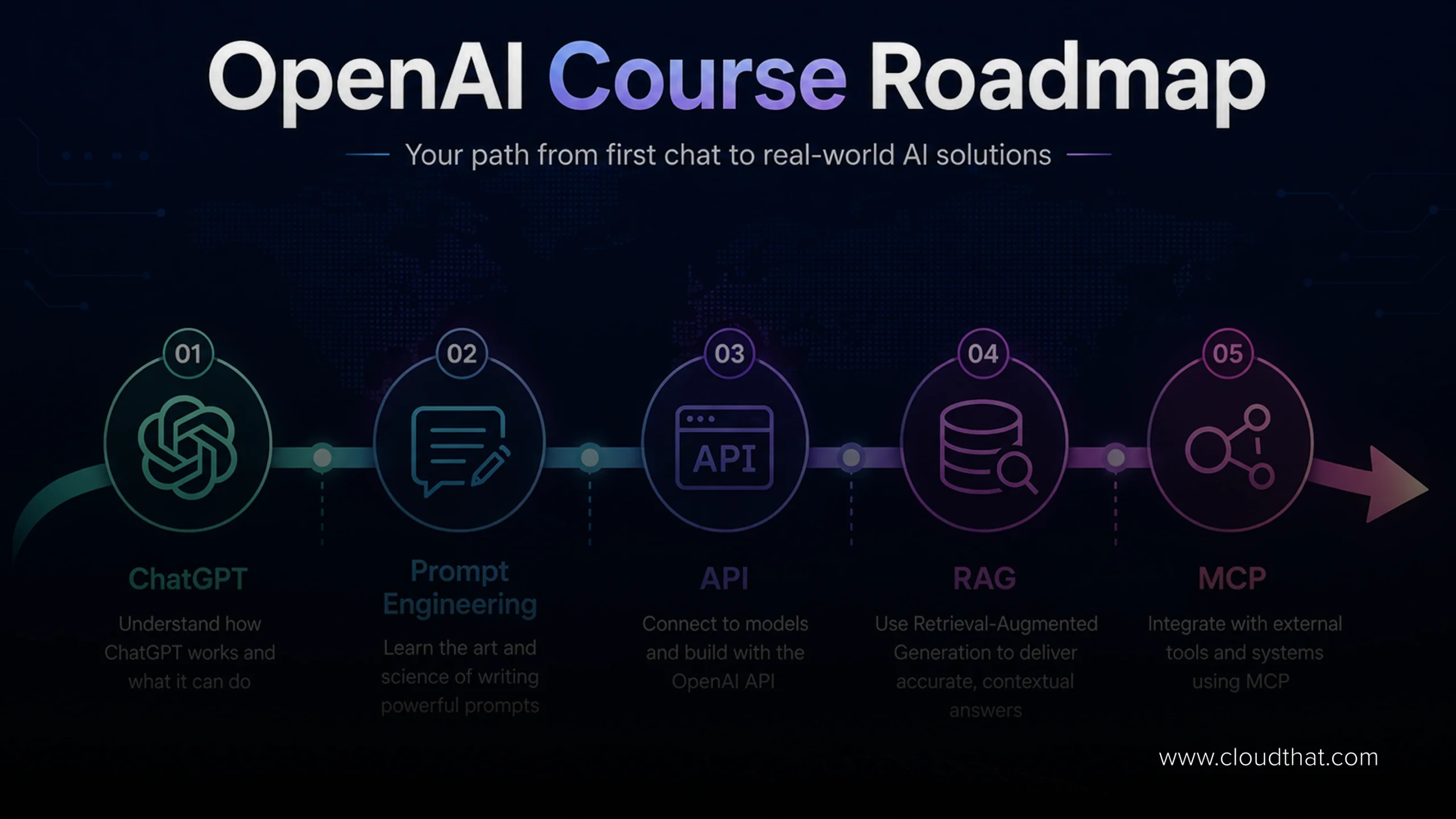
Quick Answer: A real OpenAI course does not start and stop at ChatGPT tips. The full roadmap moves through five stages: ChatGPT fluency for daily work, prompt engineering as the actual transferable skill, the OpenAI API for building real applications, RAG so your AI stops guessing and starts citing real data, and MCP for connecting AI safely to company systems. Skip prompt engineering or API work, and you are learning a hobby, not a career skill. This guide breaks down what each stage should teach, why the order matters, and how to pick training that actually gets you job-ready in 2026.
Picture this. You open ChatGPT, type a question, get a decent answer, and think, okay, I get this AI thing now.
Then your manager asks you to build something that can read company documents and answer customer queries on its own. Suddenly, “I get this AI thing” turns into “wait, what is RAG, what is an API key, and why does everyone keep saying MCP like I already know that?”
That gap is exactly what most course listings skip over, including plenty that call themselves prompt-engineering OpenAI courses and stop at basic prompts. If you are choosing an OpenAI course right now, you need a roadmap, not a random playlist. Here is the one that actually holds up.
Advance Your Career with OpenAI Training
- Build AI Applications
- GPT-5 & OpenAI APIs
- Hands-on Projects
What Should Actually Be in an OpenAI Course?
A complete OpenAI course covers five layers, not one. ChatGPT for daily fluency, prompt engineering for structured output, the API for building real products, RAG for grounding answers in real data, and MCP for connecting AI to company workflows.
Most free tutorials cover layer one and stop. A genuine OpenAI course walks through all five in order. Skip a layer, and you end up with demos that fall apart the moment someone asks a real question.
This is not hype. McKinsey’s latest State of AI research found that generative AI use has jumped sharply across enterprises this year, and the real gap now lies between people who use AI casually and those who can build with it.
Stage 1: Getting Past ChatGPT Small Talk
Every roadmap should start here, but never end here.
This stage means learning custom instructions and project folders, structuring conversations so ChatGPT holds context instead of resetting every time, and knowing when it is genuinely useful for drafting versus when it is the wrong tool entirely.
Most learners stop here because it feels like enough. It is not; it is the warm-up, not the workout. CloudThat’s live, instructor-led AI and ML training treats this as week one of a full program, because “I use ChatGPT” stopped impressing employers a while back.
Stage 2: Why Prompt Engineering Comes Next
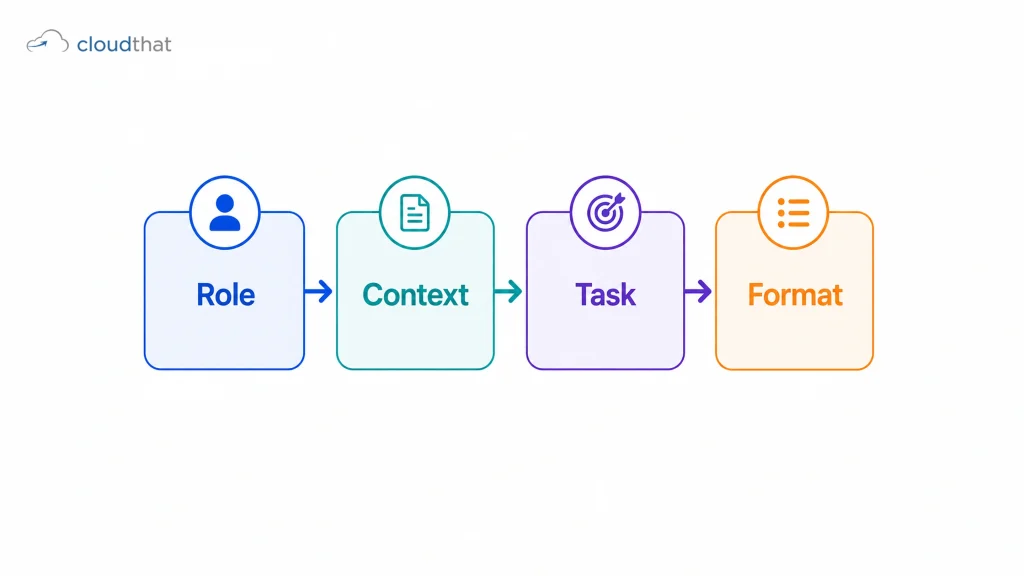
An OpenAI prompt-engineering course exists because typing a question and hoping for the best is not a skill. Structuring a prompt so the output is consistent and accurate, that is the skill.
What This Stage Actually Teaches You
A solid prompt engineering OpenAI course covers role-based prompting, few-shot examples, chain of thought reasoning, system prompts, and structured output formatting like JSON. It also covers evaluation, how you measure whether one prompt performs better than another instead of guessing by feel.
This is the stage that separates someone who plays with AI from someone who can build a repeatable process around it. Skip it, and every project you build afterward stays inconsistent because the foundation was never solid.
Stage 3: Building With the OpenAI API
Training that never touches the API is teaching you to be a user, not a builder.
This stage covers generating an API key, understanding tokens and rate limits, using function calling so the model can trigger real actions in an app, and getting structured outputs back instead of messy text you clean up manually. OpenAI’s own developer quickstart is where most learners head once the basics are behind them.
Cost control becomes real here too. Every API call has a price, and token usage becomes mandatory once a project runs in production. CloudThat’s consulting practice builds exactly these kinds of production integrations for enterprise clients.
Stage 4: RAG, or How You Stop Projects From Making Things Up
RAG, short for Retrieval-Augmented Generation, addresses the biggest complaint about AI tools: they confidently make things up.
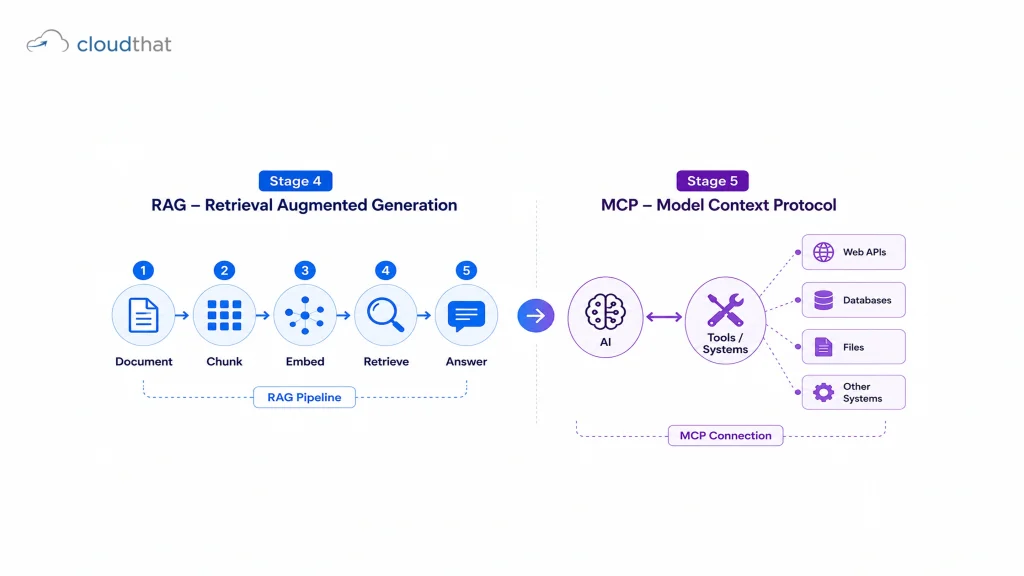
Learning RAG properly means understanding embeddings, chunking documents correctly, storing them in a vector database, and retrieving the right pieces before the model answers. Done right, your AI stops guessing and starts citing your actual company data, a policy document, or a support ticket history instead of thin air.
This is exactly the kind of build CloudThat’s GenAI Innovation Center runs with enterprise teams, turning a scattered document library into something an AI can search accurately.
Stage 5: MCP, the Newest Skill on the List
MCP, or Model Context Protocol, is the newest addition to any serious OpenAI course roadmap, and it is quickly becoming non-negotiable.
Think of it as the standard way an AI model connects to your company’s tools, calendars, databases, and internal systems, instead of every integration being custom-built and fragile. The official MCP documentation describes it as a universal connector between AI applications and external systems, and by 2026 it shows up in job descriptions the way “API integration” did a few years back.
An OpenAI course that ends at RAG is already a step behind. MCP is where AI stops being a chatbot and starts acting like a coworker who can safely take action across systems.
How Long Should This Roadmap Take?
Realistically, six to ten weeks alongside a full-time job, faster with structured instructor-led sessions.
The order matters more than the speed. Rushing to RAG or MCP without solid prompt engineering underneath just means rebuilding your foundation later, usually mid-project. CloudThat’s Experiential Learning model tests exactly this: whether a learner can apply each stage in a real scenario, not just recognize the terms in a quiz.
Why CloudThat Is Where This Roadmap Comes Together
If you want to learn this once and correctly, CloudThat runs live, instructor-led sessions across ChatGPT fundamentals, prompt engineering, API development, RAG, and MCP, taught by trainers who build these systems for enterprise clients between sessions, not freelancers reading off a script.
For individuals, the AI/ML and GenAI training tracks run with 50 to 60 percent hands-on lab time, so you are writing prompts and calling APIs in week one, not watching slides. For teams, the Capability Development Framework takes a cohort of engineers through this exact roadmap on a scoped, assessed enterprise timeline, and the Master Data Science with Azure program covers the applied AI/ML foundation that many learners lack before they even start prompt engineering.
CloudThat is an AWS Premier Tier Training Partner and an NVIDIA Training Partner with a dedicated GenAI focus, backed by 14+ years of cloud training experience and over 1.1 million professionals trained. The bigger reason to trust it is simpler: this OpenAI course is built by people who are also shipping GenAI projects for real clients.
Conclusion
An OpenAI course is only as good as its roadmap. ChatGPT fluency gets you started, prompt engineering makes it repeatable, the API lets you build, RAG keeps your answers honest, and MCP connects it all to the systems you actually work in. Learn them in order, skip nothing, and you come out able to build things that work, not demos that only look good in a screen recording.
Key Takeaways
- A real OpenAI course covers five stages: ChatGPT, prompt engineering, the API, RAG, and MCP, not just the first one or two.
- ChatGPT fluency is the starting point, never the finish line.
- A prompt engineering OpenAI course builds structure and consistency, not just better typing habits.
- The API stage moves you from user to builder, including function calling and structured outputs.
- RAG stops AI tools from making things up by grounding answers in real company data.
- MCP is the newest skill on the list, enabling safe integration of AI with company tools and systems.
- Skipping stages means rebuilding your foundation later, usually under deadline pressure.
- Realistic timelines run six to ten weeks with structured, instructor-led training.
- Hands-on lab time matters more than video hours when evaluating any OpenAI course.
- Enterprise teams can move through this entire roadmap together, rather than learning it in scattered, individual pieces.
Ready to actually build with AI instead of just chatting with it? Explore CloudThat’s live AI and GenAI training calendar and pick your starting stage.
About CloudThat
FAQs
1. Do I need coding experience before starting?
ANS: – Not for the first two stages. From the API stage onward, basic Python knowledge helps significantly.
2. Is a prompt engineering OpenAI course worth it if I already use ChatGPT daily?
ANS: – Yes. Daily use builds habits, not structure. This training teaches you to write prompts that produce consistent results instead of ones that work today and fail tomorrow.
3. What is the real difference between RAG and uploading files to ChatGPT?
ANS: – Uploading files works for small tasks. RAG is built for scale, searching thousands of documents inside a company’s own application rather than a chat window.
4. Why does MCP matter if RAG already solves the data problem?
ANS: – RAG grounds answers in your data. MCP lets AI take action across your tools and systems. Most 2026-ready training now teaches both.
5. How is CloudThat's OpenAI course different from a free playlist?
ANS: – Structure, hands-on labs, and trainers actively building GenAI systems for enterprise clients, not a video queue with no feedback loop.
6. Can a whole team be trained through this roadmap at once?
ANS: – Yes. This is exactly what the Capability Development Framework is built for, moving a full cohort through it on a scoped enterprise timeline.

WRITTEN BY Himisha Raval
Himisha Raval is a Digital Marketing Manager at CloudThat with a strong command of search engine optimization, web analytics, link building, and content strategy. She brings a data-driven approach to digital marketing, helping IT companies strengthen their online presence, improve search rankings, and generate consistent leads across channels. Beyond execution, she plays an active role in ideation, campaign strategy, and website performance optimization. Outside of work, she balances her analytical side with a love for travel, nature painting, and dancing.


 PREV
PREV











Comments