

 Login
Login


 September 2, 2026
|
Voiced by Amazon Polly |
In just a few short years, Generative AI has evolved from a fascinating consumer novelty into a foundational pillar of modern enterprise strategy. However, bridging the gap between a successful proof of concept and scalable, company-wide adoption is a complex challenge. This transition requires a structured approach known as Generative AI enablement, the strategic process of deploying AI securely, ethically, and effectively across an organization’s existing workflows and data ecosystems.
Today, enterprise leaders are no longer asking if they should adopt AI, but how to implement it without compromising security or compliance. With heavy-hitting tools dominating the market, businesses have powerful engines at their disposal. The key to unlocking their value lies in understanding their distinct architectures, establishing a robust governance framework, and targeting high-value use cases.
Start Learning In-Demand Tech Skills with Expert-Led Training
- Industry-Authorized Curriculum
- Expert-led Training
Choosing Your Engine: The Big Three
The enterprise market for Large Language Models (LLMs) and AI assistants has largely consolidated around three major platforms. While all three offer cutting-edge natural language processing, their enterprise editions are tailored to solve distinct corporate challenges.
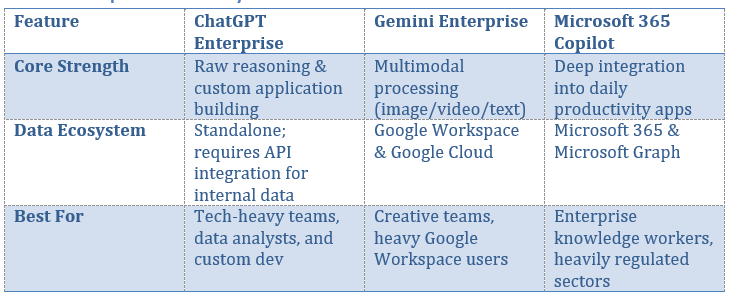
1. ChatGPT Enterprise
OpenAI’s ChatGPT Enterprise is renowned for its raw reasoning capabilities, advanced data analysis, and coding proficiency. Unlike the consumer version, the enterprise tier guarantees that organizational data is not used to train OpenAI’s public models. It offers extended context windows, faster processing speeds, and granular administrative controls. It is best suited for organizations seeking a versatile, standalone AI assistant capable of handling complex, custom workflows.
2. Gemini Enterprise
Google’s Gemini Enterprise is built for deep multimodal integration. Because Google controls the entire stack, from custom TPU hardware to cloud infrastructure, Gemini excels at processing text, code, images, and video natively. It integrates seamlessly into Google Workspace (Docs, Sheets, Slides) and Google Cloud, making it the ideal choice for companies already heavily invested in the Google ecosystem who need to analyze massive, diverse datasets.
3. Microsoft 365 Copilot
Microsoft 365 Copilot takes a different approach by embedding AI directly into the applications employees use every day: Word, Excel, Teams, and Outlook. Powered by what Microsoft calls “Work IQ,” Copilot accesses an organization’s Microsoft Graph, the interconnected web of emails, meetings, chats, and documents. This allows Copilot to provide highly contextual answers based on real-time business data while inheriting all existing Microsoft 365 security and compliance policies.
Platform Comparison Summary
The Architecture of Enterprise AI
One of the biggest hurdles in GenAI enablement is connecting large language models to proprietary company data without exposing sensitive information. You cannot simply upload your company’s financial records to a public AI model.
Modern enterprise tools address this with secure, closed-loop architectures, often leveraging techniques such as Retrieval-Augmented Generation (RAG). RAG enables the AI to search a company’s secure internal databases for relevant facts before generating a response, ensuring accuracy and reducing hallucinations.
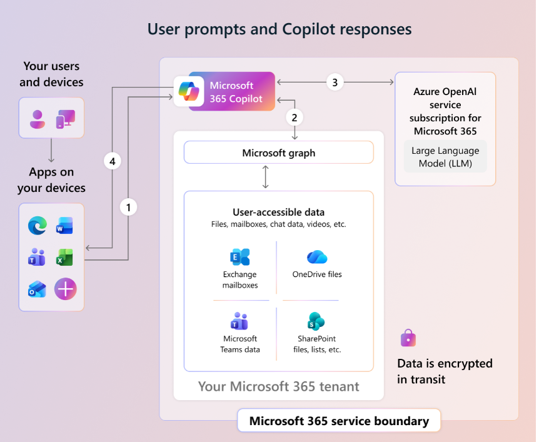
Fig 1: Enterprise GenAI securely processes data within a protected tenant boundary.
The 4-Pillar GenAI Enablement Framework
Deploying tools is easy; driving actual business value is hard. A successful GenAI enablement strategy requires a structured framework that moves an organization from scattered experimentation to scalable impact.
Pillar 1: Data Readiness
Generative AI is only as good as the data it can access. Before rolling out Copilot or Gemini, organizations must audit their data estate. Are files properly tagged? Are old, outdated documents archived? If an enterprise’s data is unstructured and chaotic, the AI will confidently retrieve outdated or incorrect information. Implementing strict data hygiene and establishing clear data lineage is the non-negotiable first step.
Pillar 2: Security & Governance
Enterprise AI without governance is a massive liability. An enablement framework must define clear policies before the first deployment:
- Sensitivity Labels: Ensure confidential files are explicitly tagged to prevent AI oversharing.
- Audit Trails: Maintain logs of AI interactions to monitor for misuse and compliance.
- Model Independence: Ensure vendor agreements prevent proprietary data from being used to train public models.
Pillar 3: Use-Case Prioritization
Avoid “solution in search of a problem” syndrome. The strongest enablement plans start with narrow, measurable business problems rather than broad technology aspirations. Don’t set a vague goal to “use AI in the legal department.” Instead, aim to “reduce non-disclosure agreement (NDA) review time by 60% using AI summarization”. Measuring baseline performance before the AI intervention ensures ROI can be proven.
Pillar 4: Talent & Change Management
The gap between a successful pilot and widespread production scale is almost always a people problem, not a technology problem. Employees need training on how to prompt effectively. A prompt like “write a report on Q3” yields generic results. A prompt like “Summarize the Q3 financial results from [Document A] and compare the revenue growth to Q2 in a bulleted list, maintaining a formal tone” yields a production-ready asset. Assessing your organization’s appetite for workflow disruption is critical; change management is not optional.
Scaling GenAI with Confidence
Generative AI enablement is not a one-time IT project; it is a continuous transformation of how an enterprise operates. By carefully selecting the right platforms, whether that is the raw power of ChatGPT Enterprise, the multimodal ecosystem of Gemini, or the integrated productivity of Microsoft 365 Copilot, organizations can equip their workforces for the future.
However, technology alone is insufficient. Success requires rigorous data preparation, uncompromising security governance, and a deep commitment to upskilling employees. Organizations that embrace this comprehensive enablement framework will not just work faster; they will fundamentally redefine what their teams can achieve.
Upskill Your Teams with Enterprise-Ready Tech Training Programs
- Team-wide Customizable Programs
- Measurable Business Outcomes
About CloudThat


WRITTEN BY Pankaj P Waghralkar
Pankaj Waghralkar is a Subject Matter Expert and Microsoft Certified Trainer at CloudThat. He has total of 15+ years of professional experience in various fields like Cloud Computing, Web Development, Digital Marketing and training experience in IT & Computer Engineering streams. He has trained more than 2500 students, working & corporate professionals. He published two national patents on biometric technologies and also published more than 10+ international research articles on different trends in technologies. His expertise includes designing secure hybrid cloud infrastructures and enhancing online visibility through strategic web development and marketing initiatives. Proficient in leveraging advanced cloud technologies, effective networking solutions and comprehensive software engineering practices to drive business growth, Pankaj has trained professionals across industries, helping them master Azure services such as Virtual Networks, Azure Active Directory, Security, Networking and more. Known for his clear teaching style and deep technical knowledge, Pankaj is dedicated to shaping the next generation of cloud experts.


 PREV
PREV







Comments