

 Login
Login

 August 24, 2026
|
Voiced by Amazon Polly |
Introduction
As AI models continue to grow in size and complexity, the demand for computational power is increasing rapidly. While GPUs and TPUs remain the foundation of modern AI, researchers are exploring whether quantum computing can accelerate specific computational tasks that are difficult for classical hardware.
This has led to the emergence of a new field known as Quantum AI, which explores the relationship between quantum computing and artificial intelligence. It includes both using AI to improve quantum computers and exploring how quantum computing can accelerate certain AI and machine learning tasks. Although Quantum AI is still an emerging field, it is one of the most exciting areas of research at the intersection of AI and quantum computing.
This article is the first part of a two-part article. In this part, we will learn the basics of quantum AI, the differences between quantum and classical computers, and quantum advantage. In the second part of this article, we will talk about how developers can try out quantum computing on Amazon Braket, a quantum computing platform provided by AWS.
Pioneers in Cloud Consulting & Migration Services
- Reduced infrastructural costs
- Accelerated application deployment
Quantum AI
Quantum AI is often used as a single buzzword, but it’s really two distinct, largely unrelated research directions.
Quantum Computing for AI: This is the more speculative direction, using quantum hardware to accelerate parts of machine learning itself, such as optimization during training or certain kernel computations. It’s an active research area (quantum kernel methods, quantum neural networks, QAOA-based optimization), but genuine, provable speed-ups over classical methods are still narrow and specific, not a general “quantum computers will train your models faster”.
AI for Quantum Computing: Quantum hardware is extremely fragile qubits lose their state (decohere) in microseconds, and noise corrupts calculations constantly. Machine learning models are now a standard part of the quantum stack itself: they characterize noise, tune control pulses, and predict/correct errors in real time. This is engineering support work, and it’s already deployed in production quantum systems today.
These are two completely different research directions, moving at very different speeds, and conflating them is where most of the confusing hype comes from.
Why Classical Computing Has Limits
Quantum computing isn’t gaining attention in a vacuum it’s arriving at the same time classical computing is running into real physical and economic walls.
Moore’s Law is slowing. Transistor density improvements that used to double every ~18 months have stretched out significantly as we approach atomic-scale limits on chip fabrication. Squeezing more raw performance out of a single classical chip is getting harder and more expensive.
GPUs are becoming a scarcity, not just a cost line. The AI boom has made high-end GPU capacity one of the most constrained resources in the industry, both financially and in terms of raw availability. Scaling AI workloads by simply buying more classical compute is running into diminishing returns per dollar.
Certain problem classes stay hard regardless of hardware. Some optimization and simulation problems don’t get meaningfully easier, no matter how many classical cores you throw at them, the search space grows exponentially with problem size. Route optimization across a large logistics network, or simulating a moderately complex molecule, are classic examples: classical computers approximate; they don’t solve.
This is where quantum computing enters the picture, not as a general replacement for classical hardware, but as a potential answer to the specific problems classical hardware structurally struggles with.
Classical Computers vs. Quantum Computers
The core difference comes down to how information is represented and manipulated.
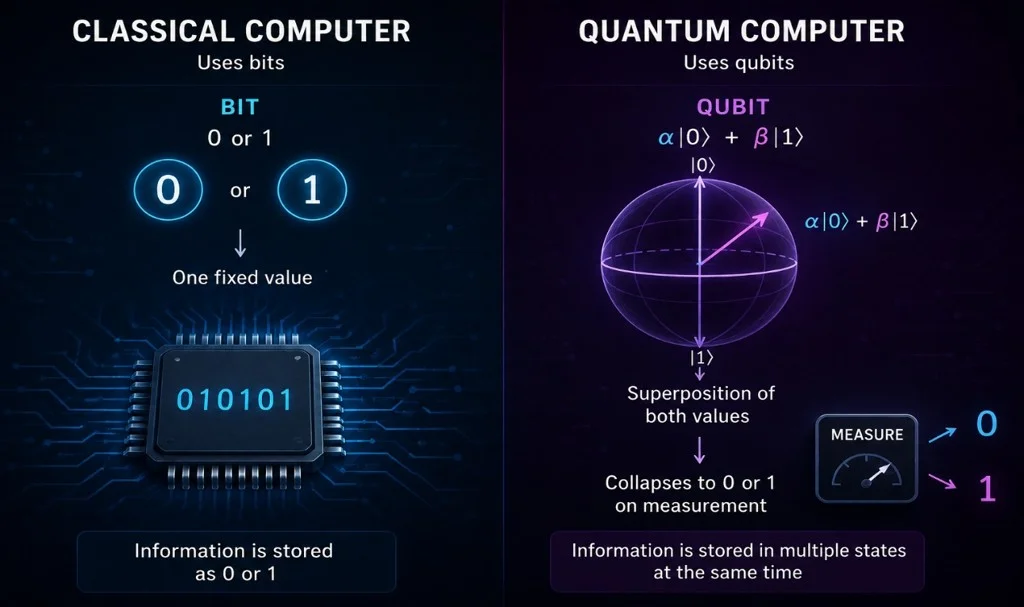
A classical bit is always definitively 0 or 1. A qubit, thanks to superposition, exists in a weighted combination of both states simultaneously it’s only forced into a definite 0 or 1 the moment you measure it.
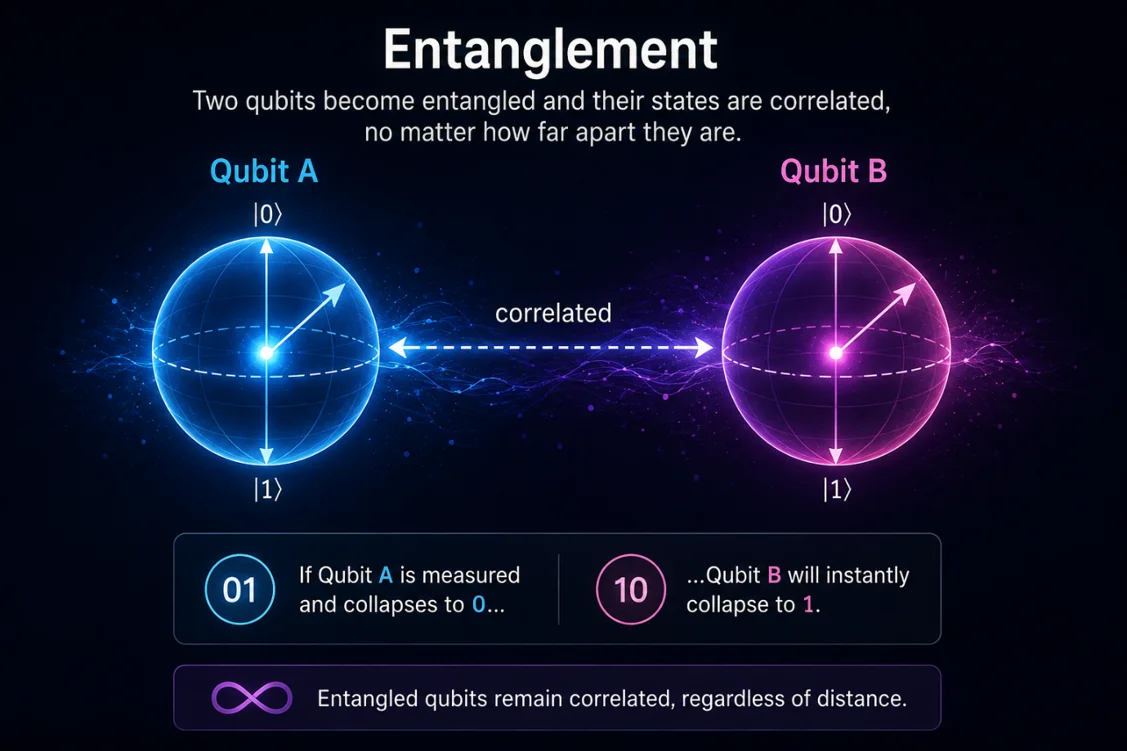
The second quantum property that matters is entanglement:
Why Qubits Matter?
Because each qubit can be in a superposition, a system of n qubits can represent up to 2ⁿ possible states simultaneously. Add qubits, and the representable state space grows exponentially, not linearly. A 50-qubit system can, in principle, represent more simultaneous states than there are atoms in a large classical dataset.
More qubits do not automatically mean a faster or better quantum computer.
Qubit quality also matters. Factors such as gate fidelity, coherence time, error rates, and connectivity determine whether a quantum processor can perform useful computations.
Quantum Advantage
Two terms get used almost interchangeably in press coverage, and they shouldn’t be.
Quantum supremacy is the (now largely retired) term for a quantum computer completing any task faster than a classical computer, even a deliberately constructed, practically useless one, designed purely to be hard for classical hardware to simulate. Google’s 2019 Sycamore result is the canonical example: a real milestone, but not evidence of practical usefulness.
Quantum advantage is the much higher, more meaningful bar: a quantum computer solving a real, useful problem faster, cheaper, or more accurately than the best available classical method and, in the most rigorous demonstrations, doing so in a way that can be independently verified as correct rather than just claimed.
The field is now firmly focused on the second, harder bar. That shift in framing from “can it do something classical computers can’t” to “can it do something useful that classical computers can’t, verifiably” is itself one of the more important developments of the last couple of years.
Current Challenges
Quantum computing still faces several major challenges:
- Noise: Quantum operations can introduce errors.
- Decoherence: Qubits lose their quantum state through interactions with their environment.
- Error correction: A reliable, logical qubit may require many physical qubits.
- Scalability: Controlling and connecting large numbers of qubits remains difficult.
- Cost: Access to real quantum hardware can be expensive and may involve queue times.
Conclusion
Quantum AI isn’t a single technology it’s a convergence of two research fields, arriving at a moment when classical computing’s easy gains are slowing down. The physics is real; the recent breakthroughs are genuine engineering milestones rather than marketing claims; and the challenges remain substantial. None of this makes quantum computing a replacement for the GPUs and TPUs running today’s AI workloads, but it does make it a legitimate, narrow-but-growing tool for a specific class of problems classical hardware structurally struggles with.
Drop a query if you have any questions regarding Quantum AI, and we will get back to you quickly.
Empowering organizations to become ‘data driven’ enterprises with our Cloud experts.
- Reduced infrastructure costs
- Timely data-driven decisions
About CloudThat
FAQs
1. How is a quantum computer different from a classical computer?
ANS: – Classical computers process information using bits (0 or 1), while quantum computers use qubits, which can exist in multiple states simultaneously through superposition and entanglement.
2. Will quantum computers replace GPUs and CPUs?
ANS: – No. Quantum computers are designed for specialized problems such as optimization and simulation. CPUs and GPUs will continue to handle most general-purpose computing and AI workloads.
3. What is quantum advantage?
ANS: – Quantum advantage is achieved when a quantum computer solves a real-world problem faster, more accurately, or more efficiently than the best available classical computer.


WRITTEN BY Aniket Bembale
Aniket Bembale is Senior Research Associate – Data & AIoT at CloudThat, focusing on Generative AI, Agentic AI solutions and Cloud Computing. He is involved in building scalable AI-driven applications and implementing modern data and AI technologies to solve real-world business challenges.


 PREV
PREV












Comments