

 Login
Login

 August 21, 2026
|
Voiced by Amazon Polly |
Introduction
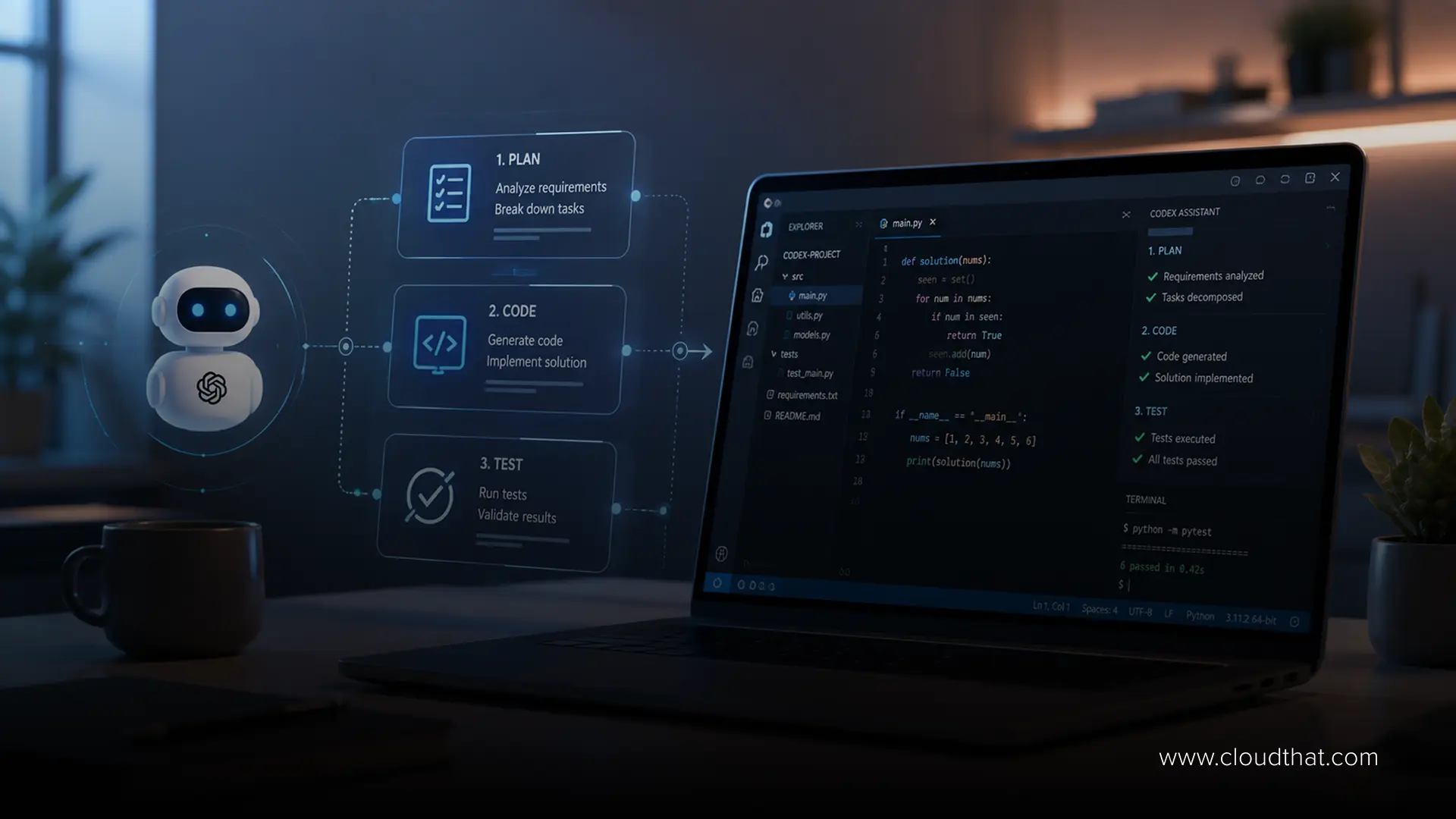
What is OpenAI Codex? It is OpenAI’s coding agent, built on top of its language models, that can plan a task, write the code, run tests, and open a pull request largely on its own inside your existing developer workflow. Unlike a simple autocomplete tool, codex openai works across an entire repository, understands file structure and dependencies, and can execute code in a sandboxed environment to check whether its own output actually works. Engineers use OpenAI Codex to scaffold features, fix bugs, write test suites, and even prepare deployment steps, with a human reviewing and approving before anything ships. If you have ever wondered what is openai codex actually capable of beyond autocomplete, the honest answer is that it behaves less like a suggestion box and more like a junior engineer who never gets tired of writing tests.
Advance Your Career with OpenAI Training
- Build AI Applications
- GPT-5 & OpenAI APIs
- Hands-on Projects
The Bug That Took Three Days, Then Three Minutes
A developer spends three days chasing a bug. Reproduces it, narrows it down, writes a fix, breaks something else while fixing it.
Sound familiar?
Now picture the same bug handed to an agent that reads the whole repository, writes a fix, runs the test suite against it, and flags exactly which tests still fail. Not three days. Three minutes, sometimes less.
That is the shift OpenAI Codex represents, and it is why so many engineering teams are suddenly asking what is openai codex and whether it is worth rebuilding parts of their workflow around it. If you already work with agentic tooling, this pairs naturally with structured Agentic AI training rather than trial and error on production code.
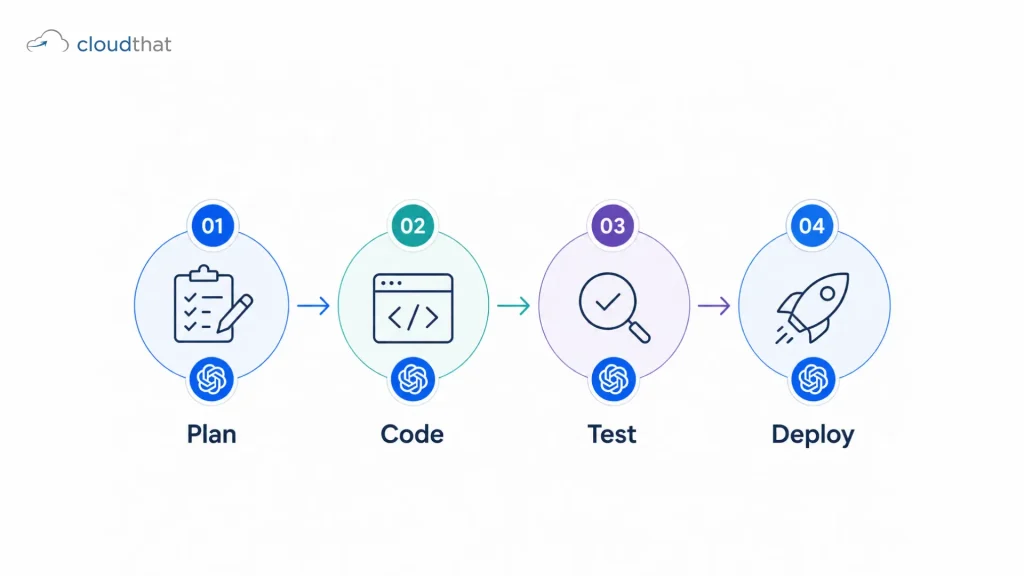
This blog walks through what OpenAI Codex actually is, how it changes planning, coding, testing, and deployment, and where it genuinely helps versus where a human still has to step in.
What Is OpenAI Codex, Exactly?
What is OpenAI Codex, stripped of the marketing language? It is a coding agent that can read a codebase, understand what needs to change, write that change, and verify it before handing it back to you.
Older tools like basic autocomplete only predict the next few lines you are likely to type. OpenAI Codex operates at a different level. Give it a task description, and it plans the steps, touches multiple files if needed, runs the code in an isolated sandbox, and iterates until the output actually passes.
This is why so many developers keep searching what is openai codex instead of assuming it is just another autocomplete plugin. It genuinely behaves differently. Codex openai sits closer to an agent than a suggestion engine, and that distinction changes how teams plan work around it.
How Does OpenAI Codex Change Planning?
Short answer: it turns vague tickets into concrete, checkable steps before a single line of code gets written. This is the part of what is openai codex that most demos skip entirely.
A typical sprint planning session involves someone breaking a feature into tasks based on gut feel and past experience. OpenAI Codex can take a rough specification, break it into implementation steps, flag which files it expects to touch, and surface dependencies a human might miss on a rushed Monday morning.
Teams exploring this at scale usually pair it with a broader Generative AI and Prompt Engineering foundation, since the quality of Codex’s plan depends heavily on how the task is framed. A vague prompt gets a vague plan. A specific one gets something close to an actual technical design doc.
How Does OpenAI Codex Change Coding?
This is where OpenAI Codex gets most of its attention, and rightly so.
Instead of writing one function at a time and hoping it fits the rest of the file, OpenAI Codex can implement a feature across several files in one pass, matching existing code style and naming conventions it picks up from the repository itself.
It is not flawless. It can misread intent on ambiguous tickets, and it will happily write code that runs but does not match your architecture decisions. Developers who get the most value treat OpenAI Codex like a fast first draft, not a final answer. Review the diff, question anything unfamiliar, and keep ownership of the merge decision.
How Does OpenAI Codex Change Testing?
Here is the part most teams underestimate when they first ask what is openai codex good for: it writes tests almost as naturally as it writes features.
Ask it to implement a function, and a decent prompt will also get you unit tests covering edge cases a rushed developer might skip on a Friday afternoon. Because it runs code in a sandbox before returning results, codex openai can tell you which tests pass and which fail, instead of just guessing.
This does not replace a proper QA process. It does mean fewer untested pull requests landing on a reviewer’s desk. Teams already running structured DevOps Engineering on AWS pipelines find it slots naturally into existing CI checks rather than replacing them.
How Does OpenAI Codex Change Deployment?
OpenAI Codex will not deploy production code without a human in the loop, and that is by design.
What it does well is prepare the groundwork: drafting deployment scripts, updating configuration files, flagging environment variables a change depends on, and writing the pull request description that explains what changed and why. A reviewer still approves the merge and still owns the release decision.
Where OpenAI Codex genuinely saves time is in the unglamorous prep work around a deployment, the checklist items that eat an afternoon but rarely need deep engineering judgment.
OpenAI Codex vs Traditional Copilot Tools
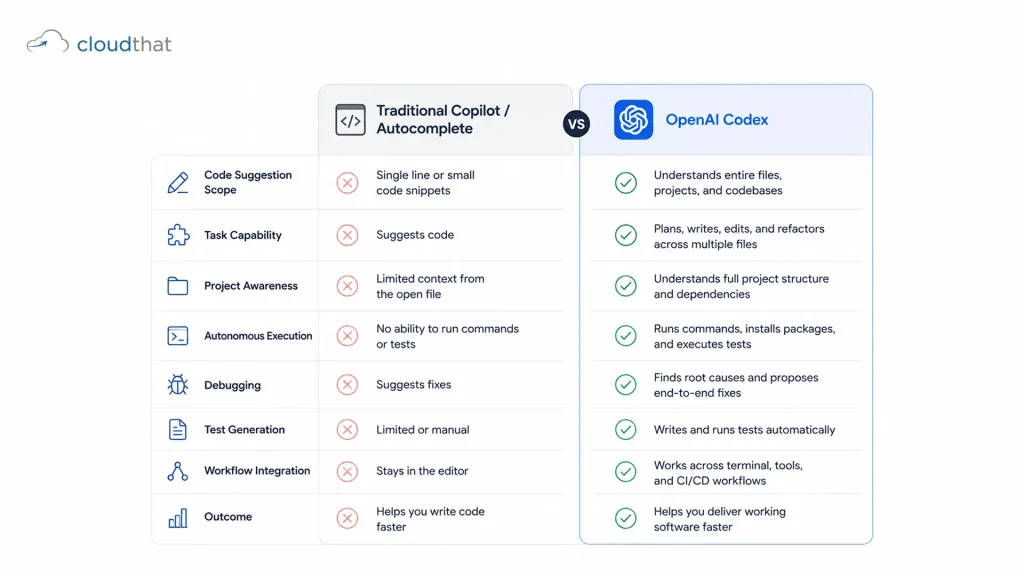
People often ask what is openai codex compared to a standard autocomplete-style coding assistant, assuming they are the same category of tool. They are not, and understanding what is openai codex actually built for changes how you would prompt it.
| Capability | Traditional Autocomplete | OpenAI Codex |
| Scope | Single line or function | Full repository, multiple files |
| Execution | No code execution | Runs code in a sandbox to verify output |
| Planning | None | Breaks tasks into steps before coding |
| Testing | Not included | Writes and runs tests automatically |
| Deployment prep | Not included | Drafts scripts, configs, PR descriptions |
Codex openai is not a bigger autocomplete. It is a different category of tool built around planning, execution, and verification, not just prediction.
Learning Codex OpenAI Skills With CloudThat
CloudThat’s Codex Deployment Practitioner Program is built specifically around using OpenAI Codex inside real development workflows, not just watching a demo. Learners work through actual repositories, prompting Codex to plan a feature, generate the implementation, write tests, and prepare deployment steps, then review and correct its output the way a senior engineer would.
The program sits inside CloudThat’s broader OpenAI training track, and pairs naturally with the AI-103 Develop AI Apps and Agents on Azure course for engineers building agent-based systems beyond just coding assistance. Teams evaluating Codex adoption across an engineering org, not just individual developers, can work with CloudThat’s corporate training arm to run a structured cohort instead of leaving adoption to trial and error. For organisations that need Codex integrated into an existing DevOps pipeline rather than just training on it, CloudThat’s GenAI Innovation Center handles the consulting side of that rollout.
This is deliberately hands-on. Reading about OpenAI Codex won’t prepare you to prompt it correctly in a messy, real codebase. Practicing on one will.
Conclusion
OpenAI Codex is not magic, and it is not a replacement for engineering judgment. It is a genuinely useful agent for planning, coding, testing, and prepping deployments, provided a human still reviews its output. Learn to prompt it well, and the three-day bug really can shrink down to three minutes.
Key Takeaways
- OpenAI Codex is an agent that plans, codes, tests, and preps deployment steps, not a simple autocomplete tool.
- The tool runs code inside a sandbox to verify its own output before returning results.
- Planning quality depends on prompt clarity, vague tickets get vague plans from OpenAI Codex.
- It writes and runs tests automatically, reducing untested pull requests reaching reviewers.
- OpenAI Codex will not deploy production code without human review and approval.
- It works across entire repositories and multiple files, unlike traditional line-by-line autocomplete.
- The tool fits naturally into existing DevOps and CI pipelines rather than replacing them.
- Treat its output as a fast first draft, review every diff before merging.
- Hands-on practice inside real repositories teaches Codex prompting far better than reading about it.
- Structured training programs speed up safe, practical adoption of OpenAI Codex across engineering teams.
Ready to move past reading about what is openai codex and start prompting it inside a real codebase? Explore CloudThat’s Codex Deployment Practitioner Program and build the skill hands-on.
About CloudThat
FAQs
1. What is OpenAI Codex used for?
ANS: – Planning tasks, writing and modifying code across files, generating tests, running them in a sandbox, and preparing deployment steps like configuration updates and pull request descriptions.
2. Is Codex OpenAI the same as GitHub Copilot?
ANS: – No. Copilot mainly autocompletes code as you type. OpenAI Codex operates as an agent that plans, executes, tests, and iterates on a task with less manual guidance.
3. Can OpenAI Codex deploy code by itself?
ANS: – It prepares deployment groundwork like scripts and configs, but a human still reviews and approves before anything ships to production.
4. Does OpenAI Codex replace QA testing?
ANS: – No. It writes and runs its own tests to catch obvious issues early, but a proper QA process and human review are still required for production releases.
5. How accurate is OpenAI Codex on large codebases?
ANS: – Accuracy depends heavily on prompt clarity and codebase structure. Well-documented repositories with consistent conventions get noticeably better results than messy, undocumented ones.
6. Do I need to know how to code to use OpenAI Codex?
ANS: – Basic coding knowledge helps significantly, since you need to review its output, catch mistakes, and understand whether its plan actually matches your architecture.

WRITTEN BY Himisha Raval
Himisha Raval is a Digital Marketing Manager at CloudThat with a strong command of search engine optimization, web analytics, link building, and content strategy. She brings a data-driven approach to digital marketing, helping IT companies strengthen their online presence, improve search rankings, and generate consistent leads across channels. Beyond execution, she plays an active role in ideation, campaign strategy, and website performance optimization. Outside of work, she balances her analytical side with a love for travel, nature painting, and dancing.


 PREV
PREV












Comments