

 Login
Login

 August 13, 2026
|
Voiced by Amazon Polly |
Introduction
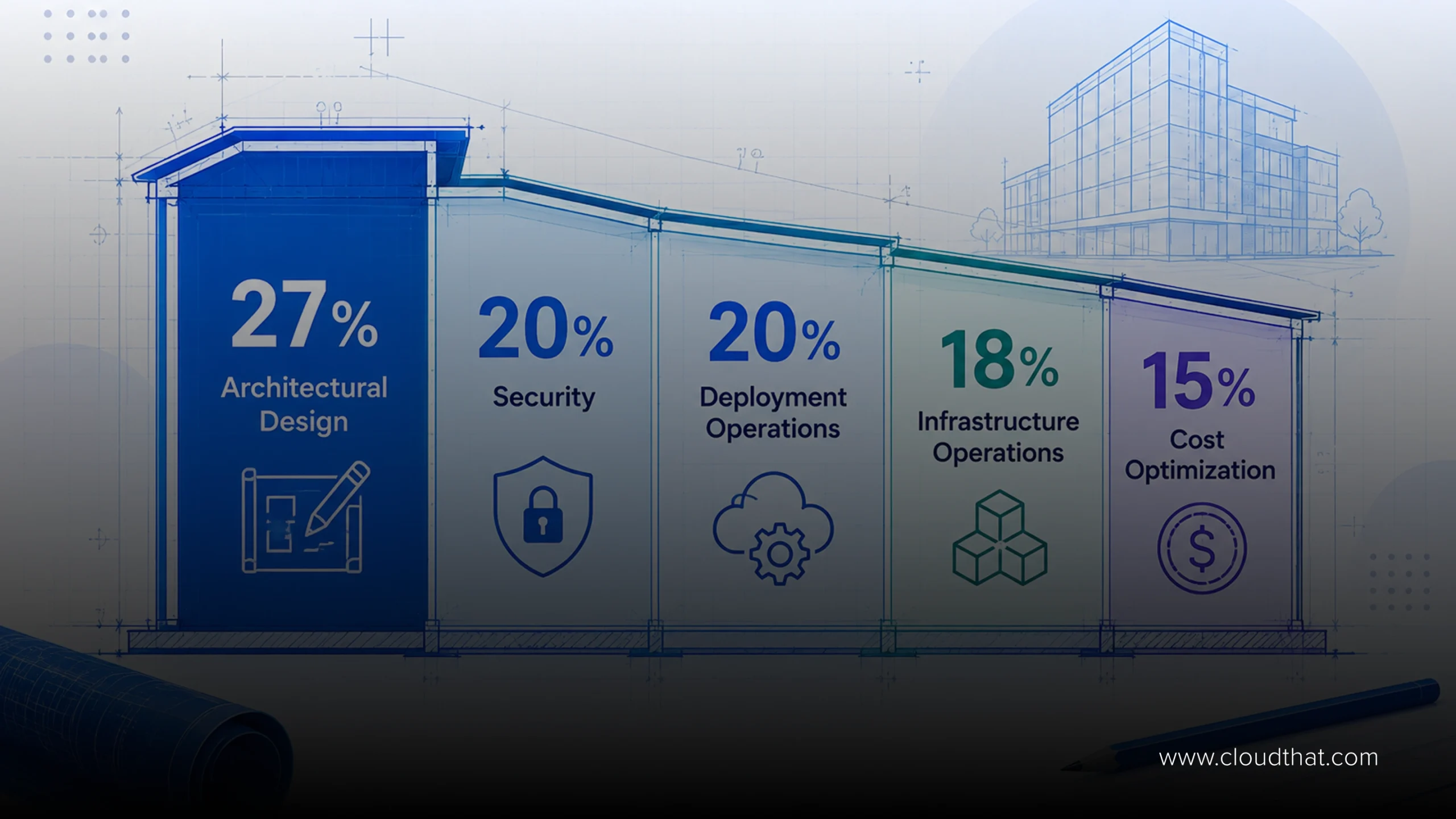
Quick Answer: The Claude Certified Architect Foundations exam, CCAR-F, tests whether you can design and build production grade Claude systems, not just talk about them. It runs 60 scenario based questions in 120 minutes, drawn from four of six real world scenario banks, and needs a scaled score of 720 out of 1,000 to pass. Five domains decide the outcome, Agentic Architecture at 27 percent, Claude Code Configuration and Prompt Engineering at 20 percent each, Tool Design and MCP at 18 percent, Context Management at 15 percent. Anthropic recommends around six months of hands on Claude experience before you book it. Cost is $125, and registration runs through the free to join Claude Partner Network.
You’ve built things on Claude for six months now. You’ve fixed a broken agent at midnight without panicking.
So why does the Claude Certified Architect Foundations exam guide still read like a different language?
Here’s what nobody tells you upfront. This isn’t a vocabulary quiz. No “define agentic loop.” Every question drops you into a scenario, a chatbot hallucinating in production, an agent stuck in a loop, a Claude Code pipeline breaking in CI/CD, and asks what you’d actually do.
That’s a different exam than the one you’re studying for if you’re memorizing flashcards.
Let’s fix that, domain by domain, so you walk in knowing exactly what’s coming.
Master Claude AI for Next-Gen Applications
- Prompt Engineering
- Claude API
- Secure AI Development
What The Claude Certified Architect Foundations Exam Actually Tests
The Claude certified architect exam validates one thing. Can you design, build, and reason about production grade Claude systems under real constraints.
Anthropic built it as the entry point into the Architect track, the credential for people who own the full system design, not just one piece of it. It sits above course completion certificates and below Architect Professional, reserved for senior architects running governance at enterprise scale.
The Claude certified architect exam is closed book, no AI assistance, every item scenario driven. You’re not asked to recall a definition. You’re asked to make an architectural call and defend it, the way you would in an actual design review.
If your Claude experience starts and ends in the chat interface, this exam isn’t for you yet. It’s built for people who’ve shipped something.
Who This Exam Is Built For
Anthropic’s guide is blunt about the target candidate. Solution architects, AI and ML engineers, and technical leads building production applications on Claude, with roughly six months of hands on experience across the Claude API, Agent SDK, Claude Code, and MCP.
None of that is a hard prerequisite. Anthropic awards the credential purely on performance, so anyone can technically register. But if you’ve only used Claude through chat, you’ll feel every gap the moment the scenarios start. That gap is exactly what the Architect Foundations course is designed to close, working through the same agentic architecture, Claude Code configuration, and tool design domains the exam scenarios draw from. For anyone earlier in the pipeline, the Claude Certified Developer or Associate tracks are the more honest starting point.
There’s also a practical gate. Registration for the Claude Certified Architect Foundations exam needs a partner email address from a Claude Partner Network organization. The good part, joining that network is free. The less good part, if your company isn’t in it yet, that conversation needs to happen first.
The Five Domains That Decide If You Pass
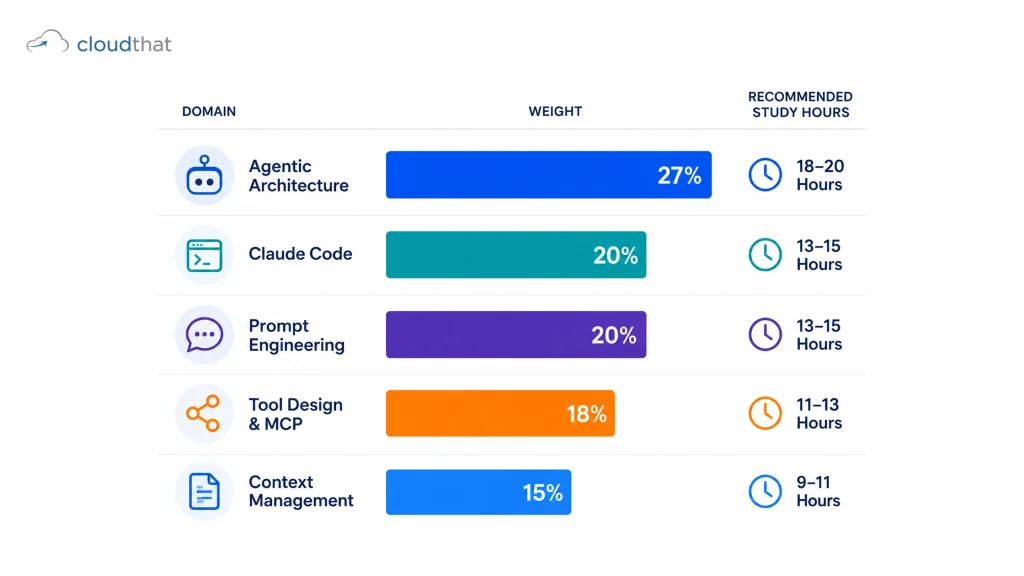
This is the part that actually changes how you study. The exam doesn’t weight its five domains equally, and studying them equally wastes hours you don’t have.
Agentic Architecture, 27 percent. The heaviest domain, and the most underestimated. Designing agent and multi agent systems with the Claude Agent SDK, agent loops, subagents, and when a system should act autonomously versus escalate to a human.
Claude Code Configuration, 20 percent. Configuring Claude Code for real workflows, CLAUDE.md files, hooks, and how it slots into a CI/CD pipeline without becoming a liability.
Prompt Engineering, 20 percent. The advanced version. Structured output design, tool based JSON schemas, extended thinking, validation retry loops that hold up in production.
Tool Design and MCP, 18 percent. Building and reasoning about MCP servers, tool definitions, and when a hook beats a system prompt instruction.
Context Management, 15 percent. Smallest domain by weight, not by consequence. Reliability patterns, token limits, keeping a long running agent coherent instead of drifting.
Five domains, 29 task objectives, all scenario based. Miss the weighting and you over prepare for the wrong thing.
What Happens On Exam Day
The Claude certified architect exam runs sixty questions in a hundred and twenty minutes, drawn from a bank of six real world contexts, with four randomly selected onto your paper. That randomness matters. Walk in slightly weaker on one scenario and you’re still fine, as long as you’ve genuinely prepared for the rest.
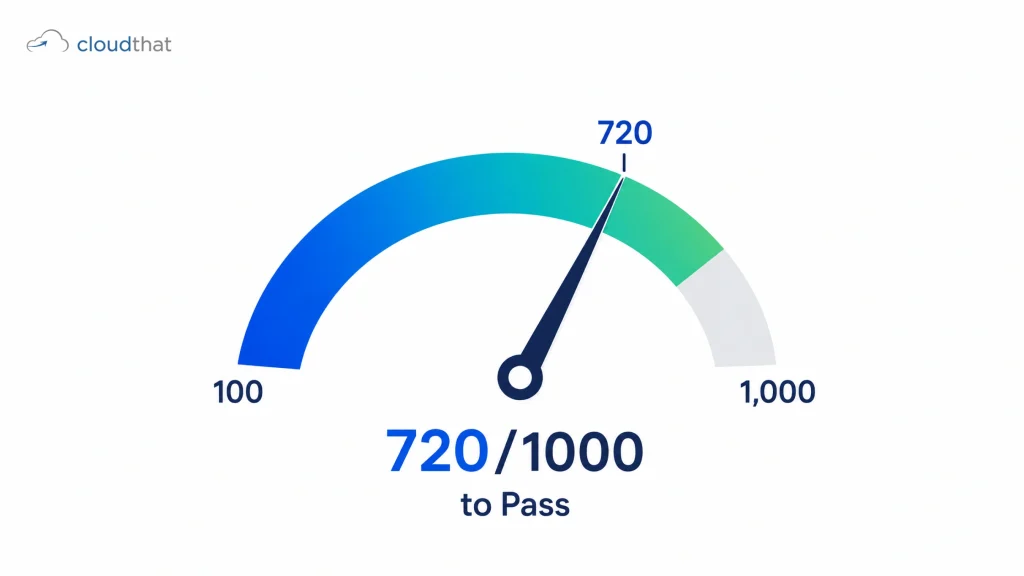
Scoring runs on a scaled system, 100 to 1,000, and you need 720 to pass. That’s not the same as answering 72 percent of questions correctly, since Anthropic weights harder items differently. Treat roughly 75 percent on quality practice material as your real safety margin, not the bare minimum.
You get a pass or fail result immediately, plus a per domain breakdown. Miss it the first time, and that breakdown tells you exactly where to go back before a retake, which costs full price again.
How To Prepare Without Losing Every Weekend
Realistic prep time sits between 40 and 100 hours, depending how deep you already are in production Claude work. Six months in already, you’re closer to 40.
Start with Claude API fundamentals, the Messages API, system prompts, model selection, streaming, prompt caching, since everything else sits on top. Move into prompt engineering next, since that’s 20 percent of the exam and where candidates quietly lose points. Then build an actual MCP server. Not read about one. Build one.
Save Agentic Architecture for a dedicated stretch of focused time, since it’s 27 percent of your score and the conceptually densest domain. Practice with genuinely scenario based questions, because that’s the real format waiting for you on the Claude certified architect exam itself.
Two mistakes keep showing up. Treating this like a memorization test when every question is a scenario. And skipping Context Management because it’s the smallest domain, forgetting that 15 percent is still nine questions on a sixty question paper.
Why CloudThat Is the Best Choice for Claude Certified Architect Foundations Prep
If you’re prepping a whole engineering team for the Claude Certified Architect Foundations exam, not just one person cramming solo, CloudThat is built for exactly that gap. Fourteen plus years turning employees into billable, production ready technical talent across 850+ corporates means CloudThat already knows how to take a team from zero to exam ready on a deadline, and that rigor now applies directly to agentic AI and Claude focused GenAI work through the GenAI Innovation Center.
CloudThat’s Capability Development Framework runs a pre training skill assessment on every cohort before a single hour of training happens, so nobody relearns Claude API fundamentals they already know. What’s left gets built through hands on labs, matching almost exactly how the Claude certified architect exam is structured, scenario first, theory second. Teams that need to prove they can ship an agentic system under real pressure, not just answer questions about one, go through Experiential Learning simulations built on the same premise. For organizations still working out Claude Partner Network access, CloudThat’s experience running the AWS Partner Acceleration Training Program means the team already understands how to build skill against a vendor partner framework.
The proof points back it up. Over 1.1 million professionals trained, 750+ projects delivered, a training model built on 50 to 60 percent hands on labs. That’s the same instinct the Claude Certified Architect Foundations exam rewards, judgment built from doing the work.
Conclusion
The Claude Certified Architect Foundations exam isn’t hard because the material is obscure. It’s hard because it tests judgment under a scenario, not recall under a timer. Study the five domains in proportion to their weight, build real things instead of reading about them, and confirm your Claude Partner Network access before you get attached to a study date.
Ready to build the hands on skills before exam day? Explore CloudThat’s corporate training programs or check the training calendar for upcoming GenAI cohorts.
Key Takeaways
- The Claude Certified Architect Foundations exam tests architectural judgment through scenarios, not memorized definitions.
- CCAR-F runs 60 questions in 120 minutes, drawn from four of six scenario banks.
- Five domains decide your score, weighted from 27 percent down to 15 percent.
- Agentic Architecture is the heaviest domain and deserves the most prep hours.
- Context Management is the smallest domain but still worth nine questions.
- Anthropic recommends six months of hands on Claude experience, though it isn’t mandatory.
- Passing score is 720 out of 1,000 on a scaled system.
- Registration requires a Claude Partner Network organization email, though the network is free to join.
- Realistic prep time runs 40 to 100 hours depending on prior experience.
- Building a real MCP server beats reading documentation every time.
Advance Your AI Career with Claude AI
- Enterprise AI Skills
- Claude API
- AI Assistants
About CloudThat
FAQs
1. What is the Claude Certified Architect Foundations exam?
ANS: – Anthropic’s entry level Architect credential, CCAR-F, testing production grade Claude system design through 60 scenario based questions in 120 minutes.
2. How hard is the Claude certified architect exam?
ANS: – Scenario based, not a vocabulary test. Most candidates with six months of Claude work need 40 to 100 hours of focused prep.
3. What are the five domains on this exam?
ANS: – Agentic Architecture at 27 percent, Claude Code Configuration and Prompt Engineering at 20 percent each, Tool Design and MCP at 18 percent, Context Management at 15 percent.
4. Do I need six months of Claude experience to take it?
ANS: – Recommended, not mandatory. Anthropic awards the credential on performance alone, but candidates without hands on experience typically struggle with the scenarios.
5. How much does the Claude Certified Architect Foundations exam cost?
ANS: – $125 per attempt, retakes charged at full price.
6. Can I take the Claude certified architect exam without my company being a Claude partner?
ANS: – No. Registration needs a partner email from a Claude Partner Network organization, though joining the network itself is free.
7. What's the passing score?
ANS: – 720 out of 1,000 on a scaled system, not a flat percentage of correct answers.

WRITTEN BY Himisha Raval
Himisha Raval is a Digital Marketing Manager at CloudThat with a strong command of search engine optimization, web analytics, link building, and content strategy. She brings a data-driven approach to digital marketing, helping IT companies strengthen their online presence, improve search rankings, and generate consistent leads across channels. Beyond execution, she plays an active role in ideation, campaign strategy, and website performance optimization. Outside of work, she balances her analytical side with a love for travel, nature painting, and dancing.


 PREV
PREV












Comments