

 Login
Login


 September 9, 2026
|
Voiced by Amazon Polly |
When AI applications move from prototypes to production, developers often assume the Large Language Model (LLM) is the bottleneck. The problem is usually the context being sent to the model.
Generative AI has evolved rapidly. We started with prompt engineering, writing better prompts, which helped improve model responses. Then came Retrieval-Augmented Generation (RAG), enabling models to access external knowledge instead of relying solely on their training data. Today, we build AI agents capable of reasoning, using tools, retrieving information, and completing multi-step tasks autonomously.
As these applications become more sophisticated, managing the information they receive has become just as important as selecting the right foundation model. This shift has led to Context Engineering, the practice of ensuring that an AI agent receives the right information at the right time in the most efficient way. Rather than asking “How to write a better prompt?”, context engineering asks a much bigger question: “How do I provide only the information the model actually needs?”
Keywords: Context Engineering, Amazon Bedrock, AI Agents, Production-Ready AI Agents, Amazon Bedrock Prompt Caching, Amazon Bedrock AgentCore Memory
Start Learning In-Demand Tech Skills with Expert-Led Training
- Industry-Authorized Curriculum
- Expert-led Training
From Prompt Engineering to Context Engineering
Prompt engineering improved how we communicated with LLMs. RAG expanded its knowledge by retrieving relevant information from external sources. AI agents took it a step further by enabling models to reason, invoke tools, interact with APIs, and automate workflows.
However, these capabilities introduced a new challenge. Every interaction now includes much more than a user’s question. A typical AI agent processes system instructions, conversation history, retrieved documents, tool definitions, tool outputs, and user inputs, all within a finite context window.
As applications scale, simply adding more context is no longer the answer. Excessive or irrelevant information often leads to slower responses, higher inference costs, and reduced response quality. Context engineering addresses this challenge by ensuring that only the most relevant information reaches the model.
Why More Context Isn’t Always Better
Scenario:
A customer asks a customer support assistant about a delayed order on Amazon Bedrock. The agent retrieves shipping details, checks previous conversations, searches the company’s knowledge base, calls an order management API, and references the organization’s support policies.
Initially, this makes the agent highly capable.
Now imagine the same customer returns a week later with another issue. The conversation history grows longer, more documents are retrieved, additional tool calls are made, and the context window continues to expand.
Eventually, the model spends more time processing information than generating useful responses. Token consumption increases, latency rises, and important details may be buried beneath irrelevant context.
This is exactly the problem context engineering is designed to solve.
Context Engineering in Practice
Optimize input formats. Structured formats reduce unnecessary tokens while preserving the information the model needs. When AI applications process thousands of requests every day, even small token savings can translate into lower inference costs and improved performance.
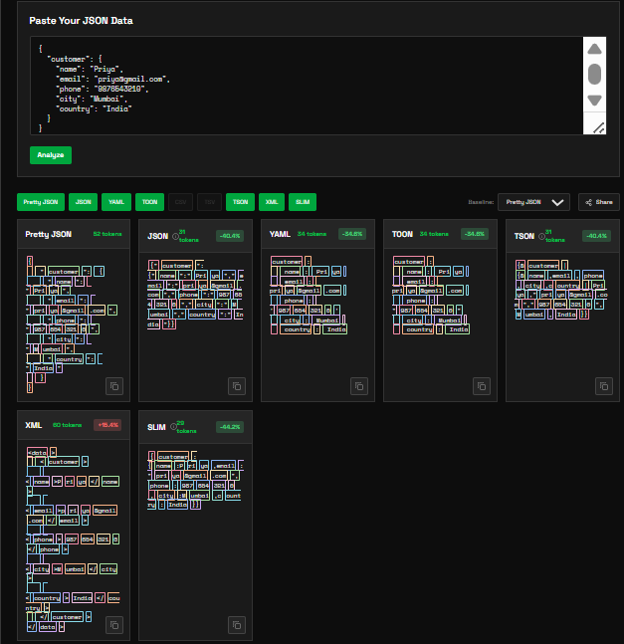
Source: Curiously Chase Tokenization Explorer
Write context externally. Not everything belongs inside the context window. Long-term user preferences, previous conversations, and application state can be stored outside the prompt and retrieved only when required.
Select relevant context. Instead of loading every available document, use semantic search or retrieval mechanisms to include only the information relevant to the user’s request.
Compress conversations. Long chat histories can be summarised while retaining key facts, allowing the model to continue the conversation without processing every previous message.
Isolate context. In multi-agent systems, each specialized agent should receive only the context necessary for its task. For example, a billing agent doesn’t need shipping information, while a technical support agent rarely requires payment history.
If you’re looking to build production-ready AI agents on AWS, understanding concepts such as Context Engineering, Amazon Bedrock Prompt Caching, AgentCore Memory, and multi-agent architectures is essential. These topics are explored in Building Advanced Agentic Systems on AWS training through hands-on labs and real-world implementation scenarios.
Reducing Latency with Amazon Bedrock Prompt Caching
Many enterprise AI applications repeatedly send the same information with every request. System prompts, company policies, tool definitions, and reference documents often remain unchanged while only the user’s query varies.
This repeated processing increases both latency and inference costs.
Amazon Bedrock Prompt Caching addresses this challenge by allowing supported foundation models to reuse previously processed prompt prefixes instead of processing identical content repeatedly. AWS also recommends following a Static-First prompt design, where static information, such as system instructions and tool definitions, appears before dynamic user input to maximize cache reuse.
Consider an HR assistant who answers employee questions throughout the day. The employee handbook and company policies remain constant, while only the employee’s question changes. By caching the static portion of the prompt, the application delivers faster responses while reducing the number of input tokens processed for every request.
Building AI Agents That Remember with Amazon Bedrock AgentCore Memory
While prompt caching improves efficiency for static information, AI agents also need to remember users across multiple interactions.
Amazon Bedrock AgentCore Memory enables developers to maintain both session-level and long-term memory for AI agents. Instead of sending entire conversation histories with every request, the service stores important events, user preferences, and accumulated knowledge, retrieving only the memories relevant to the current conversation.
Returning to our customer support example, imagine a customer contacts support several times over the course of a month. Rather than replaying every previous interaction, the agent retrieves only the customer’s recent orders, preferences, and unresolved issues. This creates a personalized experience while keeping the active context window lean and efficient.
The Future of AI Agents
As AI applications evolve from simple chatbots to autonomous agents, prompt engineering alone is no longer enough. Building reliable production systems requires thoughtful management of context to balance performance, cost, and response quality.
By combining good context engineering practices with capabilities such as Amazon Bedrock Prompt Caching and Amazon Bedrock AgentCore Memory, developers can build AI agents that are faster, more scalable, and better equipped for real-world enterprise workloads.
Upskill Your Teams with Enterprise-Ready Tech Training Programs
- Team-wide Customizable Programs
- Measurable Business Outcomes
About CloudThat


WRITTEN BY Priya Kanere
Priya Kanere is an AWS Subject Matter Expert and Champion AWS Authorized Instructor at CloudThat, specializing in cloud technologies, Python, data analytics, machine learning and generative AI. With extensive experience in training and mentoring, she has trained over 3,000 professionals to upskill in emerging technologies. Known for simplifying complex concepts through hands-on teaching and connecting theory with real-world applications, she brings deep technical knowledge and practical insights into every learning experience. Priya’s passion for empowering learners reflects in her unique approach to learning and development.


 PREV
PREV






Comments