

 Login
Login

 August 13, 2026
|
Voiced by Amazon Polly |
Introduction
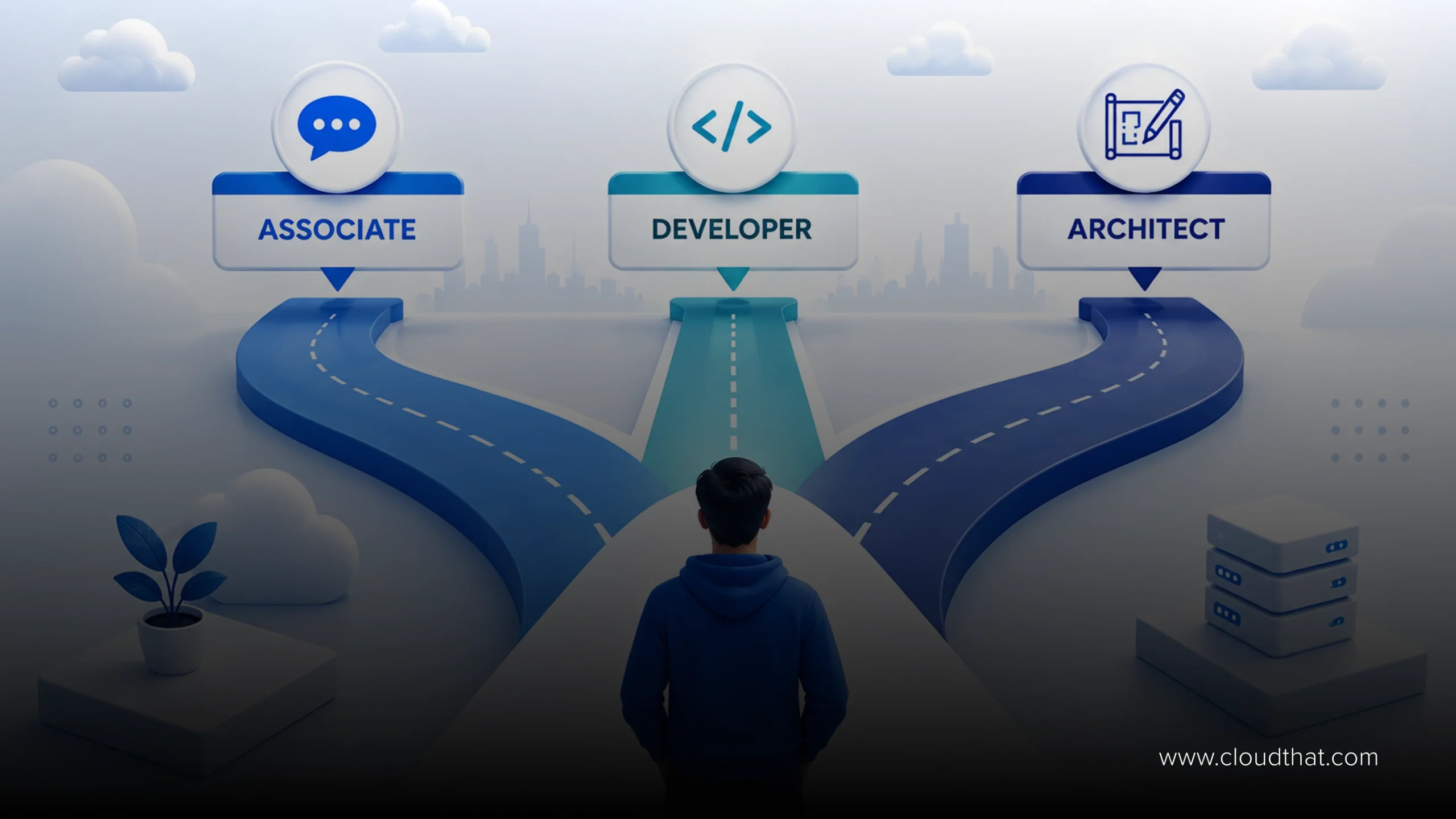
Quick Answer: Claude certification from Anthropic now comes in three roles, Associate, Developer, and Architect, with Architect split further into Foundations and Professional. Associate suits non-technical people who use Claude daily for work but don’t write code. Developer suits engineers building and shipping Claude powered apps and agents. Architect suits people designing the full production system, with Professional reserved for senior architects owning governance and scale. Every exam runs through Pearson VUE, takes 120 minutes, and needs a scaled score of 720 out of 1,000 to pass. Registration requires a partner email address from a Claude Partner Network organization, so this credential isn’t open to just anyone with a Gmail account.
So you finally decided you want to get Claude certified.
Good. Now comes the part nobody warns you about.
You open the certification page expecting one clean button that says “start here,” and instead you get four exam codes, two domains you’ve never heard of, and a small line at the bottom that quietly changes everything. More on that in a second.
I have watched this exact scene play out with three different people this month. Smart people. People who ship things for a living. All three opened the same page, all three closed the tab within ninety seconds, and all three came back to ask the same question.
“Which Claude certification do I even need?”
Fair question. Let’s actually answer it properly, instead of making you read four separate exam guides at 11 pm.
Master Claude AI for Next-Gen Applications
- Prompt Engineering
- Claude API
- Secure AI Development
What Claude Certification Actually Is Now
For over a year, Claude certification meant exactly one thing. One exam, Claude Certified Architect, built for people who design multi-agent systems for a living. If you were a marketer or a project manager who used Claude every single day, tough luck. There was no exam with your name on it.
That changed in July 2026.
Anthropic expanded the Claude certification program into four live credentials. Claude Certified Associate, Claude Certified Developer, and two tiers of Claude Certified Architect: Foundations and Professional. Suddenly the Claude certification conversation isn’t just for engineers anymore. It’s for anyone advising a client, building a workflow, or owning a Claude deployment end to end.
Here’s the part that actually matters for you. This isn’t a “pick the easy one” situation. Associate isn’t a watered-down starter cert. It tests different things entirely: business workflow design, responsible use, knowing when to hand something off to a Developer or Architect. Each Claude certification maps to a real job, not a difficulty ladder.
The One Detail That Changes Your Whole Plan
Before you get excited about which Claude certification course to start, sit down for this one.
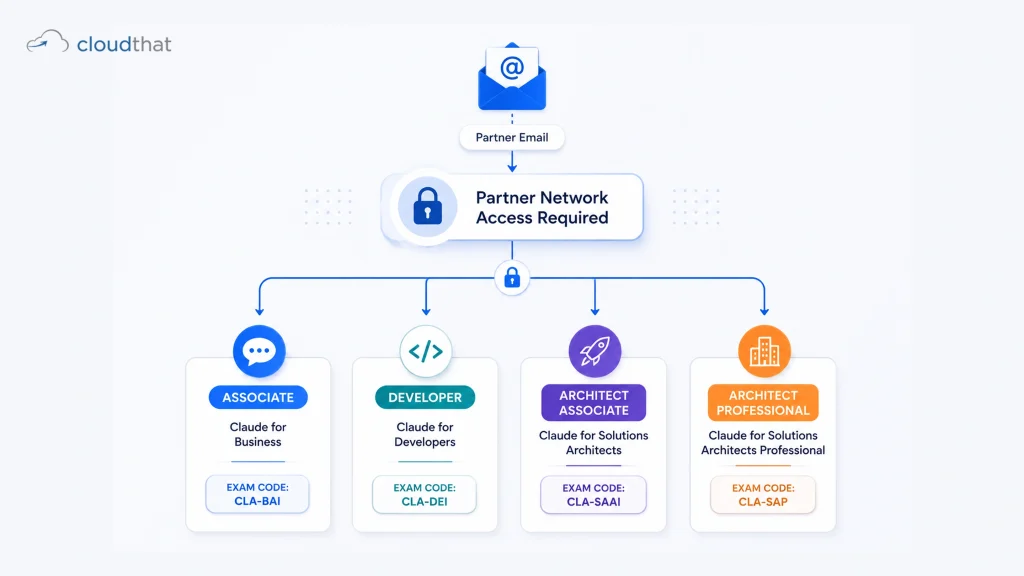
Every Claude certification exam is gated behind the Claude Partner Network. Registration needs a partner email address on a recognized company domain. Personal email doesn’t work. Anthropic runs the exams through Pearson VUE, and prep material lives on the Anthropic Partner Academy, also partner-locked.
Translation? You can’t just sit at home tonight, swipe a card, and become Claude certified by tomorrow. Your organization needs partner status first. If you’re an engineer at a company that already builds on Claude, ask whoever manages vendor relationships whether you’re inside the Claude Partner Network yet. If the answer is no, that conversation needs to happen before any exam booking does.
This is also exactly why teams increasingly lean on structured enterprise AI upskilling programs like CloudThat’s Integrated Program in AI & Data Science to build the underlying Claude, agentic AI, and applied GenAI skill set well before the partner conversation even happens, so the day access opens, the team walks in ready instead of starting from zero.
Claude Certified Associate, For The Non-Coders
Claude Certified Associate, exam code CCAO-F, is the one built for people who advise instead of build.
If your day involves prompting Claude for reports, running repeatable workflows inside Claude Projects, and knowing when to loop in a technical teammate, this is your lane. No code. No API. Anthropic’s own guide is specific about who this is for, operations, marketing, HR, project management, education, and consultants helping organizations adopt Claude.
The exam covers seven domains, weighted toward prompting technique, output evaluation, workflow design, and responsible use. It costs $99. It does not require you to work at a Claude Partner Network company for the credential to be meaningful on your resume, but registration still runs through the partner gate described above.
Here’s the twist people miss. Associate isn’t “Architect but easier.” It has heavy responsible use content that a hands-on developer usually skips studying entirely, because developers assume that section is obvious. It isn’t. People fail on it.
Claude Certified Developer, For The Builders
Claude Certified Developer, exam code CCDV-F, is where the code starts.
This one validates that you can build, integrate, and ship production-grade applications, tools, and agents using Claude. Eight domains, twenty five weighted sub skills, and it expects real hands on time. Anthropic recommends one to five years of software engineering experience, at least six months hands on with Claude or a comparable LLM, and working proficiency in Python or TypeScript.
If your week involves wiring up an MCP server, building custom tools, debugging an agent that keeps escalating when it shouldn’t, or working inside Claude Code, this is the Claude certification that actually reflects what you already do. It costs $125.
Most people prepping for CCDV-F start with the Developer Foundations course itself, since it’s built code first around the Claude API and Agent SDK rather than theory. And once you clear it, the natural next step up is Claude Certified Architect – Foundations, for anyone who wants to move from building the agent to designing the whole system around it.
Claude Certified Architect, For The People Who Own The Whole System
This is where it gets interesting, because Architect splits into two very different animals.
Architect Foundations (CCAR-F) tests design and build judgment. Sixty questions, scenario based, drawn from six real world situations where four get randomly selected onto your exam. It’s the original Claude certification, the one with the deepest question bank, and it’s open to anyone in the Claude Partner Network with roughly six months of hands on Claude experience. It costs $125.
Architect Professional (CCAR-P) is the senior track. Same architecture and integration core as Foundations, but it adds governance and risk, stakeholder communication and lifecycle, and developer enablement, three domains that don’t even appear on the Foundations blueprint. Together they make up 35 percent of the exam. This one is aimed at people with three or more years in systems architecture and at least six months of Claude in production. It costs $175.
Nobody makes you pass Foundations before attempting Professional. There’s no hard prerequisite chain. But most people who’ve sat both will tell you Foundations content works as a natural on ramp anyway.
Associate vs Developer vs Architect, Side by Side
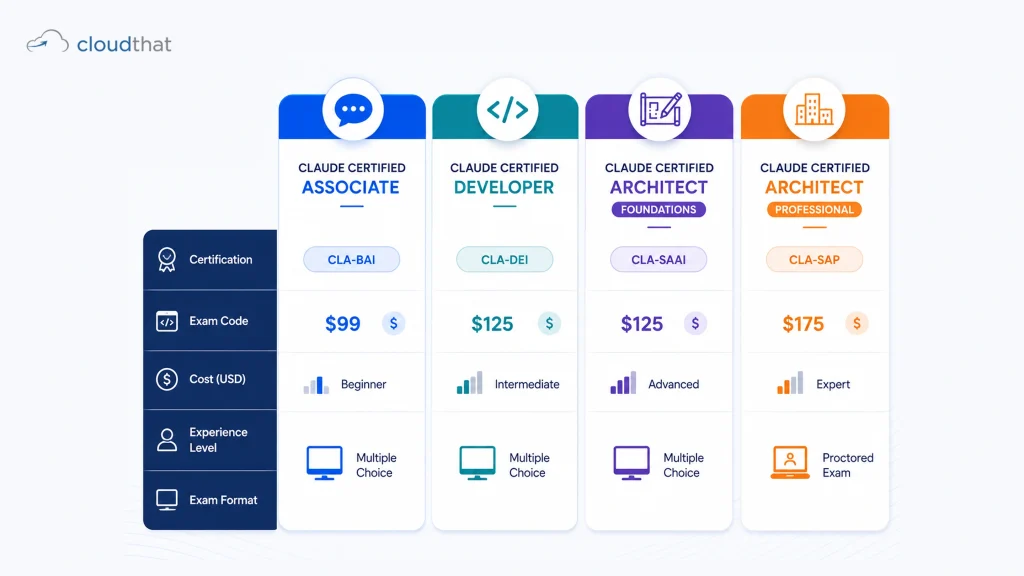
| Associate | Developer | Architect Foundations | Architect Professional | |
| Exam Code | CCAO-F | CCDV-F | CCAR-F | CCAR-P |
| Built For | Non technical, client facing roles | Engineers shipping Claude apps | Solution architects | Senior architects, enterprise scale |
| Coding Required | No | Yes | Yes | Yes |
| Recommended Experience | None mandatory | 1 to 5 years software engineering | 6+ months hands on Claude | 3+ years systems architecture |
| Cost | $99 | $125 | $125 | $175 |
| Format | 120 min, 720/1000 to pass | 120 min, 720/1000 to pass | 120 min, scenario based | 120 min, governance heavy |
Picking Your Claude Certification Course Without Wasting a Weekend
Stop trying to be strategic about this. Just answer one question honestly.
Do you write code that calls an API, or do you not?
If not, Associate is your Claude certification course. Full stop. Don’t let anyone talk you into Architect because it “sounds more impressive.” It’ll test things you’ve never touched, and you’ll fail on content that has nothing to do with your actual job.
If you build and ship, but you’re not the one drawing the system diagram for the whole org, Developer fits. If you’re the person who gets pulled into the room when something breaks at 2am and someone asks “wait, who actually designed this,” that’s Architect. Foundations if you’re newer to that seat, Professional if you’ve been sitting in it for years already.
One more thing nobody says out loud. You genuinely don’t need all four. Pick the one that matches where you sit today, not where you hope to sit in three years. You can always add the next tier later.
Teams going through this decision at scale, not just one engineer but a whole cohort, tend to skip the guesswork entirely and run it through structured skill mapping first. That’s essentially what CloudThat’s Capability Development Framework does for cloud and AI roles generally, a pre assessment that tells you exactly who belongs in which lane before anyone books an exam.
What This Actually Costs You, In Time and Money
Money first, because it’s the easy part. $99 for Associate, $125 for Developer, $125 for Architect Foundations, $175 for Architect Professional. Every retake costs full price. On time annual renewal is free.
Time is where people underestimate badly. Developers with existing Claude experience usually need 15 to 20 hours of focused study for Architect Foundations. If you’re newer to Claude entirely, budget 30 to 40 hours, closer to a full work week spread across evenings.
And here’s the quiet cost nobody puts in a blog post. The hours your team spends prepping for a Claude certification are hours they’re not shipping. That’s not a reason to skip it. It’s a reason to prepare properly the first time instead of retaking an exam because nobody built a study plan.
Why CloudThat Is the Best Choice for Building Claude-Ready Teams
If your team is eyeing a Claude certification, the exam is the easy part to talk about, the actual skill-building before it is where most companies quietly fall behind, and that is exactly where CloudThat operates. CloudThat has spent 14+ years turning employees into billable, production-ready technical talent for 850+ corporates, and the same rigor now applies to agentic AI and Claude-adjacent GenAI work through CloudThat’s GenAI Innovation Center. Teams don’t need to guess their way through MCP servers, tool design, or agent architecture before an exam, they need a partner who’s already run this playbook for AWS Bedrock and Azure AI at enterprise scale.
CloudThat’s Capability Development Framework runs a pre-training skill assessment on every cohort, builds a custom learning pathway per role, and validates project readiness through hands-on labs, so by the time a team member sits an Architect or Developer level exam, the underlying skill is already battle-tested, not freshly memorized. For organizations still working out their Claude Partner Network access, CloudThat’s Integrated Program in AI & Data Science closes the applied AI skills gap in parallel, so no one is left waiting on partner approval to start building. And for cohorts who need to prove they can actually ship, not just pass a multiple-choice test, Experiential Learning simulations put engineers through real production-pattern scenarios before they walk into any certification room.
The numbers back it up. Over 1.1 million professionals trained, 750+ projects delivered, and a training model built on 50 to 60 percent hands-on labs instead of slide decks. CloudThat doesn’t just prep people to pass an exam, it prepares them to be the engineer everyone trusts the moment something breaks in production, which is the entire point of getting Claude certified in the first place.
Conclusion
Claude certification isn’t one exam anymore, it’s a role based system, and picking the wrong one wastes weeks you don’t have. Match the exam to what you actually do today, confirm your Claude Partner Network access before you get attached to a study plan, and build the underlying skills through real hands on practice, not just exam cramming.
Ready to build the skills before you book the exam? Explore CloudThat’s corporate training programs or check the training calendar for upcoming AI and GenAI cohorts.
Key Takeaways
- Claude certification now has four exams across three roles, Associate, Developer, and Architect, with Architect split into Foundations and Professional.
- Every Claude certification exam requires a partner email from a Claude Partner Network organization to register.
- Associate needs zero coding experience and targets client-facing, non-technical roles.
- Developer expects one to five years of software engineering experience plus Python or TypeScript proficiency.
- Architect Foundations suits solution designers with roughly six months of hands-on Claude experience.
- Architect Professional targets senior architects with 3+ years of experience in systems architecture.
- All four exams are administered through Pearson VUE and last 120 minutes, with a passing score of 720 out of 1,000.
- Costs range from $99 for Associate to $175 for Architect Professional.
- Study time ranges from 15 to 40 hours, depending on prior experience with Claude.
- Choosing the wrong Claude certification course wastes both money and weeks of prep time, so match the exam to your actual job first.
Explore CloudThat’s Job Ready Cloud Operations Engineer Program or the Cloud and DevOps Expert Program to build the practical engineering foundation that carries into any Claude certification path.
Advance Your AI Career with Claude AI
- Enterprise AI Skills
- Claude API
- AI Assistants
About CloudThat
FAQs
1. Which Claude certification should I get first?
ANS: – Match it to your actual role. Non-technical, client-facing work fits Associate. Engineers shipping Claude apps fit Developer. Solution owners fit Architect Foundations, senior architects fit Professional.
2. Is Claude Certified Architect hard?
ANS: – It’s scenario based with six possible real-world situations, four selected per exam. It’s manageable with 15 to 40 hours of prep depending on your existing Claude experience.
3. Do I need to be a developer to get Claude certified?
ANS: – No. Associate exists specifically for non-technical roles like marketing, HR, operations, and consulting.
4. Can individuals take Claude certification without a company?
ANS: – Not currently. Registration requires a partner email address from a Claude Partner Network organization, personal emails aren’t accepted.
5. How much does a Claude certification course or exam cost?
ANS: – $99 for Associate, $125 for Developer, $125 for Architect Foundations, and $175 for Architect Professional, per Anthropic’s official pricing.
6. What's the difference between Architect Foundations and Professional?
ANS: – Foundations tests core design and build judgment. Professional adds governance, stakeholder communication, and lifecycle ownership, aimed at senior architects running deployments at scale.
7. Does Claude certification expire?
ANS: – Yes, it renews annually. On-time renewal is free, but a lapsed credential means retaking the full exam at full price.

WRITTEN BY Himisha Raval
Himisha Raval is a Digital Marketing Manager at CloudThat with a strong command of search engine optimization, web analytics, link building, and content strategy. She brings a data-driven approach to digital marketing, helping IT companies strengthen their online presence, improve search rankings, and generate consistent leads across channels. Beyond execution, she plays an active role in ideation, campaign strategy, and website performance optimization. Outside of work, she balances her analytical side with a love for travel, nature painting, and dancing.


 PREV
PREV












Comments