

 Login
Login


 August 13, 2026
|
Voiced by Amazon Polly |
Introduction
A team lead opens a project tracker on a Monday morning and finds three tasks already drafted, summarized, and half-solved. Nobody stayed late. Nobody pulled an all-nighter. Someone on the team had simply learned how to use Claude properly, and that one skill changed what a normal Monday looked like.
This is exactly why Anthropic Claude training has stopped being a “nice to have” and turned into something enterprises actively chase. Not because AI is trendy. Because the teams that know how to work with Claude are quietly outpacing the teams that don’t.
So here’s the real question. What does Anthropic Claude training actually teach, who needs it, and how do you pick the right path for your team? Let’s get into it.
Master Claude AI for Next-Gen Applications
- Prompt Engineering
- Claude API
- Secure AI Development
What Is Anthropic Claude Training and Why Does It Matter Right Now?
Anthropic Claude training is structured learning built around Claude, the AI model family developed by Anthropic. It covers everything from writing better prompts to building full agentic workflows with the Claude API and Agent SDK.
Here’s the part most people miss. Claude isn’t just a chatbot sitting in a browser tab. It can read documents, call tools, write code, manage structured data and even run multi step tasks on its own. Untrained teams use maybe ten percent of that.
Enterprises that invest in a proper Claude AI course see a very different picture. Their teams stop treating Claude like a search bar and start treating it like a colleague who never gets tired of the boring parts of a job.
Why Are Enterprises Rushing Toward Anthropic Claude Training?
Three things are happening at once, and none of them are slowing down.
The tools got smarter. Claude’s agentic capabilities now handle multi step reasoning, tool calling and long running tasks, which means the old “type a question, get an answer” mental model is already outdated. The competition got faster. Teams fluent in Claude are shipping features, reports and campaigns in a fraction of the time it used to take. The risk got real. Untrained employees using AI without guardrails can leak sensitive data or ship broken outputs, and that’s a cost no enterprise wants to explain to leadership.
This is exactly why Anthropic Claude training has moved from an IT wishlist item to a boardroom conversation. Leaders aren’t asking if they should train employees on Claude anymore. They’re asking how fast they can do it, and many start by scoping a rollout through CloudThat’s corporate training programs.
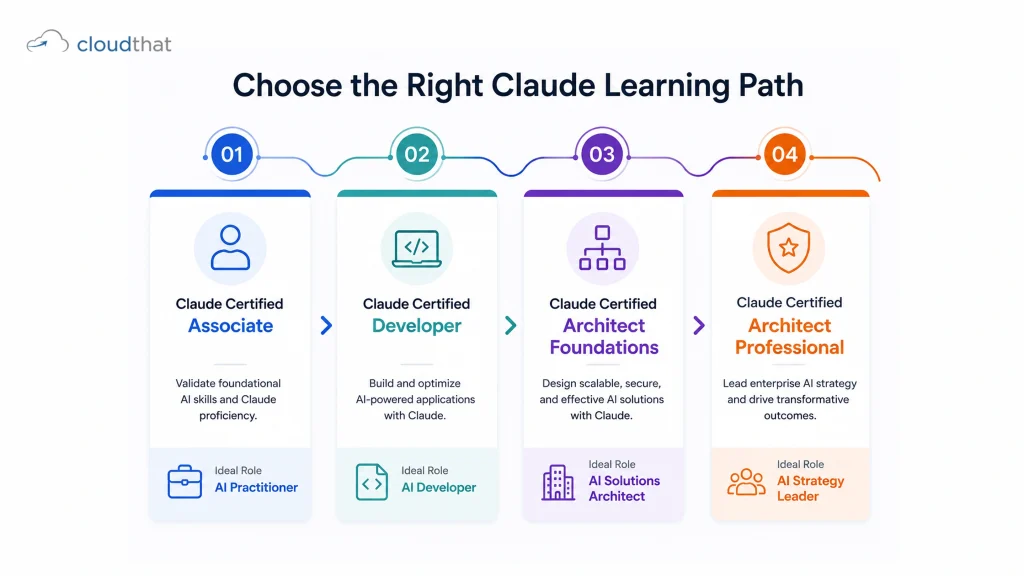
Choose the Right Claude Learning Path
What Skills Does a Claude AI Course Actually Build?
A good Claude AI course doesn’t just show people how to type prompts. It builds a real, transferable skill set that holds up under production pressure.
Prompt engineering, so instructions are clear enough that Claude gets it right the first time. Tool use and function calling, so Claude can pull live data, run calculations or trigger workflows instead of just talking about them. Structured output handling, so Claude’s responses plug directly into existing systems without messy cleanup. Agent SDK fundamentals, so teams can build agents that observe, think and act with minimal supervision. Responsible AI practices, so nobody accidentally exposes confidential data while chasing a quick win.
Every one of these skills is taught, step by step, inside the Claude Certified Developer Foundations course, which is built for engineers who want to move past casual use and into real application building. Teams building a broader AI foundation alongside Claude can also pair this with CloudThat’s wider AI and Machine Learning training tracks.
What Learning Paths Should Enterprises Actually Follow?
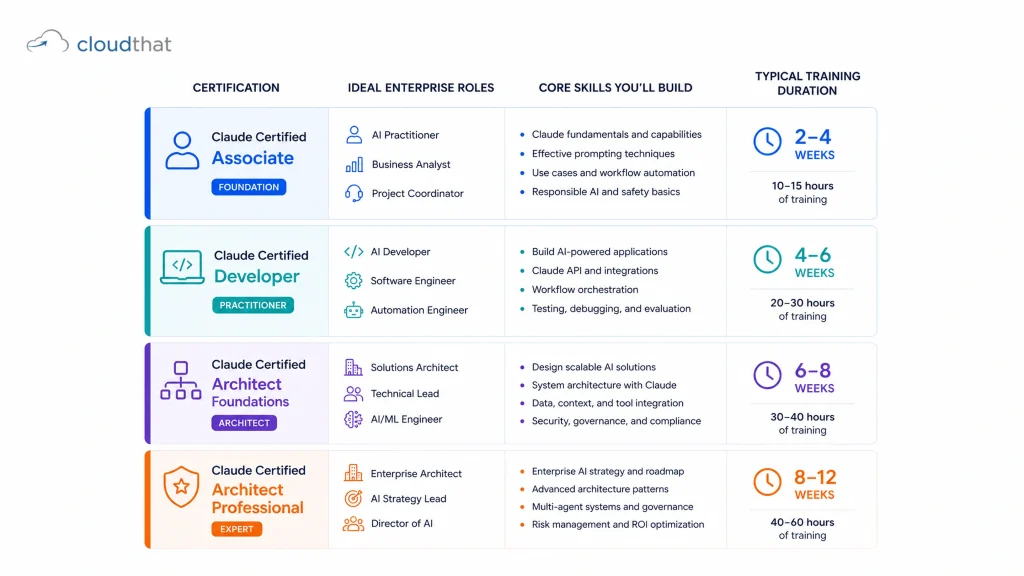
Not every employee needs the same depth of Anthropic Claude training. A support executive and a solutions architect are not solving the same problem, so their learning paths shouldn’t look identical either.
| Role | Recommended Path | Core Focus | Typical Duration |
| Business users, analysts | Claude Certified Associate – Foundations | Everyday Claude use, safe prompting, basic workflows | 1 day |
| Software developers | Claude Certified Developer – Foundations | Claude API, tool use, Agent SDK basics | 2 days |
| Solution architects | Claude Certified Architect – Foundations | Production design, scaling, governance | 3 days |
| Senior architects, tech leads | Claude Certified Architect – Professional | Advanced architecture, enterprise deployment | Multi day, expert level |
This is the part enterprises often get wrong. They enroll everyone in the same generic Claude AI course and wonder why adoption stays flat. The smarter move is matching the path to the role, then letting people grow into deeper certifications as their use of Claude matures.
For teams unsure where to start, CloudThat’s Claude Courses hub lays out every track side by side, so choosing the right one takes minutes, not weeks.
What Are the Real Use Cases Once Training Is Done?
This is where the story actually gets interesting, because trained teams stop asking “can Claude do this” and start building things nobody expected.
Customer support teams use Claude to draft responses, summarize tickets and flag urgent issues before a human even opens the queue. Engineering teams use the Claude API and Agent SDK to automate code review, generate test cases and chain tools together for multi step tasks. Data teams use Claude to clean messy datasets, generate structured JSON output and validate results without manual rechecking. Leadership teams use Claude to summarize reports, compare scenarios and prep for high stakes meetings in minutes instead of hours.
None of this happens by accident. It happens because someone on the team completed real Anthropic Claude training, often starting from the Claude Certified Associate Foundations course, and knew exactly how to point Claude at the problem.
How Does Claude AI Course Training Compare Across Skill Levels?
A common question enterprises ask is whether one course is “enough.” It rarely is, and here’s why.
An Associate level Claude AI course teaches safe, effective daily use. It’s perfect for non technical staff who need Claude to draft emails, summarize documents or answer quick questions accurately.
A Developer or Architect level course goes much deeper. It covers the Claude API, structured output enforcement, agentic workflows and production level deployment, which matters when Claude becomes part of an actual product or internal system rather than just a personal assistant. Teams weighing which track fits can compare options directly on CloudThat’s Claude training catalog.
The honest advice? Start broad with foundational Anthropic Claude training across the company, then let technical teams go deeper through developer and architect tracks as real projects demand it.
Why CloudThat Is the Enterprise Standard for Anthropic Claude Training
If your enterprise is serious about Anthropic Claude training, CloudThat is the partner built for exactly this moment. While generic AI workshops skim the surface, CloudThat runs certified, role mapped Claude training aligned directly to Anthropic’s official certification pathway, so every hour spent training turns into a credential, a skill and a working deployment, not just a slide deck.
This isn’t one generic workshop stretched across every role. Engineering teams get hands on with the Claude Certified Developer Foundations course to build structured output pipelines, tool use integrations and agentic features using the Claude API and Agent SDK. Architects and tech leads go deeper with the Claude Certified Architect Foundations and Claude Certified Architect Professional tracks to design governed, production scale Claude deployments across departments. Business teams and new hires start with the Claude Certified Associate Foundations course to build safe, confident daily habits with Claude from day one, and enterprises rolling this out company wide can scope full cohorts through CloudThat’s corporate training programs.
The proof is in how far the training goes. Labs run at roughly 75 percent hands on, every course maps directly to Anthropic’s official exam blueprint, and learners walk away with both a certification and a working project. CloudThat also backs this up beyond the classroom through the GenAI Innovation Center, structured GenAI solution frameworks, and deep generative AI expertise, so Claude training turns into deployed, working systems instead of a one time workshop.
Final Thoughts
Here’s the honest truth. Claude is only as good as the person prompting it, and that gap between a mediocre result and a genuinely impressive one usually comes down to training, not talent.
Enterprises that treat Anthropic Claude training as a checkbox get checkbox results. Enterprises that treat it as a real capability investment get teams who build things competitors are still trying to figure out.
If your team is still using Claude the way most people used search engines in 2010, typing questions and hoping, it might be time to change that. A structured Claude AI course, matched to the right role and the right depth, tends to do more for productivity than another tool subscription ever will.
Explore CloudThat’s full Claude training catalog, check the upcoming training calendar, or reach out through Hire From Us if you’re building a Claude ready team from scratch.
Key Takeaways
- Anthropic Claude training equips enterprise teams with practical skills that go far beyond basic prompting, including API integration, tool use, structured outputs, and agentic workflows.
- Role-based learning paths deliver better adoption than one-size-fits-all AI training, with separate tracks for business users, developers, architects, and technical leaders.
- Well-trained teams use Claude to automate customer support, software development, data analysis, and executive decision-making, driving measurable productivity gains.
- Enterprise AI success depends on responsible AI practices, governance, and structured training to reduce security risks and ensure reliable outputs.
- Building foundational Claude skills across the organization, then advancing technical teams into specialized certifications, creates a scalable long-term AI adoption strategy.
- CloudThat offers Anthropic-aligned, certification-based Claude training with hands-on labs, enterprise-focused learning paths, and practical deployment experience.
Advance Your AI Career with Claude AI
- Enterprise AI Skills
- Claude API
- AI Assistants
About CloudThat
FAQs
1. What is Anthropic Claude training?
ANS: – It’s structured training built around Claude, Anthropic’s AI model family, covering everything from safe daily use to building production applications with the Claude API and Agent SDK.
2. Who should take a Claude AI course?
ANS: – Anyone working with Claude regularly. Business users benefit from Associate level training, while developers and architects need Developer and Architect level Anthropic Claude training to build and deploy real systems.
3. How long does Claude certification training take?
ANS: – It depends on the track. Associate level training runs about a day, Developer training runs around two days, and Architect tracks can run three days or more depending on depth.
4. Does Anthropic Claude training include hands on labs?
ANS: – Yes. Programs like CloudThat’s Claude Certified Developer Foundations course are built around build along labs covering the Claude API, tool use, structured output and the Agent SDK.
5. Is coding experience required for Claude AI course enrollment?
ANS: – Only for the Developer and Architect tracks. Associate level Anthropic Claude training is designed for non technical business users with no coding background.
6. What's the difference between Claude Developer and Architect certifications?
ANS: – Developer certification focuses on building with the Claude API and SDK. Architect certification focuses on designing and governing Claude deployments at scale across an organization.
7. Can enterprises train entire teams together?
ANS: – Yes. CloudThat runs corporate training batches so entire departments can go through Anthropic Claude training together, with paths customized by role. Learn more via CloudThat’s corporate training programs.
8. Why should enterprises choose CloudThat for Claude AI course training?
ANS: – CloudThat pairs certified Claude trainers with real production experience, hands on labs mapped to Anthropic’s official exam blueprint, and post training support that carries learning into actual deployed systems.

WRITTEN BY Himisha Raval
Himisha Raval is a Digital Marketing Manager at CloudThat with a strong command of search engine optimization, web analytics, link building, and content strategy. She brings a data-driven approach to digital marketing, helping IT companies strengthen their online presence, improve search rankings, and generate consistent leads across channels. Beyond execution, she plays an active role in ideation, campaign strategy, and website performance optimization. Outside of work, she balances her analytical side with a love for travel, nature painting, and dancing.


 PREV
PREV












Comments