

 Login
Login


 July 29, 2026
|
Voiced by Amazon Polly |
Introduction
The AZ-204 (Azure Developer Associate) certification proves you can build cloud-native applications on Azure. The exam covers five major domains: develop Azure compute solutions (25-30%), develop for Azure storage (10-15%), implement Azure security (15-20%), monitor, troubleshoot, and optimize Azure solutions (10-15%), and connect to Azure services (15-20%).
You need hands-on experience deploying applications, managing data, integrating services, and troubleshooting production problems. The certification is language-agnostic but expects fluency with REST APIs, authentication patterns, microservices architecture, and cloud-native design.
Most developers prepare for 8 to 12 weeks while working. The real difference comes from building actual projects, not just watching tutorials.
Access to Unlimited* Azure Trainings at the cost of 2 with Azure Mastery Pass
- Microsoft Certified Instructor
- Hands-on Labs
- EMI starting @ INR 4999*
Understanding the AZ-204 Exam Structure
The AZ-204 is a 120-minute exam with 40 to 60 questions. You pass with 700 out of 1,000 points. The scoring scale matters. You don’t need to ace every question. You need to demonstrate competency across the five domains. Miss several on one topic, as long as you’re solid on others, you’re fine.
The exam format is mostly scenario-based. “Your application is deployed to App Service. It’s experiencing memory leaks. Design a solution.” You’re not identifying definitions. You’re making architectural decisions like a developer would. That’s harder to fake with pure memorization.
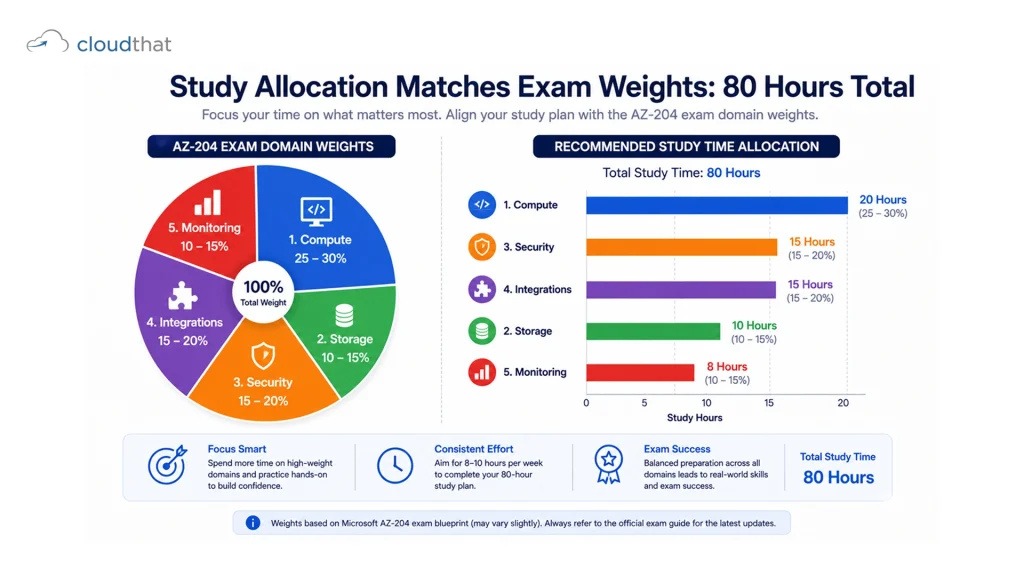
The five domains are weighted based on operational reality. Compute accounts for 25-30% because applications run on it. Storage accounts for 10-15% because data management is fundamental, but Azure abstracts away the complexity. Security gets 15-20% because authentication and authorization are everywhere. Integrations get 15-20% because modern applications are never monolithic. Monitoring gets 10-15% because you need visibility into production.
Here’s the strategic insight: if you have 80 hours to prepare, don’t split equally across domains. Spend 20 hours on compute. Spend 15 hours on security and integrations. Spend 10 hours on storage. Spend 8 hours on monitoring. The heavier domains deserve more study time.
Most developers underestimate preparation time. You might think “I’ve built web apps, so Azure App Service will be obvious.” Then you hit the exam and encounter questions about scaling, deployment slots, and resource configuration that expose gaps. Budget 8 to 12 weeks. Treat it seriously.
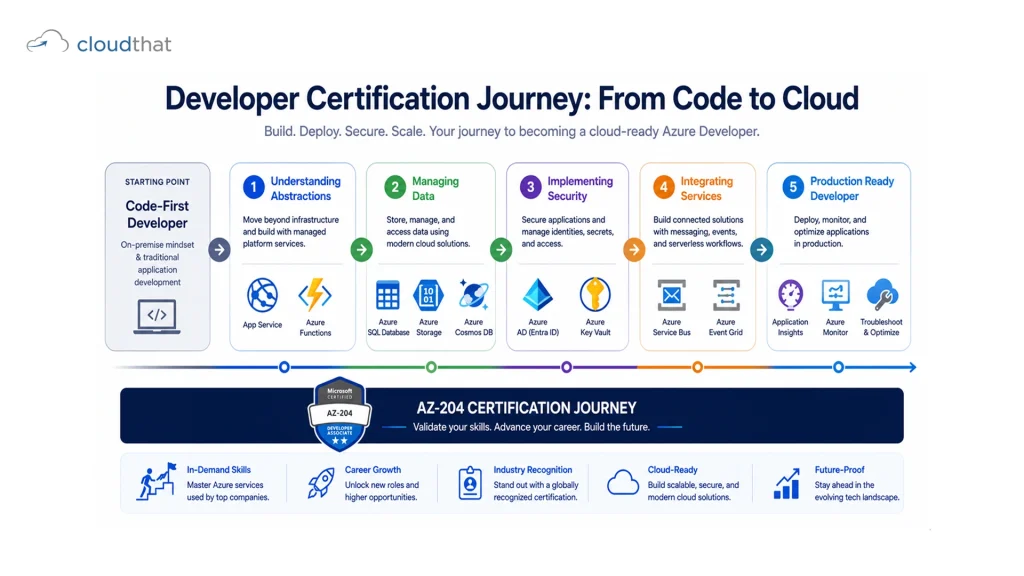
The Developer Mindset Shift Required
This is the moment most developers struggle.
You’ve spent years building monolithic applications. You own every layer. You control the database. You manage deployments. You debug production issues by logging into servers. That mindset doesn’t work on Azure.
Azure is fundamentally about abstraction. You don’t manage servers. Azure does. You don’t configure databases manually. Azure provides managed databases that you can configure via APIs. You don’t handle authentication. Azure AD does. You don’t build your own message queues. Azure Service Bus does.
This shift feels like losing control. It actually feels like freedom once you accept it.
Consider authentication. Traditionally, you built login forms, hashed passwords, managed sessions. That’s complex. Azure AD integration means you offload all of that. Your application sends users to Azure AD. Azure handles authentication. Your app receives a token proving the user is who they claim. You validate the token and proceed. One hour of work instead of days.
The AZ-204 tests whether you understand this abstraction mindset. Questions ask: “Your application needs to scale to 1 million users. Design the solution.” You can’t say “I’ll buy more servers.” That’s traditional thinking. You say “I’ll use App Service with auto-scaling based on CPU/memory metrics.” That’s cloud thinking.
The certificate rewards developers who think differently. You’re not building for one deployment. You’re building for scale, automation, and managed services. The exam tests that you’ve internalized this shift.
Azure Compute Solutions: Running Your Code in the Cloud
Every application needs somewhere to run.
Azure offers multiple compute options. Each serves different scenarios. The AZ-204 expects you to make the correct choice.
App Service
App Service is the obvious starting point. Upload code. Azure runs it. You configure the runtime stack (Node, Python, .NET), resource tier, and scaling rules. Done. App Service handles operating system patching, framework updates, and scaling. You focus on code. This is where most web applications and APIs live. The exam emphasizes App Service heavily because it’s the most common deployment target.
Azure Functions
But App Service isn’t right for everything. Functions are better for short-lived tasks triggered by events. Your application doesn’t need a constantly running server. A function runs when needed, scales to zero when idle, and you pay only for execution time. A developer learning Azure for the first time often misses this insight. Functions are cheaper for sporadic workloads. The exam tests whether you know when to use them.
Containers and Kubernetes
Container Instances are useful for containerized applications that don’t need orchestration overhead. You have a Docker image. Container Instances run it. Simpler than Kubernetes but less powerful than AKS (Azure Kubernetes Service). Most developers preparing for AZ-204 focus on App Service and Functions, which is appropriate given the exam’s weight. Container Instances appears less frequently.
Virtual Machines are the fallback. Full control. You manage the operating system, patches, scaling. It’s powerful and complex. Developers often start here because it’s familiar. The AZ-204 teaches you to consider managed alternatives first. VMs are Plan B, not Plan A.
The mindset shift: start with the most abstracted service that fits your needs. App Service first. Functions if you need event-driven compute. Containers if you need portability. VMs if you need full control. That hierarchy defines how developers should think about compute.
Azure Storage: Where Your Data Lives
Data is the lifeblood of applications.
Azure Storage offers multiple options optimized for different access patterns. The AZ-204 expects developers to choose based on actual requirements, not just familiarity.
Blob Storage and Unstructured Data
Blob Storage is for unstructured data. Files, images, videos, logs, backups. You organize data in containers. Access patterns matter. Hot tier for frequently accessed data. Cool tier for infrequent access. Archive tier for compliance backups is rarely touched. Developers often don’t think about storage tiers. The exam teaches you to optimize. Archive storage costs 90% less than Hot. If your backup hasn’t been accessed in months, Archive is the answer.
NoSQL and Relational Options
Table Storage is NoSQL for semi-structured data. Developers used to relational databases often dismiss NoSQL. But for applications handling millions of events or user activity logs, Table Storage shines. No schema enforcement. Linear scaling. Query flexibility. The exam tests whether you recognize scenarios where NoSQL fits better than relational databases.
SQL Database and PostgreSQL are managed relational options. Developers are usually comfortable with SQL. The AZ-204 teaches you to recognize when you’re using managed databases versus traditional setups. You configure connections, backups, and scaling through Azure, not manually. That shift in responsibility is tested.
Cosmos DB is the exotic option. Multi-region, globally distributed, designed for massive scale. Most applications don’t need it. But when they do, Cosmos DB is the answer. The exam includes scenarios where Cosmos DB is the correct choice. Developers preparing for AZ-204 often overlook it because it seems advanced. It’s simpler than you think and tested enough to matter.
Asynchronous Communication
Queue Storage enables asynchronous communication. Your application receives a request. Instead of processing immediately (synchronously), you queue the work and respond later. A background job processes the queue. This pattern is crucial for scalable applications. Long-running operations don’t block user requests. The exam expects you to strategically design systems using queues.
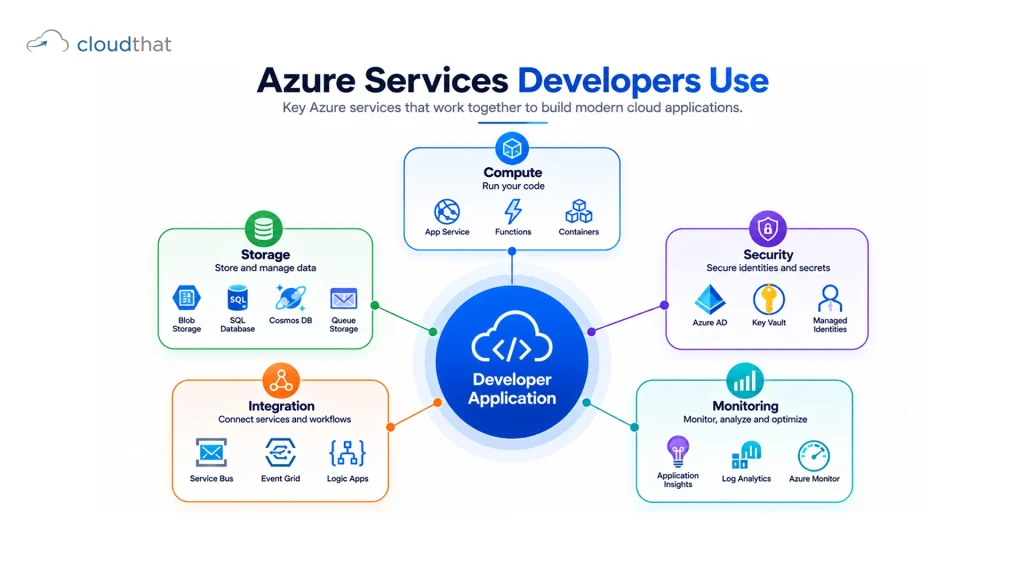
Security and Authentication: Why This Matters More Than You Think
Security isn’t an afterthought on Azure. It’s woven throughout. The AZ-204 exam dedicates 15-20% to security because compromised applications can destroy organizations. The certification ensures you think about security from the start.
For developers seeking to deepen their security understanding, Microsoft Security Certifications offer specialized credential paths beyond AZ-204.
Azure AD and Identity Management
Azure AD (Microsoft Entra ID) is the foundation. Every Azure service integrates with it. Your application can’t bypass authentication. You’re forced to build secure patterns. The exam tests whether you understand managed identities (services authenticating to other services), service principals (applications with their own credentials), and role-based access control (who can do what).
Managed identities are the “aha” moment. Traditionally, you stored database connection strings in configuration. Encrypted, but still a liability. Managed identities eliminate that. Your application has an identity in Azure AD. It authenticates automatically. No credentials to store. No secrets to rotate. That’s a completely different security model. The exam tests whether you can recognize scenarios where managed identities elegantly solve security problems.
Secrets and Certificates
Key Vault is where you store secrets safely. API keys, certificates, database passwords. Your application retrieves them at runtime without hardcoding. Secrets rotate. Access is audited. This pattern is essential for production applications. The AZ-204 tests whether you know how to use Key Vault for sensitive data instead of embedding secrets in code.
SSL/TLS certificates secure communication. Application Gateway and App Service automatically support custom domains with HTTPS. The exam includes scenarios where you configure HTTPS, manage certificates, and enforce secure protocols. Developers sometimes overlook this because it’s infrastructure-focused. It’s actually crucial for application security.
The mindset: security is built-in on Azure, not added on. You can’t deploy anything without configuring access. You can’t pass an exam without understanding these patterns.
Integrating Azure Services: Connecting the Dots
Modern applications are never isolated.
Your application needs to send emails (Communication Services). Process payments (Payment Gateway). Trigger notifications (Service Bus). Store files (Blob Storage). Query data (Azure Search). These integrations are complex in traditional environments. Azure abstracts the complexity.
Asynchronous Messaging
Service Bus is the messaging backbone. Your application sends a message. Service Bus queues it. A subscriber receives and processes it. This decoupling allows independent scaling. Your application can send messages at peak traffic rates. Subscribers catch up when they can. The exam tests whether you design asynchronous systems using Service Bus strategically.
Event Grid is for event-driven architectures. When something happens (a file is uploaded, a database is changed), Event Grid notifies subscribers instantly. You build reactive systems without polling. Developers trained on traditional patterns often don’t think in an event-driven way. The AZ-204 teaches you to recognize scenarios where Event Grid fits.
AI and Cognitive Capabilities
Azure’s AI & ML capabilities through Cognitive Services provide intelligent features without ML expertise. Computer Vision for image analysis. Text Analytics for sentiment detection. Language Understanding for conversational AI. These are plug-and-play. You don’t build machine learning models. You call APIs. The exam includes scenarios where Cognitive Services solve problems elegantly.
Low-Code Automation
Logic Apps enable workflow automation without code. A file arrives in Blob Storage. Logic Apps triggers an approval workflow. The manager approves. File processes. No custom code needed. Developers sometimes dismiss Low-Code solutions. The AZ-204 tests whether you know when Low-Code is the right answer.
The skill: integrating services confidently. Knowing which service solves which problem. Designing systems where services communicate efficiently.
Monitoring and Troubleshooting: Production Reality
Code works locally. It breaks in production.
The AZ-204 includes 10-15% monitoring content because production visibility is non-negotiable. You deploy applications to Azure. Things go wrong. You need to understand what happened. For teams managing large-scale production systems, DevOps and DevSecOps Services can complement your developer certification with operational expertise.
Application Insights
Application Insights tracks application performance, exceptions, and user behavior. Developers often skip this during development. The exam expects you to understand when to instrument applications and what metrics matter. Response time, error rates, dependency performance. That visibility prevents firefighting in production.
Log Analytics and Queries
Log Analytics is where you query logs and metrics. Your application logs events. You query them later. “How many requests failed yesterday?” “Which dependency is slow?” Developers trained on console debugging need to relearn investigation techniques for distributed systems.
Azure Monitor provides dashboards and alerts. Configure alerts for anomalies. When CPU spikes unexpectedly, you’re notified. You can respond before users complain. The exam tests whether you design monitoring proactively rather than reactively.
End-to-End Tracing
Application Performance Monitoring (APM) tracks requests end-to-end. A user request flows through multiple services. APM traces the entire journey. Where does time get spent? Which service is the bottleneck? That visibility is invaluable for optimization. The AZ-204 expects developers to understand the benefits of APM.
The realization: production systems need monitoring from day one. The developers who thrive on Azure are those who instrument applications, monitor continuously, and troubleshoot systematically.
Real Projects That Build the Skills the Exam Tests
Theory teaches concepts. Projects embed them deeply.
The best preparation combines study with building. Here are projects that align with exam domains.
Project 1: Build a Microservice API
Create an API using App Service. Use Azure SQL Database for data. Implement authentication with Azure AD. Add blob storage for file uploads. This single project touches compute, storage, security, and integrations.
Project 2: Implement Asynchronous Processing
Build an application that receives requests, queues work items to Service Bus, and processes them asynchronously. Add different processors for different message types. Implement dead-letter handling for failures. This teaches asynchronous architecture deeply.
Project 3: Build a Multi-Tenant Application
Different customers, separate data, shared infrastructure. Use Application Insights to monitor per-tenant performance. Implement tenant isolation using Azure AD. Handle backup and recovery per tenant. This mirrors real-world complexity and is relevant to app modernization approaches.
Project 4: Implement Event-Driven Architecture
Deploy an application to App Service. Upload files to Blob Storage. Trigger Event Grid notifications. Process files with Functions. Store results in Cosmos DB. Query results with Azure Search. This ties multiple services together.
Project 5: Troubleshoot a Failing Application
Deploy an application intentionally with issues. Memory leaks. Slow queries. Unhandled exceptions. Use Application Insights and Log Analytics to diagnose. Fix issues. Monitor improvements. This teaches troubleshooting methodology.
These projects aren’t contrived exam prep. They’re how real applications behave. Developers who complete them don’t just pass the exam. They actually know how to build on Azure.
CloudThat’s Comprehensive Developer Certification Path
Preparing for the AZ-204 as a developer requires training that speaks your language and dives deep into Azure.
CloudThat’s Azure Developer certification course is built for developers who code. It’s not infrastructure-focused. It’s not theoretical. It walks through building actual applications on Azure, integrating services, and troubleshooting production problems. Unlike generic Azure courses that skim topics, CloudThat’s developer curriculum dives deep into compute options, storage patterns, authentication implementation, service integration, and monitoring strategies that matter to developers.
The hands-on labs are developer-focused. You’re not configuring portal settings for the sake of learning settings. You’re deploying code to App Service, connecting to databases, implementing authentication, and debugging real issues. The Azure Mastery Pass includes developer certification tracks with 35+ courses and hands-on labs where you build projects aligned to the domains tested in AZ-204. Each lab reinforces patterns you’ll use in production.
The instructors are developers first. They’ve built applications on Azure, dealt with production issues, and learned hard lessons. They teach from experience, not scripts. When they explain why managed identities matter, they’re not quoting documentation. They’re sharing patterns that prevented security incidents in their own projects.
For teams upskilling developers at scale, corporate training programs can simultaneously transform entire engineering groups into cloud-native developers. Ready to schedule your preparation? Check the training calendar for upcoming AZ-204 cohorts and live instructor-led sessions.
Explore the Azure Mastery Pass for comprehensive developer certification, including hands-on labs to build real applications, or review the Azure Developer Associate certification program if you’re specifically targeting AZ-204 preparation.
Conclusion
The AZ-204 certification isn’t a checkbox. It’s a signal that you’ve internalized cloud-native development patterns and can build scalable, secure applications on Azure. That’s different from knowing Azure facts. It’s different from being able to click through the portal. It’s about thinking like a cloud developer.
Your preparation journey transforms you from “developer who uses cloud” to “cloud developer.” That transformation happens through study, hands-on labs, and building actual projects. The exam validates that transformation. But the real value comes after. You’ve earned the skills to build cloud applications that scale, that integrate services elegantly, and that run reliably in production.
Ready to start your developer certification journey? Explore the Azure Mastery Pass for comprehensive developer certification that combines conceptual learning with hands-on labs to build real applications, or browse the Azure Developer Associate program to chart your specific AZ-204 preparation path.
Key Takeaways
- Azure development requires a mindset shift from on-premises systems to managed services and cloud-native architecture.
- The AZ-204 exam covers five domains: compute (25-30%), storage (10-15%), security (15-20%), integrations (15-20%), and monitoring (10-15%).
- App Service and Azure Functions are the primary compute targets; choose based on workload, not familiarity.
- Managed storage (Blob, Table, SQL, Cosmos) beats building your own; understand access patterns and tier selection.
- Azure AD and managed identities replace traditional credential management; security is built-in, not added on.
- Service Bus and Event Grid enable asynchronous, scalable architectures; synchronous processing doesn’t scale.
- Application Insights and Log Analytics provide production visibility; monitoring from day one prevents firefighting later.
- Real projects building actual applications teach deeper than theory alone; combine study with hands-on coding.
- Developers preparing for AZ-204 should allocate 60% of study time to hands-on labs and 40% to concepts.
- The certification rewards developers who think in cloud patterns, not those who memorize Azure facts.
- Passing the exam is one milestone; the goal is actual capability building cloud-native applications on Azure.
Accelerate Your Azure Career Without Quitting Your Job
- Authorized Training
- Live Hands-on Labs
- Flexible Batches
About CloudThat
FAQs
1. How long does it take to prepare for the AZ-204 exam?
ANS: – Most developers prepare for 8 to 12 weeks while working. That’s 8 to 10 hours weekly, including study and hands-on labs. If you have prior Azure experience, 6 weeks might suffice. If you’re new to cloud entirely, budget 12 to 16 weeks. Rushed preparation often results in failing. Thorough preparation feels slow but works.
2. Can I pass the AZ-204 without coding experience?
ANS: – Unlikely. The exam assumes programming fluency. You need to understand code, APIs, and data flow fundamentals. If you’re transitioning from infrastructure to development, you’ll struggle. If you’re a developer new to Azure, you’re in the right position. The certification is for developers, not for people learning to code at the same time.
3. Which Azure services should I focus on for AZ-204 preparation?
ANS: – Prioritize App Service, Azure Functions, Azure SQL Database, and Blob Storage. These appear on almost every exam. Service Bus, Event Grid, and Application Insights appear frequently. Container Instances, Logic Apps, and Cognitive Services appear occasionally. Cosmos DB and Queue Storage appear infrequently but are worth understanding. Focus on the first tier first. Expand from there.
4. Should I use C#, Python, or another language for AZ-204 preparation?
ANS: – Language choice doesn’t matter for the exam. The exam is language-agnostic. Choose whatever you’re most comfortable coding in. C# is common in Azure ecosystems. Python is popular for data work. Node.js is used for APIs. Pick your strength and focus on Azure services, not language syntax.
5. Is hands-on lab experience required, or is study material enough?
ANS: – Hands-on labs are not optional. They’re essential. You can pass with study material alone, but you’ll pass narrowly and lack actual skills. Developers who build projects during preparation don’t just pass. They graduate ready to build in production. The exam is testing operational competence, not theoretical knowledge.
6. What's the passing score for the AZ-204 exam?
ANS: – The passing score is 700 out of 1,000. You don’t need to be perfect. You need competency. Missing several questions on specialized topics (like Cosmos DB) won’t tank you if you’re strong on core services (compute, storage, security). The scoring accounts for question difficulty. Harder questions are worth more.

WRITTEN BY Himisha Raval
Himisha Raval is a Digital Marketing Manager at CloudThat with a strong command of search engine optimization, web analytics, link building, and content strategy. She brings a data-driven approach to digital marketing, helping IT companies strengthen their online presence, improve search rankings, and generate consistent leads across channels. Beyond execution, she plays an active role in ideation, campaign strategy, and website performance optimization. Outside of work, she balances her analytical side with a love for travel, nature painting, and dancing.


 PREV
PREV












Comments