

 Login
Login


 July 20, 2026
|
Voiced by Amazon Polly |
Introduction
Modern Large Language Models (LLMs) are excellent at generating text, but real-world applications require much more than conversation. An AI assistant may need to:
- Search the internet
- Query databases
- Call APIs
- Perform calculations
- Generate reports
- Execute Python code
- Chain multiple tools together
This is where AI agents come in.
smolagents is an open-source Python library from Hugging Face that enables developers to build these intelligent agents with minimal code. Unlike traditional tool-calling frameworks that rely heavily on JSON-based function calls, smolagents introduces Code Agents, where the LLM writes executable Python code to solve tasks. This approach allows the agent to perform loops, conditional logic, calculations, and tool orchestration naturally while keeping the framework remarkably lightweight, its core logic is only about 1,000 lines of code.
Pioneers in Cloud Consulting & Migration Services
- Reduced infrastructural costs
- Accelerated application deployment
Key Features of Smolagents
- Lightweight and Minimalistic
Smolagents is designed to be simple and easy to use, with a core implementation of around 1,000 lines of code. Its minimal architecture makes it easy to understand, customize, and extend.
- Code Agents
Instead of relying only on JSON-based tool calls, Code Agents generate executable Python code to solve tasks. This enables better reasoning, complex workflows, loops, and conditional logic.
- Model Agnostic
Smolagents supports multiple LLM providers, including Hugging Face models, OpenAI, Anthropic, Ollama, and LiteLLM-compatible models. This allows developers to switch models with minimal code changes.
- Easy Tool Integration
Any Python function can be converted into a reusable tool using the @tool decorator. Agents can seamlessly interact with APIs, databases, web search, and other external services.
- Secure Code Execution
Generated Python code can be executed in secure sandboxed environments such as Docker, Modal, E2B, and Pyodide. This helps improve safety while running AI-generated code.
- Multi-Modal Support
Smolagents supports text, images, audio, and video, enabling developers to build AI agents that handle multiple data formats within a single application.
- Multi-Agent Support
The framework allows multiple specialized agents to collaborate on complex tasks. Each agent can focus on a specific responsibility, improving modularity and task execution.
- Hugging Face Hub Integration
Developers can easily share, discover, and reuse agents and tools through the Hugging Face Hub. This promotes collaboration and accelerates the development of AI applications.
Common Use Cases of Smolagents
- Intelligent Customer Support
Build AI agents that can answer customer queries, retrieve order details, check ticket status, access knowledge bases, and escalate complex issues when needed.
- Research and Information Retrieval
Create research assistants that search the web, summarize articles and documents, compare information from multiple sources, and generate concise reports.
- Enterprise Knowledge Assistants
Develop internal AI assistants that can retrieve company policies, HR documents, technical documentation, and organizational knowledge to help employees quickly find information.
- Data Analysis and Reporting
Enable agents to process datasets, perform calculations, analyze trends, generate visualizations, and create automated reports using Python code execution.
- Workflow and API Automation
Automate repetitive business processes by integrating with external APIs, databases, email services, CRMs, and cloud platforms to perform actions without manual intervention.
- Software Development Assistance
Build coding assistants that can generate code, explain programming concepts, debug errors, search technical documentation, and automate routine development tasks.
- Multi-Step Task Automation
Allow agents to break complex problems into smaller tasks, use multiple tools, perform intermediate reasoning, and deliver accurate, end-to-end solutions autonomously.
- Multi-Agent Collaboration
Design systems that enable multiple specialized agents to collaborate to accomplish complex objectives, such as combining research, planning, coding, and reporting into a single automated workflow.
Code Examples
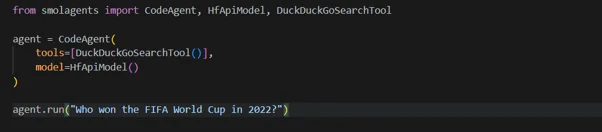
- Creating Your First Code Agent
This example creates a simple CodeAgent that can search the web and answer questions.
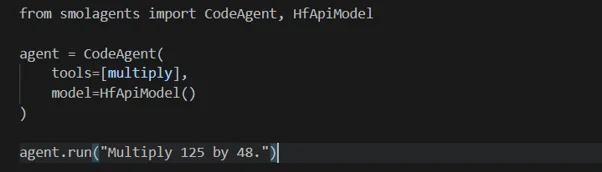
- Creating a Custom Tool
You can easily convert any Python function into a tool using the @tool decorator.

Register the tool with the agent:
- Using Multiple Tools
Smolagents allows an agent to combine multiple tools to complete multi-step tasks.
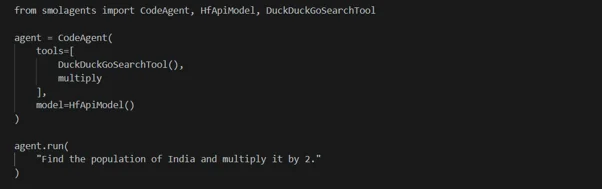
The agent automatically decides when to search the web and when to use the multiplication tool.
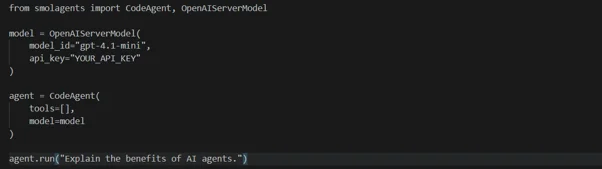
- Using an OpenAI Model
Smolagents supports multiple LLM providers, including OpenAI.
Real-World Implementations of Smolagents
- Enterprise Knowledge Assistants: Organizations use smolagents to build AI assistants that search internal documentation, company policies, and knowledge bases to provide accurate answers to employees.
- Agentic RAG Applications: Smolagents is used to develop Retrieval-Augmented Generation (RAG) systems that retrieve relevant information from documents before generating context-aware responses.
- Text-to-SQL Systems: Businesses leverage smolagents to convert natural language questions into SQL queries, enabling users to interact with databases without writing SQL.
- Web Research Agents: AI agents can browse websites, gather up-to-date information, summarize content, and generate research reports automatically.
- Business Workflow Automation: Organizations integrate smolagents with APIs, databases, and cloud services to automate repetitive tasks such as report generation, notifications, and data processing.
- Software Development Assistants: Development teams use smolagents to generate code, debug applications, search technical documentation, and automate routine programming tasks.
Conclusion
Smolagents simplifies AI agent development by combining the reasoning capabilities of Large Language Models with tool integration and executable Python code. Its lightweight architecture, minimal setup, and support for multiple LLM providers make it an ideal framework for both rapid prototyping and production-ready applications.
Drop a query if you have any questions regarding Smolagents, and we will get back to you quickly.
Empowering organizations to become ‘data driven’ enterprises with our Cloud experts.
- Reduced infrastructure costs
- Timely data-driven decisions
About CloudThat
FAQs
1. Do I need to use Hugging Face models with smolagents?
ANS: – No. Smolagents is model-agnostic and supports multiple LLM providers, including OpenAI, Anthropic, Ollama, LiteLLM-compatible models, and Hugging Face models.
2. Is smolagents suitable for production applications?
ANS: – Yes. With secure code execution, tool integration, and support for scalable workflows, smolagents can be used to build production-ready AI applications
3. Is smolagents beginner-friendly?
ANS: – Yes. Its lightweight design and simple API make it easy for beginners to start building AI agents while providing enough flexibility for advanced use cases.


WRITTEN BY Livi Johari
Livi Johari is a Research Associate at CloudThat with a keen interest in Data Science, Artificial Intelligence (AI), and the Internet of Things (IoT). She is passionate about building intelligent, data-driven solutions that integrate AI with connected devices to enable smarter automation and real-time decision-making. In her free time, she enjoys learning new programming languages and exploring emerging technologies to stay current with the latest innovations in AI, data analytics, and AIoT ecosystems.


 PREV
PREV











Comments