

 Login
Login

 July 29, 2026
|
Voiced by Amazon Polly |
Introduction
Your company has months’ worth of customer data, product documentation, and internal knowledge scattered across databases, PDFs, and SharePoint folders. An executive asks your team to build an AI assistant that understands it all. Instantly. Without hallucinating. Without confidently telling a customer something completely false.
Your data scientists look at each other. ChatGPT won’t cut it. A basic LLM won’t work. You need something smarter. You need an AWS GenAI engineer.
This is where the real magic happens. Not the hype-filled AI we see in headlines, but the practical, production-grade systems that enterprises are betting their customer relationships on. And honestly? Most people have no idea what these engineers actually build or how they do it.
Let’s change that.
Launch Your AI Career with AWS GenAI Training
- Interview Guarantee
- Up to 75% Money Back
- Real-World Learning
What Does an AWS GenAI Engineer Actually Do?
An AWS GenAI engineer isn’t just someone who knows how to call an API. They’re architects of intelligence.
These engineers design systems where AI doesn’t just talk. It thinks. It remembers. It decides what to do next. They work with Amazon Bedrock (AWS’s fully managed service for foundation models), build retrieval systems that pull the right information at the right time, and create autonomous agents that can reason, plan, and execute multi-step tasks without human intervention.
Here’s the cold reality: A DevOps engineer can deploy infrastructure. A software engineer can write code. But a GenAI engineer? They have to understand the psychology of language models, the mathematics of vector databases, the architecture of distributed systems, and the compliance nightmares of enterprise AI, all at once.
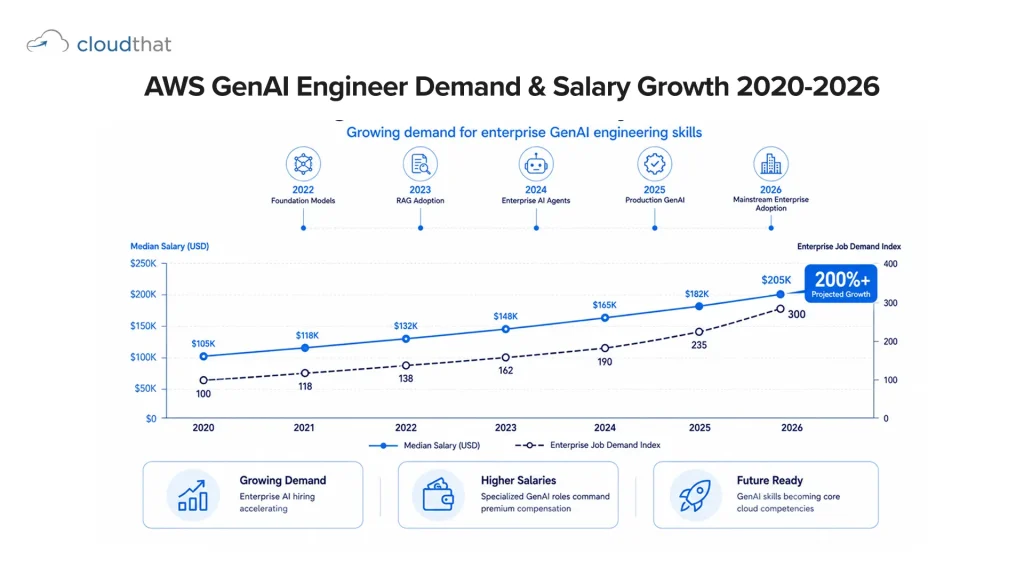
The demand is insane. According to LinkedIn, AI engineer roles have grown 74% year-over-year, with GenAI specializations posting salaries 25-40% higher than traditional ML roles. But the skills gap is even more dramatic. Companies can’t find these people because most training programs don’t teach what actually gets built in production.
RAG: When Your AI Needs a Memory
Let’s talk about the scariest moment in AI implementation: your chatbot confidently tells a customer something that’s completely wrong.
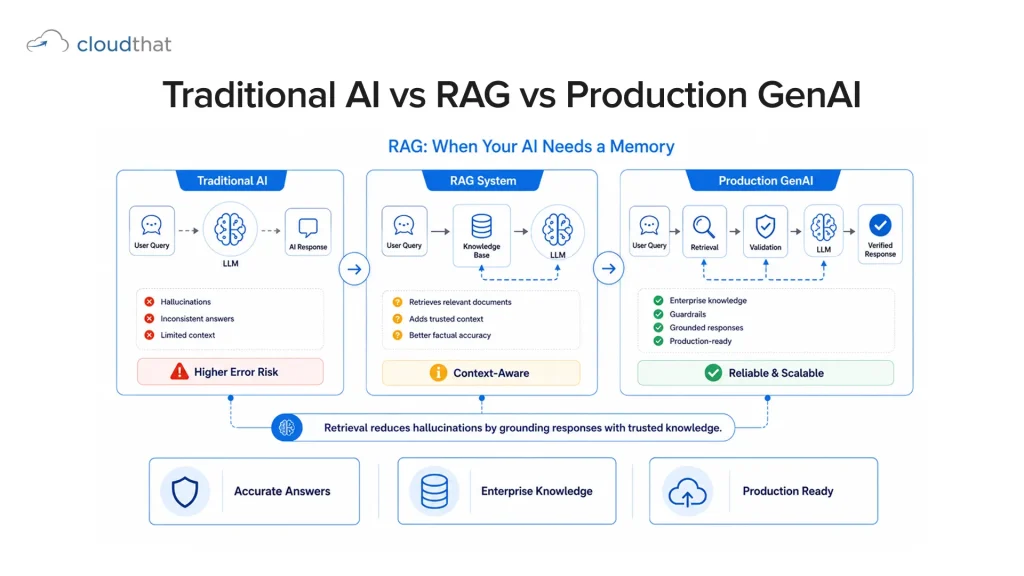
This is called hallucination, and it happens because large language models generate text based on patterns in training data. They don’t “know” your specific business rules, product roadmap, or customer contracts. They just make educated guesses.
Enter RAG: Retrieval-Augmented Generation.
An AWS GenAI engineer building a RAG system creates a pipeline that works like this: When someone asks a question, the system doesn’t immediately ask the LLM to answer. Instead, it first retrieves the most relevant documents, knowledge bases, or data from your company’s actual sources. Then it feeds both the question and the retrieved context to the LLM, essentially saying: “Here are the facts. Now answer based on these facts.”
The difference is night and day.
A bank’s customer service AI, using RAG, will retrieve the customer’s account details, transaction history, and product terms before answering. An e-commerce platform’s RAG system retrieves inventory data, return policies, and shipping timelines before making recommendations. A healthcare provider’s GenAI assistant pulls patient records and clinical guidelines before offering health information.
The engineering challenge? Building this fast, reliably, and at scale. You need to choose the right vector database (think of it as specialized storage for AI embeddings). You need to design retrieval logic that actually finds relevant documents, not just mathematically similar ones. You need to handle edge cases where context is contradictory or incomplete.
This is where AWS GenAI engineers spend weeks optimizing. And this is precisely what most AI courses skip over.
Autonomous Agents: Teaching AI to Think and Act
Here’s where it gets wild: What if your AI didn’t just answer questions, but actually took actions?
Imagine a customer support AI that can: look up a customer’s order, check inventory for replacements, process a refund, and send a confirmation email, all without a human touching a keyboard. Or a data analysis AI that queries databases, runs calculations, generates visualizations, and writes insights, completely autonomously.
These are agents. And building them is complex.
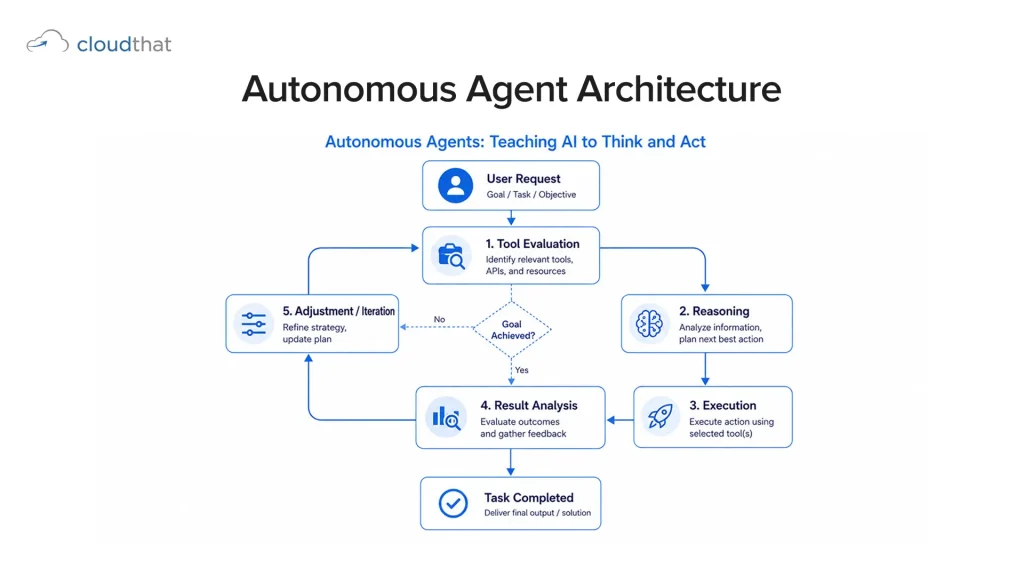
An AWS GenAI engineer designing an autonomous agent using tools like AWS Bedrock’s agent framework defines what actions the AI can take (called “tools”), creates decision logic that helps the AI choose which tools to use and in what order, and builds the guardrails that prevent the AI from doing something catastrophic.
The architecture looks something like this: The LLM receives a user request. It evaluates available tools (APIs, database connections, external services). It reasons through a plan: “I need to do X first, then Y, then Z.” It executes each step, evaluates the results, and adjusts. If something goes wrong, it backtracks and tries a different approach.
But here’s the hidden complexity: How do you prevent an agent from getting stuck in loops? What happens when the LLM makes a wrong decision? How do you ensure it doesn’t call the delete-all-records API when it should call the read-records API? How do you monitor what’s happening when autonomous systems are making decisions in production?
These are the engineering problems that separate a prototype from a system enterprises actually trust with their data.
Building Production Systems with AWS Bedrock
AWS Bedrock is where everything comes together. It’s the managed service that gives engineers access to foundation models from Anthropic (Claude), Cohere, Llama 2, Mistral, and others, without having to manage the underlying infrastructure.
For an AWS GenAI engineer, Bedrock is the foundation, but production systems require so much more.
You need to handle prompt engineering at scale (different prompts for different use cases). You need to manage context windows carefully (LLMs have limits on how much information they can process at once). You need to implement caching to avoid repeatedly processing the same context and incurring higher costs. You need to build evaluation frameworks to measure whether your GenAI system actually improves over time.
Then there’s the enterprise stuff: compliance and security. You need to ensure customer data isn’t accidentally leaked to other customers in multi-tenant systems. You need audit logs that show exactly what the AI did and why. You need privacy controls that comply with GDPR, HIPAA, or whatever regulations your industry requires.
A GenAI engineer building with Bedrock is thinking about throughput, latency, cost optimization, failure handling, and scaling. They’re writing code to monitor model performance, integrate with your existing data pipelines, and ensure the system degrades gracefully when things break.
This isn’t something you can learn by following a tutorial. It requires understanding the entire stack: from foundational model capabilities down to DevOps practices.
Why Traditional AI Training Falls Short
Here’s the uncomfortable truth: Most AI and GenAI training programs teach you the concepts, then show you a demo. They don’t show you the real problems.
They don’t teach you how RAG actually fails in production. They don’t show you the debugging nightmare when an agent gets stuck in a loop. They don’t explain the cost implications of running inference at scale or the compliance headaches of processing sensitive data with third-party models.
You finish the course feeling confident, then hit reality. Your retrieval logic pulls irrelevant documents. Your agent makes illogical decisions. Your costs explode. Your security team has questions you can’t answer.
The best way to learn AWS GenAI isn’t through slide decks. It’s through hands-on labs that you build these systems with guidance, see what happens when things break, and practice solving the problems that actually matter in production.
This is why completion of an AWS GenAI course isn’t the same as being job-ready. The gap between “I understand the concept” and “I can architect and deploy this” is massive.
Why CloudThat Is Your Go-To for AWS GenAI Training
Building AWS GenAI systems isn’t theoretical knowledge. It’s applied engineering. And that’s exactly where CloudThat’s approach diverges from everyone else.
CloudThat isn’t just a training company. It’s an AWS Premier Tier Training Partner with a dedicated GenAI Innovation Center. The difference matters: CloudThat’s trainers aren’t career instructors who read slides. They’re practicing consulting engineers who build production GenAI systems for enterprises every single day.
When you enroll in CloudThat’s AWS training programs, you’re learning from people who literally architected the RAG systems, agents, and Bedrock implementations that enterprises are running right now. They bring real problems, real solutions, and real failures into every classroom.
The hands-on labs aren’t “build a basic chatbot for practice.” They’re structured around the exact architectures enterprises use: building RAG pipelines with knowledge bases, creating autonomous agents with proper guardrails, implementing cost-optimization strategies, and handling the operational concerns that come with production GenAI systems.
CloudThat’s Capability Development Framework transforms you from “I completed a course” to “I can architect and deploy AWS GenAI systems.” The program includes skill assessments before training (so instructors know your level), custom learning pathways (so you don’t waste time on concepts you already know), hands-on labs with real feedback, and post-training support that extends beyond the course.
If you’re serious about becoming an AWS GenAI engineer, explore CloudThat’s AWS Mastery Pass, which includes all AWS certifications and specializations, or their targeted GenAI modules within their broader consulting practice.
Conclusion
The AWS GenAI engineer role won’t be hiring in five years. It’s hiring right now. Companies are desperately looking for people who can take their legacy data, business problems, and Bedrock instances and turn them into intelligent systems that actually work.
The difference between a person who completes an AWS GenAI course and a person who becomes an AWS GenAI engineer is the difference between understanding the theory and surviving the production disasters. It’s the difference between knowing what RAG is and knowing why your RAG system retrieved the wrong document at 3 AM on a Sunday.
If you’re ready to move from “I know the concepts” to “I can actually build this,” start with hands-on training that treats GenAI as an engineering discipline rather than a buzzword. Explore CloudThat’s AWS Mastery Pass and specialized GenAI training programs designed for engineers who want to ship production systems, not just pass exams.
The future belongs to engineers who can build with AI. The time to start is now.
Key Takeaways
- AWS GenAI engineers architect systems where AI doesn’t just generate text, it retrieves relevant data, reasons through decisions, and takes autonomous actions.
- RAG (Retrieval-Augmented Generation) solves the hallucination problem by grounding AI in actual enterprise data before generating responses.
- Autonomous agents powered by AWS Bedrock can reason through multi-step tasks, make decisions, and execute actions without human intervention, but require robust guardrails.
- Production GenAI systems demand expertise in prompt engineering, vector databases, cost optimization, compliance, and observability that most training programs don’t cover.
- The salary premium for AWS GenAI engineers reflects the real scarcity: there are far more job openings than qualified engineers.
- Hands-on labs and real-world problem-solving matter infinitely more than theory when learning AWS GenAI engineering.
- Foundation models are tools. The engineering challenge is building reliable, scalable, secure systems around them.
- Your next competitive advantage isn’t knowing that GenAI exists. It’s knowing how to actually build production systems with it.
- The skills gap is real, which means early movers who get proficient now will see outsized career growth.
- Start with fundamentals (Python, data structures, AWS basics), then specialize in GenAI architecture, RAG, and agents through hands-on courses.
Become an AI Engineer with AWS GenAI Training
- Mock Interviews
- AWS Expert Trainers
- Career Support
About CloudThat
FAQs
1. What's the difference between an AI engineer and a GenAI engineer?
ANS: – An AI engineer typically works with traditional machine learning (classification, regression, prediction). A GenAI engineer specializes in building systems with large language models and foundation models, focusing on prompt engineering, RAG, agents, and production deployment. The skill sets overlap, but GenAI is its own discipline.
2. How much does an AWS GenAI engineer make?
ANS: – According to recent salary data from Glassdoor and Levelsfyi, AWS GenAI engineers in the US earn between $150K and $250K+ annually, depending on experience and location. In India, entry-level roles start around 12-18 LPA, with senior roles reaching 30+ LPA.
3. Can I become an AWS GenAI engineer without a machine learning background?
ANS: – Yes, but you need strong fundamentals in Python, data structures, and basic statistics. You don’t need years of ML experience, but you need to understand how data flows and why algorithms make different decisions.
4. What certifications should I pursue?
ANS: – AWS Certified Machine Learning Specialty is a solid foundation. Beyond that, specialized training in GenAI, RAG systems, and Bedrock deployment is more valuable than additional certificates. Real portfolio projects matter more than credentials.
5. How long does it take to become job-ready as an AWS GenAI engineer?
ANS: – With structured training and hands-on labs, 3-6 months of focused study can get you to a junior level. Reaching mid-level proficiency typically takes 12-18 months of applied experience.
6. Are AI hallucinations solved?
ANS: – Not completely. RAG reduces hallucinations by grounding AI in actual data. Guardrails and monitoring reduce the damage. But foundation models still occasionally generate incorrect information, which is why human oversight remains critical.
7. What tools do AWS GenAI engineers use daily?
ANS: – AWS Bedrock, Amazon SageMaker, vector databases (Pinecone, Weaviate, or OpenSearch), prompt engineering frameworks, and monitoring tools. Plus standard DevOps: Docker, Lambda, CloudFormation, and IAM.
8. Can I build GenAI systems without AWS?
ANS: – Absolutely. But AWS Bedrock gives you managed access to multiple foundation models, integrated security, and seamless scaling. If you’re already in the AWS ecosystem, it’s the path of least resistance.

WRITTEN BY Himisha Raval
Himisha Raval is a Digital Marketing Manager at CloudThat with a strong command of search engine optimization, web analytics, link building, and content strategy. She brings a data-driven approach to digital marketing, helping IT companies strengthen their online presence, improve search rankings, and generate consistent leads across channels. Beyond execution, she plays an active role in ideation, campaign strategy, and website performance optimization. Outside of work, she balances her analytical side with a love for travel, nature painting, and dancing.


 PREV
PREV










Comments