

 Login
Login

 June 19, 2026
|
Voiced by Amazon Polly |
As Large Language Model (LLM)–powered applications move from prototypes to production systems, teams face a new challenge: understanding what their models are actually doing in real usage. Prompt changes, model upgrades, latency spikes, hallucinations, and cost overruns can quietly degrade user experience if left unmonitored.
This is where Langfuse fits into the modern AI stack. Langfuse is an open source observability platform designed specifically for LLM applications. It helps teams trace prompts, inspect model responses, measure quality, and analyze costs, without being intrusive or overly complex.
This blog introduces Langfuse, explains its core capabilities, and walks through a small, practical lab to help you install and gain experience with how it works in a real application context. The scope is intentionally focused on understanding observability fundamentals and using Langfuse features.
Start Learning In-Demand Tech Skills with Expert-Led Training
- Industry-Authorized Curriculum
- Expert-led Training
What Is Langfuse and Why It Matters
Langfuse is an observability and analytics layer built for applications that use LLMs such as GPT, Claude, or open-source models.
Core problems it addresses
- Lack of reproducibility in debugging
When LLM outputs change due to prompt tweaks, model updates, or external factors, reproducing past results becomes difficult. Without proper versioning and a traceable history, engineers cannot reliably reproduce issues for debugging or validation. - No centralized prompt management
Prompts often live scattered across codebases, notebooks, or team members’ workflows. This leads to duplication, inconsistency, and difficulty in maintaining standardized prompt versions across environments. - Limited collaboration across teams
Product managers, data scientists, and engineers need shared visibility into LLM behavior. Without a unified platform, it’s hard to review outputs, annotate issues, or align on improvements. - Weak monitoring in production
Unlike traditional systems, LLM applications lack clear failure signals. Silent failures like hallucinations, degraded response quality, or context loss can go unnoticed without continuous monitoring. - Limited observability across multi-step pipelines
Modern LLM apps often involve chains, agents, or tool calls. Without end-to-end tracing, understanding how each step contributes to the final output becomes complex and opaque. - Compliance and auditability concerns
Organizations need visibility into what data was sent to the model and how outputs were generated for governance, auditing, and regulatory purposes. Lack of traceability creates risk
Key Features of Langfuse
Langfuse focuses on practicality rather than abstract dashboards. Its features are designed around real engineering workflows.
- Tracing and logging: One of its core capabilities is tracing and logging, which allows teams to capture every prompt, response, and associated metadata flowing through their LLM application. Instead of treating logs as isolated events, Langfuse organizes them into end-to-end traces, giving a complete picture of each request. Engineers can also attach contextual information such as user IDs, session IDs, or custom tags, making it significantly easier to debug production issues, especially those that cannot be reproduced locally.
- Prompt management: Enables teams to store and version prompts centrally. This eliminates the common problem of prompts being scattered across codebases or notebooks. With version control in place, teams can compare outputs across different prompt iterations and quickly roll back to a stable version if quality degrades. This approach treats prompts as first-class artifacts, similar to code, improving maintainability and collaboration.
- Evaluation and scoring: Langfuse also provides robust evaluation and scoring capabilities, which are essential for improving LLM output quality. Teams can manually evaluate responses for relevance or correctness, while also logging automated scores generated by another LLM or by rule-based systems. Over time, these evaluations can be analyzed to identify trends and measure improvements, helping teams move toward stable and predictable production behavior.
- Cost and latency insights: Langfuse offers detailed cost and latency insights, giving visibility into how resources are being consumed. It tracks token usage in granular detail and enables cost breakdowns by model, user, or feature. This helps teams detect expensive or slow operations early, preventing unexpected cost overruns and performance bottlenecks in production.
- Dataset and replay capabilities: The platform further supports dataset and replay capabilities, allowing teams to build datasets directly from historical traces. These datasets can be reused to replay past inputs against new models or prompt versions, enabling evaluation before deployment. This ensures that improvements are validated in a controlled manner, reducing the risk of regressions.
- Integration with LLM frameworks: Langfuse integrates seamlessly with popular LLM frameworks, including LangChain and OpenAI SDKs, requiring minimal setup to start capturing traces. Its flexible APIs also allow custom integration, ensuring it fits naturally into existing technology stacks without disrupting current workflows.
- Role-based access control: For enterprise use cases, it is an essential feature that enables organizations to define permissions for different user types, such as developers, analysts, and administrators. Sensitive data and environments can be restricted by role, ensuring proper governance and security across teams.
- Real-time monitoring and alerts: Langfuse includes real-time monitoring and alerting capabilities that help teams track system behavior in real time. It can detect anomalies in latency, cost, or output patterns and trigger alerts when unusual activity occurs. This proactive monitoring ensures that LLM applications remain reliable and performant in production environments.
Install Langfuse using Docker Compose
Docker Compose includes:
- PostgreSQL database
- Langfuse backend + frontend
- Persistent storage using Docker volumes
- Access Langfuse UI using http://localhost:3000
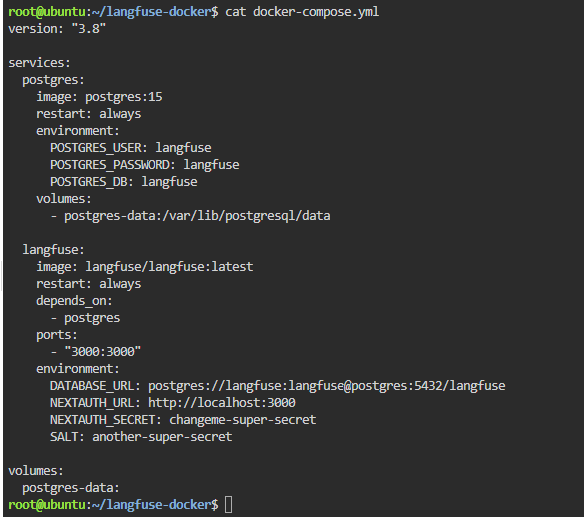
Fig 1: Langfuse deployed via Docker Compose with PostgreSQL backend.
Refer to the official link to install on VM and Local
Best Practices When Using Langfuse
To get consistent value, teams often follow these patterns:
- Log all production traffic, not just failures.
- Use consistent naming conventions for traces and events.
- Add human evaluations early, even if informal.
- Regularly review cost and latency dashboards.
These practices turn observability data into actionable insights rather than passive logs.
Future of LLM Observability
Building reliable LLM applications requires more than good prompts and powerful models. Without visibility, teams are effectively flying blind. Langfuse provides a practical, engineering-friendly way to observe, debug, and evaluate LLM behavior in real environments.
In this blog, we explored what Langfuse is, why it matters for developers and ML engineers working with production LLMs, and how Langfuse offers a clear path from experimentation to operational maturity, without unnecessary complexity.
Upskill Your Teams with Enterprise-Ready Tech Training Programs
- Team-wide Customizable Programs
- Measurable Business Outcomes
About CloudThat


WRITTEN BY Martuj Nadaf
Martuj Nadaf is a Subject Matter Expert at CloudThat, specializing in DevOps Tools and multi-cloud. With 14 years of experience in training and industry, he has trained over 2000+ professionals/students to upskill in Hardware, Networking, Windows, Linux, DevOps, Docker, Kubernetes, Monitoring tools, Multi-cloud globally. Known for explaining complex technical concepts in a simple and understandable manner, hands-on teaching and industry insights, he brings deep technical knowledge and practical application into every learning experience. Martuj's passion for exploring new technologies reflects in his unique approach to learning and development.


 PREV
PREV











Comments