

 Login
Login


 June 17, 2026
|
Voiced by Amazon Polly |
Introduction
The growth of artificial intelligence and data science has been remarkable in the past few years, spanning healthcare, finance, retail, and manufacturing. So many organizations are currently relying on various data-driven solutions to stay ahead. Global spending on AI-driven data analytics is expected to reach $236 billion by 2033.
Now, this high demand also indicates a growing need for high-quality professional AI data science courses. Most learners prefer the CloudThat’s AI training courses to build future-ready skills and unlock new career opportunities.
But before you enroll in any course, there are a few aspects that you need to analyze about the courses. Let’s learn more about that.
Launch Your AI Career with AWS GenAI Training
- Interview Guarantee
- Up to 75% Money Back
- Real-World Learning
What is Included In An AI Data Science Course?
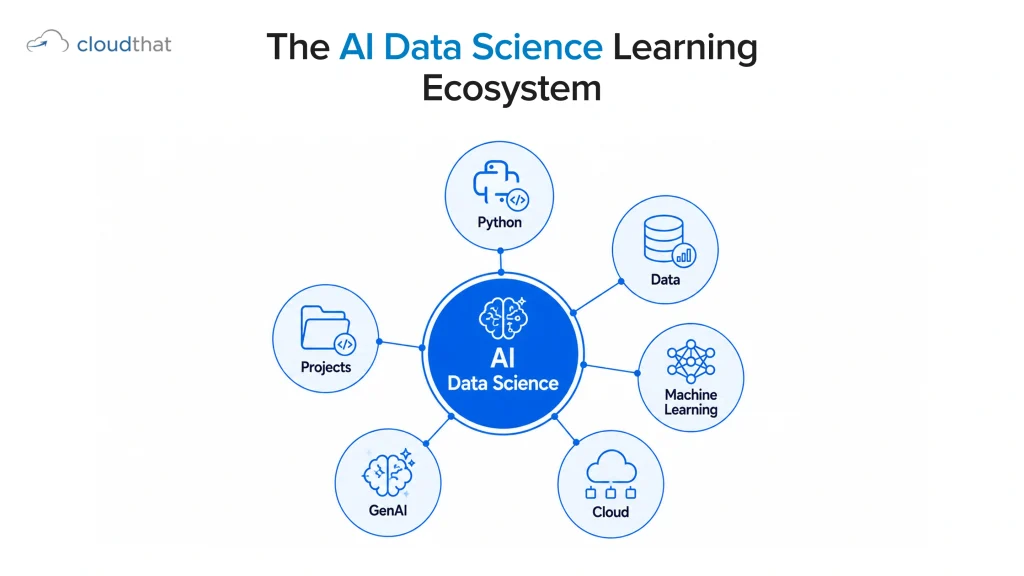
An AI Data Science Course combines traditional data science concepts with modern Artificial Intelligence and Generative AI technologies.
Instead of focusing solely on data analysis and machine learning, modern programs teach learners how to:
- Collect, clean, and process large datasets.
- Analyze business data to uncover insights.
- Build machine learning models.
- Create predictive analytics solutions.
- Work with cloud-based AI platforms
- Use Generative AI tools and Large Language Models.
- Deploy AI applications into production environments.
Why AI And Data Science Skills Are In Demand?
Businesses today are actively generating massive volumes of data every day. Now, all this raw data has no value without meaningful insights. This is where AI and data science professionals become so important.
The following market trends are driving the demand for AI and data science professionals:
- Organizations are investing heavily in AI-powered decision-making.
- Businesses want more structured and predictive insights rather than just historical reporting.
- Generative AI adoption is creating new opportunities across industries.
- Companies require professionals who can combine technical expertise with business understanding.
- AI literacy is becoming a highly valued skill across job functions.
The key is to identify the problems, validate the best possible outcomes, interpret the results, and communicate the recommendations effectively.
Which Skills Will You Learn In An AI Data Science Course?
A quality AI Data Science Course should help you build both technical and business-oriented capabilities.
- Programming Skills
Python remains the most widely used programming language in data science and AI.
You will typically learn:
- Python fundamentals
- Data structures
- Functions and libraries
- Object-oriented programming
- Automation techniques
Python forms the foundation for most machine learning and AI workflows.
- Statistics And Mathematics
Strong analytical thinking begins with a solid understanding of statistics.
Topics often include:
- Probability
- Descriptive statistics
- Inferential statistics
- Hypothesis testing
- Linear algebra
- Optimization techniques
These concepts help you understand how machine learning algorithms make predictions.
- Data Analysis And Visualization
Before building models, you need to understand the data.
Key skills include:
- Data cleaning
- Exploratory Data Analysis (EDA)
- Data transformation
- Dashboard creation
- Business reporting
Professionals who can convert raw data into actionable insights are highly valued across industries.
- Machine Learning
Machine learning remains a core component of any data science course.
Common topics include:
- Supervised learning
- Unsupervised learning
- Classification algorithms
- Regression models
- Clustering techniques
- Model evaluation
These techniques enable organizations to predict outcomes and optimize decision-making processes.
- Generative AI Skills
Modern AI Data Science Course programs increasingly include Generative AI modules.
You may learn:
- Prompt engineering
- Large Language Models (LLMs)
- AI-powered automation
- Retrieval-Augmented Generation (RAG)
- AI application development
Generative AI skills are becoming a significant differentiator for job seekers.
- Communication And Business Understanding
Sure, your technical knowledge plays an integral role. But you can never ignore this skill when applying to a job role.
Successful data professionals must be able to:
- Present findings clearly
- Explain technical concepts to non-technical stakeholders
- Understand business objectives
- Recommend data-driven actions
Which Tools Are Covered In A Modern AI Data Science Course?
One of the best ways to evaluate a course is by reviewing the tools included in the curriculum.
- Python
The primary programming language for data science and AI applications.
- SQL
Necessary for querying and managing massive databases.
SQL still remains as one of the most requested skills in most analytics and data science job descriptions.
- Excel
Despite advancements in AI, Excel remains widely used for reporting, analysis, and business decision-making.
- NumPy
Supports numerical computing and mathematical operations.
- Pandas
Used for data manipulation and analysis.
- Matplotlib And Seaborn
Popular visualization libraries for creating charts and insights.
- Machine Learning Frameworks
You may encounter:
- Scikit-learn
- TensorFlow
- PyTorch
- Cloud Platforms
Organizations increasingly deploy AI workloads on cloud environments.
Popular platforms include:
Cloud skills often provide a competitive advantage in the job market.
- Generative AI Platforms
Modern programs may also introduce:
- OpenAI technologies
- Azure AI Services
- AI copilots
- Prompt engineering frameworks
Which Projects Should You Expect To Build?
Working on projects is non-negotiable. This is one of the most important aspects, where you can actively apply your learning in real-world scenarios.
- Customer Churn Prediction
Build models that identify customers likely to leave a service.
- Sales Forecasting
Use historical sales data to predict future business performance.
- Recommendation Systems
Develop engines similar to those used by e-commerce and streaming platforms.
- Fraud Detection
Apply machine learning techniques to identify suspicious transactions.
- Sentiment Analysis
Analyze customer reviews and social media conversations.
- Generative AI Applications
Create solutions such as:
- AI chatbots
- Document summarisation systems
- Knowledge assistants
- AI-powered search applications
- End-To-End Capstone Projects
The best programs include projects that combine:
- Data collection
- Cleaning
- Analysis
- Modeling
- Deployment
- Business presentation
These projects closely resemble workplace scenarios and help build a strong portfolio.
Job Roles After Completing The Course
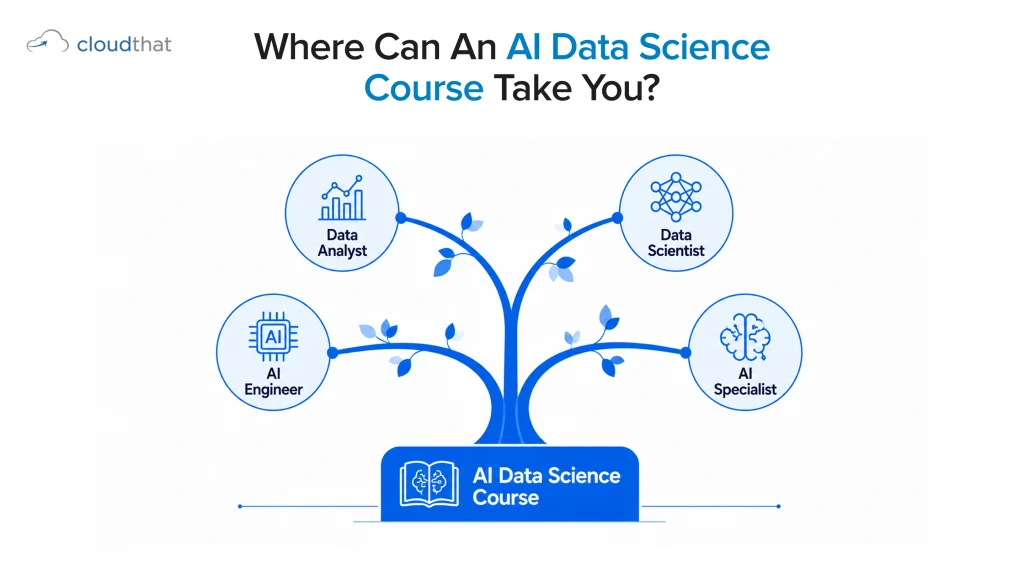
A comprehensive AI Data Science Course can prepare learners for several career paths.
- Data Analyst
Focuses on extracting insights and creating reports for business stakeholders.
- Business Intelligence Analyst
Uses dashboards and visualization tools to support strategic decisions.
- Data Scientist
Develops predictive models and advanced analytical solutions.
- Machine Learning Engineer
Builds and deploys machine learning systems into production environments.
- AI Specialist
Works on AI-powered business applications and automation solutions.
- Data Engineer
Designs data pipelines and infrastructure required for analytics and AI projects.
- AI Product Analyst
Combines technical knowledge with business strategy to improve AI-driven products.
Learn Generative AI Data Science With CloudThat
Professionals looking for a structured learning pathway can explore CloudThat’s Generative AI and Data Science training programs.
This integrated program actively combines foundational data science concepts along with various advanced AI and Generative AI skills. These skills are carefully designed as per the growing demand of the job market now.
Key highlights include:
- You get detailed coverage about different skills like Python, SQL, machine learning, cloud technologies, and more in a structured format.
- Hands-on learning projects through practical assignments and real-world business scenarios can help you build solid portfolios.
- Active guidance from experienced instructors and industry experts helps you gain practical insights about the current hiring trends, project execution, and career development strategies.
- Flexible learning options make learning seamless even when you are working full-time.
- Preparation for leading cloud and AI certifications that can strengthen professional credibility and support long-term career advancement.
If you really want to build a solid foundation along with having future-ready skills, choosing this emerging AI course is your best shot. It gives you a structured program with a clearer and better learning path.
Conclusion
With the rise in demand for more and better AI and data science professionals, it is time to choose the right courses that will shape your career in the future. With best-in-class data-driven decision-making and intelligent automation capabilities, the AI Data Science Course by CloudThat will ensure you have a strong foundation across all subjects.
You also get direct access to work on your skills through various real-life practical projects, making all of these simpler and easier. All of these aspects will help you transition from training to employment successfully.
Key Takeaways:
- A modern AI Data Science Course combines data science, machine learning, cloud computing, and Generative AI skills. This broader approach better reflects how organizations are building and deploying AI solutions today.
- Strong fundamentals in Python, SQL, statistics, and data analysis remain important. Even as AI tools become more powerful, these core skills continue to drive professional success.
- Real-world projects are often more valuable than certificates alone. Employers want evidence that candidates can solve practical business problems using data and AI.
- Generative AI is becoming an important component of modern data science roles. Learning how to work alongside AI tools can significantly improve productivity and career opportunities.
- Choosing a structured learning program with mentorship, hands-on projects, and career support can accelerate your growth. It also helps bridge the gap between theoretical learning and workplace expectations.
Become an AI Engineer with AWS GenAI Training
- Mock Interviews
- AWS Expert Trainers
- Career Support
About CloudThat
FAQs
1. What is an AI Data Science Course?
ANS: – An AI Data Science Course teaches data analysis, machine learning, AI concepts, cloud technologies, and Generative AI skills required for modern data-focused careers.
2. Is data science still a good career choice?
ANS: – Yes. Organizations continue to invest heavily in analytics, machine learning, and AI initiatives, creating strong demand for skilled professionals.
3. Which programming language is most important for data science?
ANS: – Python is considered the most widely used programming language for data science, machine learning, and AI development.
4. Do I need a technical background to join a data science course?
ANS: – Many programs welcome beginners, graduates, and working professionals. However, a willingness to learn analytical concepts and programming is beneficial.
5. Are Generative AI skills important for data scientists?
ANS: – Yes. Generative AI is increasingly becoming part of modern workflows, making these skills valuable for future career growth.
6. What projects should I include in my portfolio?
ANS: – Projects such as customer churn prediction, recommendation systems, sales forecasting, fraud detection, and AI-powered applications are highly relevant.
7. What job roles can I apply for after completing an AI Data Science Course?
ANS: – Common roles include Data Analyst, Data Scientist, Machine Learning Engineer, Business Intelligence Analyst, Data Engineer, and AI Specialist.

WRITTEN BY Himisha Raval
Himisha Raval is a Digital Marketing Manager at CloudThat with a strong command of search engine optimization, web analytics, link building, and content strategy. She brings a data-driven approach to digital marketing, helping IT companies strengthen their online presence, improve search rankings, and generate consistent leads across channels. Beyond execution, she plays an active role in ideation, campaign strategy, and website performance optimization. Outside of work, she balances her analytical side with a love for travel, nature painting, and dancing.


 PREV
PREV











Comments