

 Login
Login


 June 17, 2026
|
Voiced by Amazon Polly |
Introduction
Cloud adoption is growing rapidly. With businesses adopting this transition at such a fast pace, learning the right skills is truly important. 55% of companies worldwide now use two or more cloud providers for their operations and performance improvements
Most people get confused about where to start. There are abundant resources, but only the right direction can help you succeed here. A structured AWS DevOps course by CloudThat ensures that you have the much-needed guidance along with the best expertise that will help you learn real-world cloud operations in a more productive way.
This guide provides a clear roadmap for getting started and being productive on your AWS DevOps journey.
Already in IT? Switch to Cloud & Earn 55% More
- Weekend Batches
- Dedicated Career Support
- Official AWS Labs
What Is An AWS DevOps Role?
An AWS DevOps professional will effectively bridge the gap between your development and operations teams. They help automate various parts of your organization, such as software delivery, cloud infrastructure management, deployment speed, and overall application reliability.
A cloud operations engineer typically works on:
- Infrastructure provisioning
- Application deployment
- CI/CD pipeline automation
- Cloud monitoring
- Security implementation
- Performance optimization
- Incident management
Why AWS DevOps Skills Are In Demand?
Manual operations are no longer relevant. Most companies are switching to cloud services for the right reasons. And professionals who know the right skills can adapt to this transition in the best way. They can manage modern cloud environments while still ensuring faster software releases.
Companies are actively looking for professionals who can:
- Automate infrastructure deployment
- Build CI/CD pipelines
- Manage containerized applications
- Improve cloud security
- Optimize operational efficiency
- Monitor cloud environments proactively
This is precisely why so many students, developers, and IT professionals choose CloudThat’s AWS DevOps courses.
What Are The Skills Required For Cloud Operations?
Before jumping into advanced tools, learners must develop strong foundational knowledge.
- Linux Administration
Linux powers most cloud environments. Understanding file systems, permissions, processes, package management, and shell commands is essential.
Topics to learn include:
- Linux commands
- File management
- User management
- Networking basics
- Process monitoring
- Bash scripting
- Networking Fundamentals
Cloud infrastructure heavily relies on networking concepts.
Important topics include:
- IP addressing
- DNS
- Subnets
- Routing
- Load balancing
- Firewalls
- TCP/IP protocols
- Programming And Scripting
DevOps professionals are not expected to become full-time developers, but they do need automation skills.
Popular languages include:
- Python
- Bash
- PowerShell
These languages actually help automate repetitive operational tasks and infrastructure management.
- Cloud Computing Concepts
A strong understanding of cloud fundamentals is also extremely critical here.
Learn:
- IaaS
- PaaS
- SaaS
- Virtualization
- Scalability
- High availability
- Disaster recovery
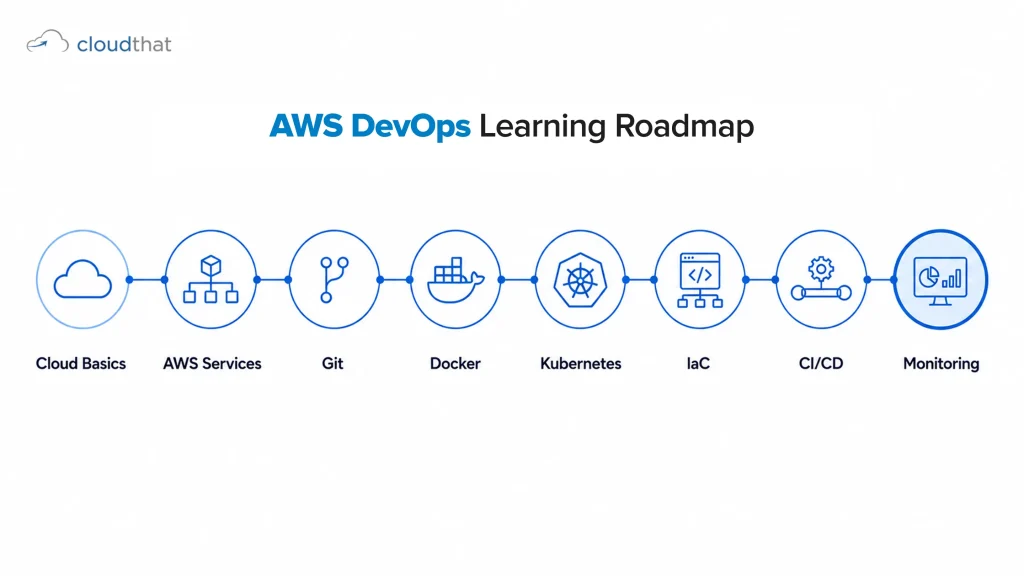
AWS DevOps Course Learning Roadmap
Here’s a structured step-by-step process of an ideal AWS DevOps Course.
- Stage 1: Learn Cloud Fundamentals
Start with:
- Cloud computing concepts
- AWS global infrastructure
- Shared responsibility model
- AWS pricing basics
At this stage, learners should understand how cloud services work before diving into implementation.
- Stage 2: Master Core AWS Services
Focus on:
- Amazon EC2
- Amazon S3
- Amazon VPC
- IAM
- CloudWatch
- RDS
- Auto Scaling
- Elastic Load Balancer
These services form the foundation of most AWS environments.
- Stage 3: Learn Version Control
Version control is a critical part of every DevOps course.
Key concepts include:
- Git repositories
- Branching
- Merging
- Pull requests
- Collaboration workflows
GitHub and GitLab are commonly used platforms.
- Stage 4: Understand Containerization
Containers have become standard in modern cloud environments.
Learn:
- Docker architecture
- Images and containers
- Docker Compose
- Container networking
- Container security basics
As applications become increasingly cloud-native, many organizations also combine containerized workloads with VMware environments to support hybrid infrastructure strategies and modernization initiatives.
- Stage 5: Learn Kubernetes
Kubernetes helps manage large-scale container deployments.
Important topics include:
- Pods
- Services
- Deployments
- Namespaces
- ConfigMaps
- Scaling
- Cluster management
- Stage 6: Infrastructure As Code
Manual infrastructure management is no longer scalable.
Learn Infrastructure as Code using:
- Terraform
- AWS CloudFormation
- Ansible
These tools allow infrastructure deployment through reusable code.
- Stage 7: Build CI/CD Pipelines
Continuous Integration and Continuous Deployment are core DevOps practices.
Tools include:
- Jenkins
- GitHub Actions
- AWS CodePipeline
- AWS CodeBuild
At this stage, learners should be able to automate application deployment workflows.
- Stage 8: Monitoring And Observability
Modern cloud environments require continuous monitoring.
Learn:
- Amazon CloudWatch
- Prometheus
- Grafana
- Logging practices
- Alerting systems
- Incident response
What Are The Important AWS Services To Learn?
An effective AWS DevOps course should include hands-on experience with major AWS services.
Compute Services
- Amazon EC2
- AWS Lambda
- ECS
- EKS
Storage Services
- Amazon S3
- EBS
- EFS
Database Services
- Amazon RDS
- DynamoDB
Networking Services
- VPC
- Route 53
- Load Balancer
- CloudFront
Security Services
- IAM
- KMS
- Security Groups
- AWS Secrets Manager
Monitoring Services
- CloudWatch
- AWS X-Ray
These services frequently appear in real-world cloud operations environments.
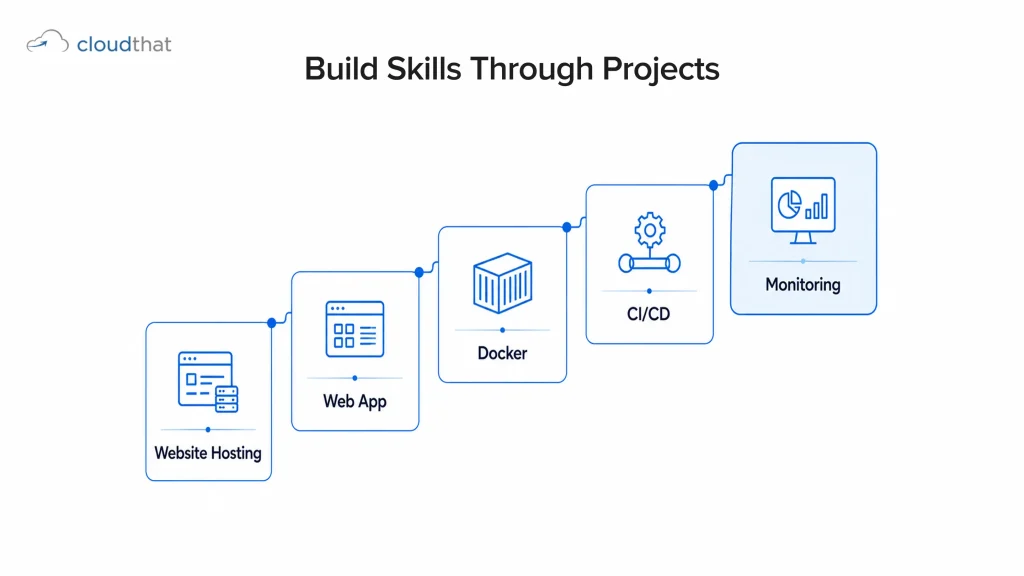
Real-World Projects For Practical Experience
Projects play a crucial role in transforming theoretical knowledge into practical expertise.
- Project 1: Static Website Hosting On AWS
Skills learned:
- S3
- CloudFront
- Route 53
- Project 2: Multi-Tier Web Application Deployment
Skills learned:
- EC2
- RDS
- Load Balancer
- VPC
- Project 3: Dockerized Application Deployment
Skills learned:
- Docker
- Container management
- Image creation
- Project 4: Kubernetes Cluster Deployment
Skills learned:
- Kubernetes
- Container orchestration
- Scaling
- Project 5: Automated CI/CD Pipeline
Skills learned:
- Jenkins
- GitHub
- AWS deployment automation
- Project 6: Infrastructure As Code Deployment
Skills learned:
- Terraform
- AWS automation
- Infrastructure provisioning
- Project 7: Monitoring Dashboard Implementation
Skills learned:
- CloudWatch
- Prometheus
- Grafana
Learners interested in expanding beyond cloud operations can also explore related domains such as full-stack development, Internet of Things (IoT), and Databricks, where cloud infrastructure and DevOps practices frequently play a critical role in application deployment, analytics, and connected device management.
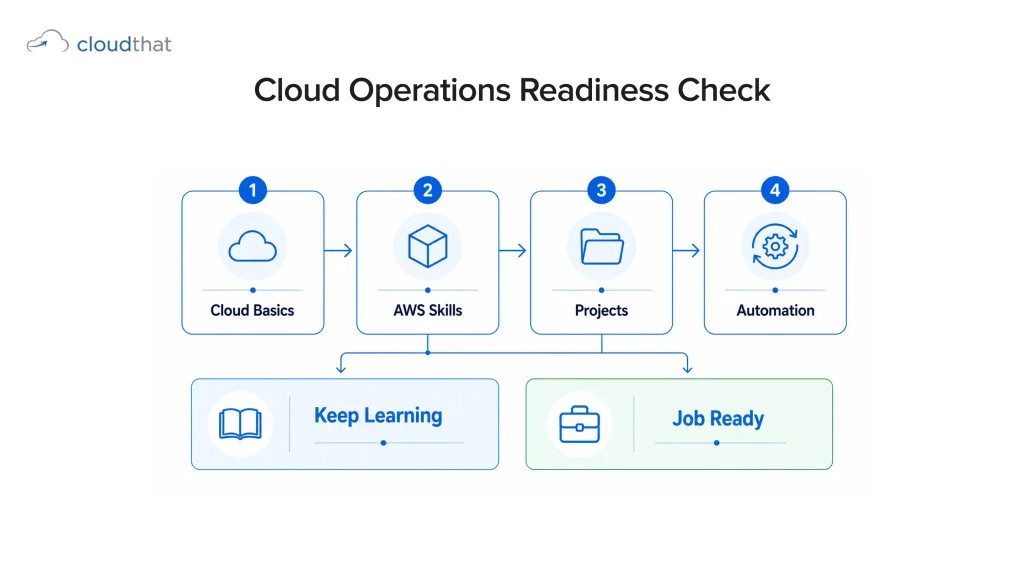
How CloudThat Helps Build Job-Ready Skills?
CloudThat offers so many industry-focused cloud and DevOps training programs designed to bridge the gap between learning and employment.
Some advantages include:
- You get hands-on AWS and DevOps training that actually allows you to work directly on various cloud services, automation tools, deployment workflows, and more.
- You have live instructor-led sessions wherein you can experience cloud professionals share their real-world experiences, insights, and even implementation techniques.
- You get to work on various projects in real-time that will help you apply your knowledge to practical business scenarios.
- Industry-aligned curriculum ensures that your knowledge always stays updated as per the latest AWS services, trends, and practices.
- AWS authorized learning pathways ensure that you get structured guidance and access to all relevant training content at all times.
- You get exclusive access to expert mentorship and personalized support throughout your AWS journey.
- This is a career-focused learning approach that emphasizes job-ready skills, practical application, and hands-on experience with AWS services.
Through a combination of practical labs, guided projects, industry-relevant tools, and expert-led instruction, CloudThat truly helps learners build the technical confidence and real-world experience required to succeed in modern cloud operations and DevOps environments.
Conclusion
The journey towards becoming a professional AWS DevOps engineer is never easy. It requires the right direction, strategy, and knowledge. The goal is to blend your theoretical knowledge with real-world projects to help you better understand how to implement it across various cloud environments.
The AWS DevOps courses by CloudThat ensure that your foundational concepts are strong, along with various advanced cloud operations that will help you develop the confidence and expertise required to succeed in today’s cloud-first world.
Key Takeaways:
- Start with cloud fundamentals before learning advanced DevOps tools. Building a strong foundation makes complex concepts easier to understand and implement.
- Focus on hands-on practice rather than purely theoretical learning. Real-world projects help develop job-ready cloud operations skills.
- Learn AWS services and DevOps tools together rather than separately. Modern organizations expect professionals to understand both cloud infrastructure and automation workflows.
- Prioritize Infrastructure as Code, containerization, and CI/CD pipelines. These skills are increasingly becoming standard requirements for cloud operations roles.
- Choose a structured learning path with mentorship and practical projects. Guided training can significantly accelerate career growth and improve industry readiness.
No Job After Graduation? Cloud Engineering is Your Answer
- Beginner Friendly
- 92% Placement Rate
- Live Instructor-Led
About CloudThat
FAQs
1. Is AWS DevOps a good career choice in 2026?
ANS: – Yes. AWS DevOps remains one of the most sought-after career paths because organizations continue to expand cloud adoption and automation initiatives.
2. Can beginners learn AWS DevOps?
ANS: – Absolutely. Beginners can start with cloud fundamentals, Linux, networking, and AWS basics before moving toward advanced DevOps tools and automation practices.
3. How long does it take to learn AWS DevOps?
ANS: – The timeline varies based on experience and consistency in learning. Most learners can build strong foundational skills within six to twelve months through structured training and projects.
4. Which programming language is best for AWS DevOps?
ANS: – Python is widely preferred because of its simplicity, automation capabilities, and extensive cloud integration support.
5. Are certifications necessary for cloud operations roles?
ANS: – Certifications are beneficial, but should be supported by practical project experience and hands-on implementation skills.
6. Which DevOps tools should beginners learn first?
ANS: – Start with Git, Docker, Jenkins, and Terraform before progressing toward Kubernetes and advanced monitoring tools.
7. What projects should I build for an AWS DevOps portfolio?
ANS: – CI/CD pipelines, cloud infrastructure deployments, Dockerized applications, monitoring systems, and Infrastructure as Code projects are highly valuable additions to the portfolio.

WRITTEN BY Himisha Raval
Himisha Raval is a Digital Marketing Manager at CloudThat with a strong command of search engine optimization, web analytics, link building, and content strategy. She brings a data-driven approach to digital marketing, helping IT companies strengthen their online presence, improve search rankings, and generate consistent leads across channels. Beyond execution, she plays an active role in ideation, campaign strategy, and website performance optimization. Outside of work, she balances her analytical side with a love for travel, nature painting, and dancing.


 PREV
PREV











Comments