

 Login
Login

 June 11, 2026
|
Voiced by Amazon Polly |
Introduction
Cloud computing course fees in India start at ₹500 for self-paced video courses and can reach ₹1.5 lakhs for job-ready programs with placement support. The most value-for-money option for multi-certification paths is a Mastery Pass (₹49,900 to ₹1,14,900), which includes annual access to 15–35+ live courses, hands-on labs, and exam prep. Hidden costs, including exam fees (₹12,500–₹13,500 per attempt), lab environment charges, and study materials, can add ₹20,000–₹50,000 to the total, depending on how many certifications you pursue.
Cloud engineer salaries in India start at ₹6–8 lakhs for entry-level roles and cross ₹20+ lakhs at the senior level, according to AmbitionBox and Glassdoor salary data for cloud roles in India (2024–25). The problem is not deciding whether to learn cloud. It is figuring out which training program is worth paying for.
This guide breaks down what cloud computing course fees in India actually include at each price point, the hidden costs that inflate your real spend, and how to pick a program that produces a job outcome, not just a certificate.
Start Learning In-Demand Tech Skills with Expert-Led Training
- Industry-Authorized Curriculum
- Expert-led Training
What a Cloud Computing Course Actually Costs in India
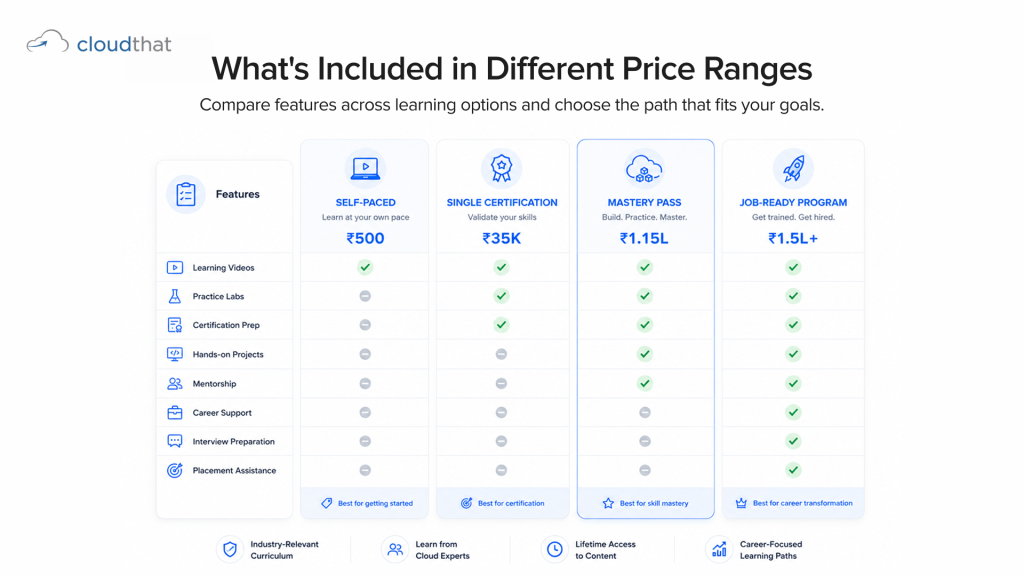
Cloud computing course fees in India fall into five clear tiers:
Self-paced video courses: ₹500–₹5,000. Udemy, Coursera, LinkedIn Learning. You get recorded lectures and quizzes. No live instructor, no real cloud labs, no job support. Useful for testing whether cloud interests you, not for landing a role.
Single certification courses: ₹15,000–₹35,000. Covers one certification, such as AWS Certified Solutions Architect Associate or Azure Administrator. Live instructor-led sessions (20–30 hours), exam prep, practice tests. Lab access is often simulator-based rather than real AWS or Azure environments. No placement support.
Mastery Pass programs: ₹49,900–₹1,14,900 for annual access. CloudThat’s AWS Mastery Pass at ₹1,14,900 includes 35+ AWS courses from foundational to specialty level. The Azure Mastery Pass at ₹49,900 covers 17 Azure certifications. The DevOps Mastery Pass at ₹74,900 covers the full DevOps track. These work well if you plan to complete 3+ certifications within a year.
Job-ready programs: ₹75,000–₹1,50,000. Multiple certifications bundled with hands-on projects, resume preparation, mock interviews, and placement assistance. CloudThat’s Job Ready Cloud Operations Engineer Program falls in this range.
Bootcamps and degree programs: ₹1,50,000–₹5,00,000+. Full-stack programs combining cloud, DevOps, programming, and data engineering over 6–12 months.
The pricing gap between ₹5,000 and ₹1.5 lakhs comes down to delivery format, lab access, instructor quality, and what happens after the course ends. AWS defines the exam, not the training provider.

What Is Included at Each Price Point
Under ₹10,000 (self-paced courses): Recorded lectures, PDF guides, practice quizzes. No live instructor, no real cloud sandbox, no exam voucher, no job support. Good for casual exploration.
₹15,000–₹35,000 (single certification courses): Live sessions, exam-focused curriculum, practice tests, limited lab access. An exam voucher is sometimes included. No placement support. Good for working professionals who need one specific certification.
₹50,000–₹1.15 lakhs (Mastery Pass programs): Annual access to 15–35+ courses, live instructor-led sessions, hands-on labs with real cloud environments, 50–60% lab-based delivery, community access. No placement guarantees. Best for engineers planning multi-certification paths.
₹75,000–₹1.5 lakhs (job-ready programs): Everything in Mastery Pass, plus real-world project portfolio, resume and LinkedIn optimization, mock interviews, placement assistance or guarantee, and post-training mentorship. Best for career switchers and engineers with 0–3 years of experience.
The biggest jump in value is between self-paced and live instructor-led training. The second is between certification-only programs and job-ready programs with structured placement support.
Hidden Costs Nobody Mentions
Budget beyond the course fee. These add up.
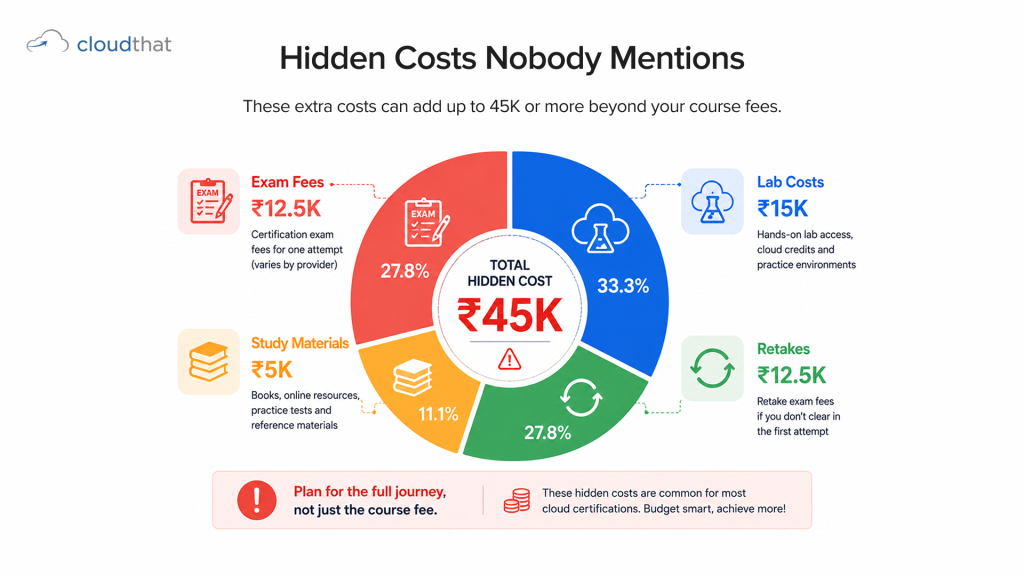
Exam fees: AWS certification exams cost $150 (₹12,500). Azure exams cost $165 (₹13,500). If your program does not include an exam voucher and you fail on your first attempt, you will pay again. Most programs do not include retake vouchers.
Lab environment costs: Practicing on real AWS or Azure accounts incurs charges. EC2 instances, S3 storage, and managed databases cost money. Budget ₹2,000–₹5,000 per month if you run your own cloud account. Programs with managed lab environments eliminate this.
Study materials: Official AWS practice exams cost $40 each. Quality third-party tests (Tutorials Dojo, Whizlabs) cost ₹1,200–₹2,000 per certification. Add ₹3,000–₹5,000 for thorough practice coverage.
Recertification: Most cloud certifications expire after three years. Recertification costs ₹8,000–₹12,000 per certification. Not a surprise for experienced engineers, but easy to miss when comparing a “lifetime access” self-paced course to an annual program.
Total hidden costs: ₹20,000–₹50,000 depending on the number of certifications and first-attempt pass rates. Programs that bundle exam vouchers, managed labs, and practice tests meaningfully reduce this.
How to Compare Cloud Computing Courses Beyond Price
Price tells you nothing about quality. These five checks matter.
Instructor credentials. Are they AWS- or Azure-certified? Have they deployed production systems? CloudThat is an AWS Premier Tier Training Partner, which means instructors work on live enterprise migrations, not just certification prep.
Hands-on lab percentage. Aim for 50–60% hands-on. If the course is 90% lecture and 10% quizzes, you will struggle in real environments. CloudThat’s delivery model holds 50–60% labs across all corporate and individual programs.
Certification pass rates. The industry average for AWS Solutions Architect Associate on the first attempt is around 60–70%. Strong programs publish 80%+ pass rates. If a provider will not share this data, ask why.
Placement outcomes. For job-ready programs, ask for placement rates, average time to placement, and the role types. “100% placement” without a defined timeline is a marketing claim, not a metric.
Post-training access. CloudThat’s Mastery Passes give one year of access to all courses and labs, because completing 15+ certifications in eight weeks is not realistic.
For the AWS Well-Architected Framework documentation, which is the best free reference for what production cloud teams are expected to know, the skills coverage in any course you evaluate should map to its five pillars.
Which Cloud Certifications Deliver the Best ROI
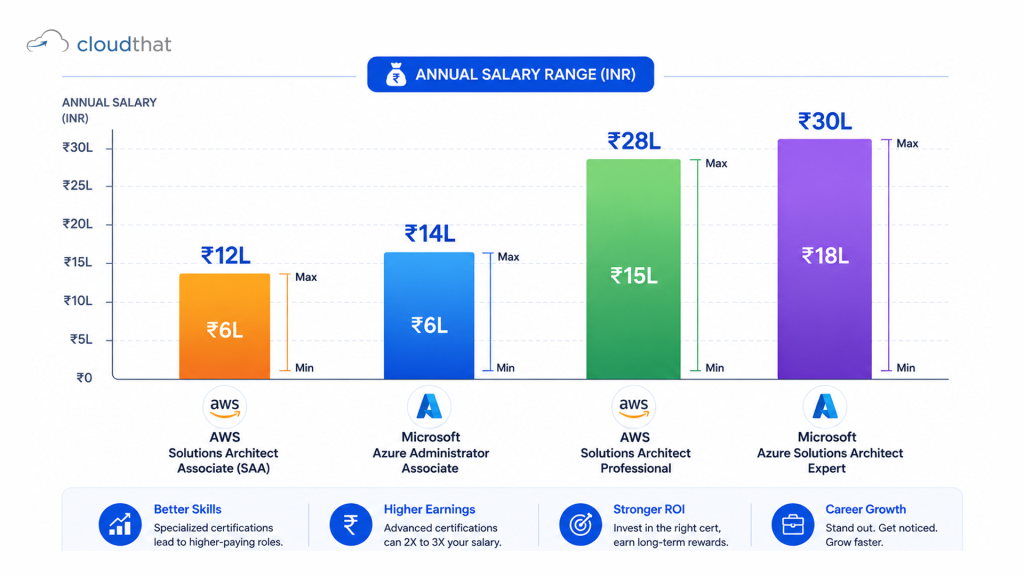
Salary data below is sourced from AmbitionBox and LinkedIn Salary Insights for cloud roles in India (2024–25).
AWS Certified Solutions Architect – Associate. ₹6–₹12 LPA. The most commonly requested certification in Indian cloud job postings. Opens doors to cloud engineer, DevOps, and solutions architect roles.
Azure Administrator Associate (AZ-104). ₹6–₹14 LPA. Strong demand in enterprises with Microsoft infrastructure. Consulting firms such as Accenture, Deloitte, and HCL consistently request this.
AWS/Azure Solutions Architect Professional. ₹15–₹30 LPA. Requires Associate-level certification first. High ROI for engineers with 3+ years of experience.
DevOps certifications (AWS DevOps Engineer, Azure DevOps). ₹12–₹22 LPA. Combine cloud with automation skills. High ROI because both skill sets are requested in the same job description.
Google Associate Cloud Engineer. ₹7–₹13 LPA. Lower demand than AWS or Azure, but less competition in the market.
Best ROI path: AWS Solutions Architect Associate or Azure Administrator, followed by a DevOps certification, then a Professional-level specialization. This sequence takes 6–12 months and positions you for ₹15–₹20 LPA roles.
For Microsoft’s official learning roadmap, the Microsoft Learn training catalogue is structured and free, and pairs well with a live instructor-led program that adds labs and feedback.
Why CloudThat Is the Right Choice for Cloud Computing Training
CloudThat is an AWS Premier Tier Services Partner, the highest tier in the AWS Partner Network, with 14+ years of cloud training and consulting experience. Instructors are not career teachers. They are certified engineers who run production cloud environments for 850+ enterprises. That is what 50–60% hands-on labs actually means: guided practice on real services from practitioners who have shipped the same infrastructure commercially.
For individual learners, the AWS Mastery Pass at ₹1,14,900 includes 35+ courses across Solutions Architect, SysOps, DevOps, Security, and Machine Learning, with one year of access and no hidden fees. The Azure Mastery Pass at ₹49,900 covers 17 Azure certifications from Fundamentals through Solutions Architect Expert. EMI starts at ₹4,999 per month. For career switchers, the Job Ready Cloud Operations Engineer Program bundles AWS and Azure training with project work, interview prep, and placement support.
Corporate teams use CloudThat’s Capability Development Framework to move cohorts from baseline to billable in 1–60 days. Pre-training assessment first. Custom learning paths per role next. Hands-on labs, weekly evaluations, and a project-readiness check at the end. No minimum batch size.
Conclusion
Cloud computing course fees in India range from ₹500 to ₹1.5 lakhs. The cheapest option is rarely the best value once you account for hidden costs: exam fees, lab access charges, and time to job readiness. Programs worth paying for include live instructor-led delivery, 50%+ hands-on labs, managed lab environments, and post-training support. Compare on instructor credentials, pass rates, and placement outcomes, not just the listed price.
Ready to start? Explore CloudThat’s AWS Mastery Pass, Azure Mastery Pass, or Job Ready Cloud Operations Engineer Program for structured, job-focused cloud training.
Key Takeaways
- Cloud computing course fees in India range from ₹500 (self-paced) to ₹1.5L+ (job-ready programs). Mastery Pass programs (₹49,900–₹1,14,900) give the best value for multi-certification paths.
- Hidden costs, including exam fees, lab account charges, and study materials, add ₹20,000–₹50,000 beyond the advertised course fee.
- Compare programs on instructor credentials, hands-on lab percentage (50%+ is the standard), pass rates, and placement outcomes, not just price.
- Salary data source: AmbitionBox and LinkedIn Salary Insights. Entry-level: ₹6–₹12 LPA. Mid-level: ₹14–₹22 LPA. Senior: ₹25–₹30 LPA.
- Best ROI sequence: AWS/Azure Associate → DevOps certification → Professional-level specialization. Takes 6–12 months.
- Programs that bundle exam vouchers and managed labs reduce total spend significantly compared to building your own practice environment.
- Self-paced free courses are useful for exploration. Paid programs with live instruction and placement support are what convert learning into employment.
- AWS Premier Tier partner status is audited by AWS. It means instructors have deployed production systems, not just passed exams.
- For corporate teams, the Capability Development Framework handles everything from skill assessment to project-readiness validation in 1–60 days.
- Recertification costs ₹8,000–₹12,000 per cert every three years. Factor this into the long-term cost of your certification path.
Upskill Your Teams with Enterprise-Ready Tech Training Programs
- Team-wide Customizable Programs
- Measurable Business Outcomes
About CloudThat
FAQs
1. What is in a cloud computing course?
ANS: – Most cover compute, storage, networking, security, and managed services. Strong programs add 50–60% hands-on labs where learners deploy real infrastructure, not just watch recorded walkthroughs.
2. What do cloud engineers earn in India?
ANS: – Based on AmbitionBox and LinkedIn salary data: entry-level roles with certifications start at ₹6–₹8 LPA. Mid-level engineers with 3–5 years and multiple certifications earn ₹14–₹22 LPA. Senior architects and DevOps leads cross ₹25–₹30 LPA.
3. Which cloud computing course is best for beginners?
ANS: – Start with one provider. AWS Certified Cloud Practitioner or Azure Fundamentals (AZ-900) are designed for beginners. Both are recognised by Indian recruiters and serve as the base for Associate-level certifications.
4. Can I become a cloud engineer in 3 months?
ANS: – Possible with prior IT experience and focused daily study. Career switchers without a technical background typically need 9–12 months to be genuinely job-ready, not just exam-certified.
5. Is a cloud computing course worth it in India?
ANS: – Yes, if you pick the right program. A ₹1 lakh program that gets you a ₹15 LPA role in six months has a clear ROI. A ₹10,000 course that leaves you uncertified and without projects does not.
6. Do cloud computing courses include exam fees?
ANS: – Most do not. Single certification courses rarely include vouchers. Mastery Pass programs from CloudThat bundle exam prep, but confirm voucher inclusions for specific exams before enrolling.
7. What are the hidden costs of a cloud certification course?
ANS: – Exam fees (₹12,500–₹13,500 per attempt), lab account costs if not managed (₹2,000–₹5,000/month), quality practice tests (₹3,000–₹5,000), and potential retake fees. Budget ₹20,000–₹50,000 beyond the course fee.
8. Does CloudThat offer corporate cloud training?
ANS: – Yes. CloudThat’s Capability Development Framework handles corporate cohorts from 10 to 2,000 engineers, with custom learning paths, weekly reporting, and no minimum batch size requirement.

WRITTEN BY Himisha Raval
Himisha Raval is a Digital Marketing Manager at CloudThat with a strong command of search engine optimization, web analytics, link building, and content strategy. She brings a data-driven approach to digital marketing, helping IT companies strengthen their online presence, improve search rankings, and generate consistent leads across channels. Beyond execution, she plays an active role in ideation, campaign strategy, and website performance optimization. Outside of work, she balances her analytical side with a love for travel, nature painting, and dancing.


 PREV
PREV










Comments