

 Login
Login


 June 5, 2026
|
Voiced by Amazon Polly |
Introduction
Search “cloud computing courses online” and Google throws 50,000 results at you in half a second.
Coursera. Udemy. LinkedIn Learning. Free YouTube playlists. A bootcamp ad for ₹1,99,000. A “complete AWS course in 6 hours” promising career transformation. And somewhere in there is the actual course that will get you hired.
This blog is a decision guide. Not a list of 50 courses. By the end, you will know how to evaluate any cloud computing course online, what a job-ready learning path actually looks like, and how to avoid the most expensive mistakes people make when picking one.
No Job After Graduation? Cloud Engineering is Your Answer
- Beginner Friendly
- 92% Placement Rate
- Live Instructor-Led
Why Most Cloud Computing Courses Online Don’t Lead to Jobs?
The market is full of courses. Most are not built for outcomes.
The reason is simple. A platform makes money when you enroll, not when you get hired. So the incentive is to fill the curriculum with hours of content, hand you a certificate, and hope you come back for the next course. The actual job-readiness step, building real projects and getting feedback from working engineers, is missing from 90 percent of cloud computing courses online.
A job-ready cloud course is built differently. It has hands-on labs on real services. Project work that maps to what enterprise teams actually ship. Feedback loops with practitioners. And ideally, placement support that has a track record.
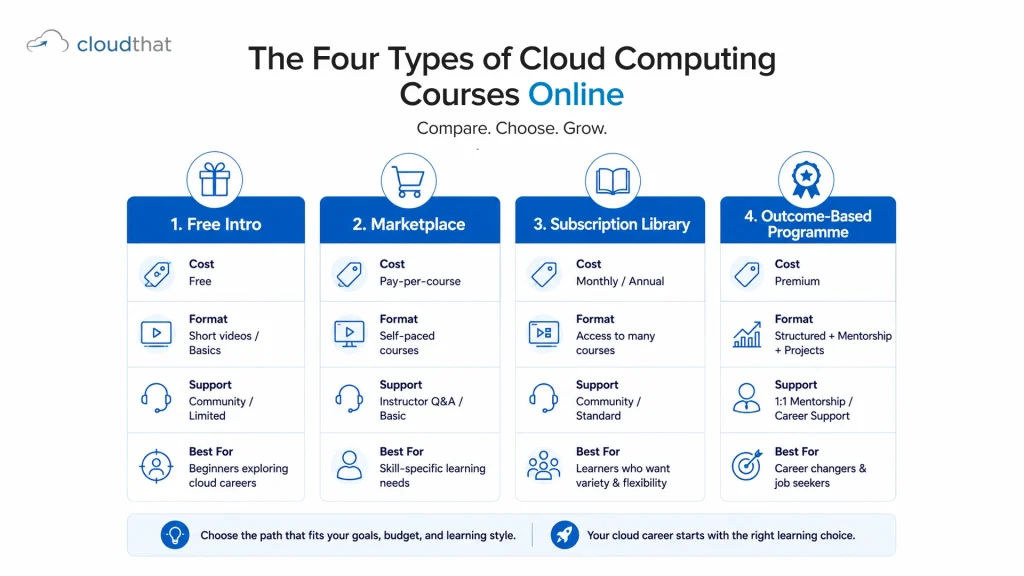
The Four Types of Cloud Computing Courses Online (And Which You Need)
Before you pick, know what you are picking from.
Type 1: Free introductory courses. Google Cloud Skills Boost, AWS Skill Builder free tier, Microsoft Learn. Great for testing whether the cloud is your space. Useless as a standalone path to a job.
Type 2: Marketplace courses. Udemy, Coursera, individual courses. Cheap, vast catalog, wildly varying quality. Good for filling specific knowledge gaps. Not designed for job outcomes.
Type 3: Subscription learning libraries. A Cloud Guru, Pluralsight, Cloud Academy. Solid self-paced content. Light on live instruction, lighter on placement support.
Type 4: Outcome-based programs with placement. Programs like the Job Ready Cloud Operations Engineer Program. Live cohorts, capstone projects, structured certification preparation, and placement assistance are built into the curriculum.
If your goal is “learn what cloud computing is,” any of the first three works. If your goal is “land a cloud engineer job in six to nine months,” type four is the only category that matches the goal.
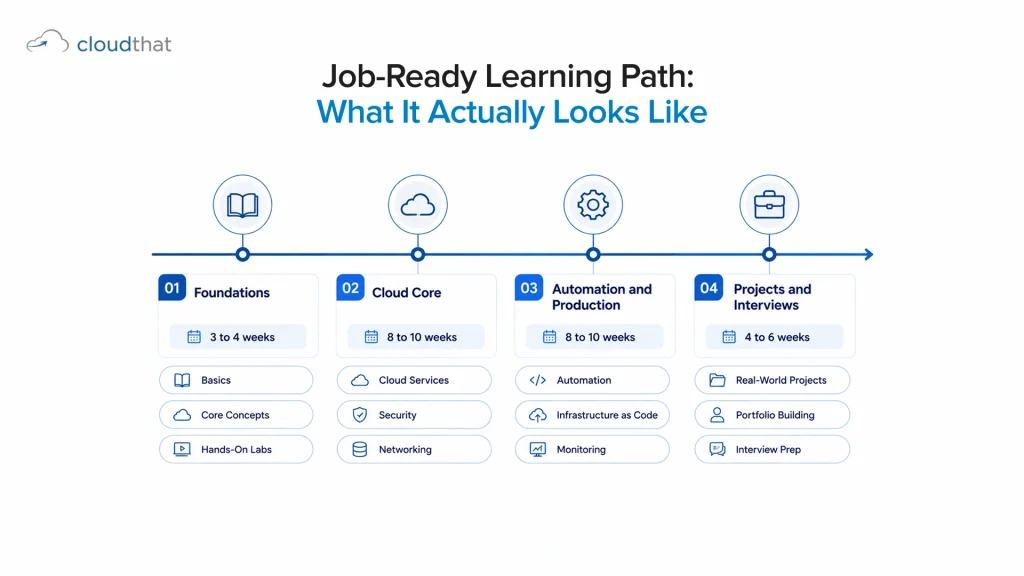
Job-Ready Learning Path: What It Actually Looks Like?
A job-ready path through cloud computing courses online has four phases. Skip any of them and you will struggle in interviews.
Phase 1: Foundations (3 to 4 weeks). Linux basics, networking fundamentals, Python at a working level, version control with Git. This phase is short but non-negotiable.
Phase 2: Cloud core (8 to 10 weeks). Pick one major cloud provider. AWS for Indian audiences is the highest-leverage choice. Cover compute, storage, networking, identity, security, and cost management end to end. Pass one foundational certification at the end of this phase.
Phase 3: Automation and production (8 to 10 weeks). Terraform, CI/CD pipelines, Docker, Kubernetes basics, observability. This is the phase that separates beginners from hireable cloud engineers.
Phase 4: Projects and interview preparation (4 to 6 weeks). Three real projects on GitHub with proper documentation. Mock interviews. CV reviews. Active job applications.
Total: roughly six months if you are already in tech, nine to twelve months if you are switching careers from outside tech.
Skills Every Cloud Computing Course Online Must Cover in 2026
If a course curriculum is missing any of these, ask why before paying.
Foundational layer:
- Linux, shell scripting, networking
- Python at a working level (not just syntax tutorials)
- Git, branching, pull request workflows
Cloud core:
- Compute, storage, networking, IAM, security across at least one provider
- VPC, subnets, routing, load balancing
- Cloud cost management and FinOps basics
Automation and modern engineering:
- Terraform end to end, including modules and state management
- CI/CD with GitHub Actions, GitLab CI, or Jenkins
- Containerisation with Docker, orchestration with Kubernetes
Production readiness:
- Observability with CloudWatch, Prometheus, Grafana
- Incident response, post-mortems, runbooks
- Cloud security and compliance basics
For the official AWS reference on what production cloud teams are expected to know, the AWS Well-Architected Framework documentation is the most useful free resource on the internet.
Certifications That Recruiters in India Actually Care About
A certificate from any online cloud computing course is one signal. A vendor certification is a different signal entirely. Vendor certifications are gatekept by real exams.
AWS certifications that move the needle:
- AWS Certified Cloud Practitioner (entry signal)
- AWS Certified Solutions Architect Associate (most requested)
- AWS Certified SysOps Administrator Associate
- AWS Certified DevOps Engineer Professional
Microsoft Azure:
- Azure Fundamentals (AZ-900)
- Azure DevOps Engineer Expert (AZ-400)
- Azure Administrator Associate (AZ-104)
- Azure Solutions Architect Expert (AZ-305)
Google Cloud:
- Associate Cloud Engineer
- Professional Cloud Architect
Stick to one provider for the first year. Multi-cloud is for engineers with two-plus years of single-cloud experience, not for first job seekers.
For Microsoft’s official cloud computing training roadmap, the Microsoft Learn training catalog is structured and free, and it pairs well with a paid program that adds live instruction and labs.
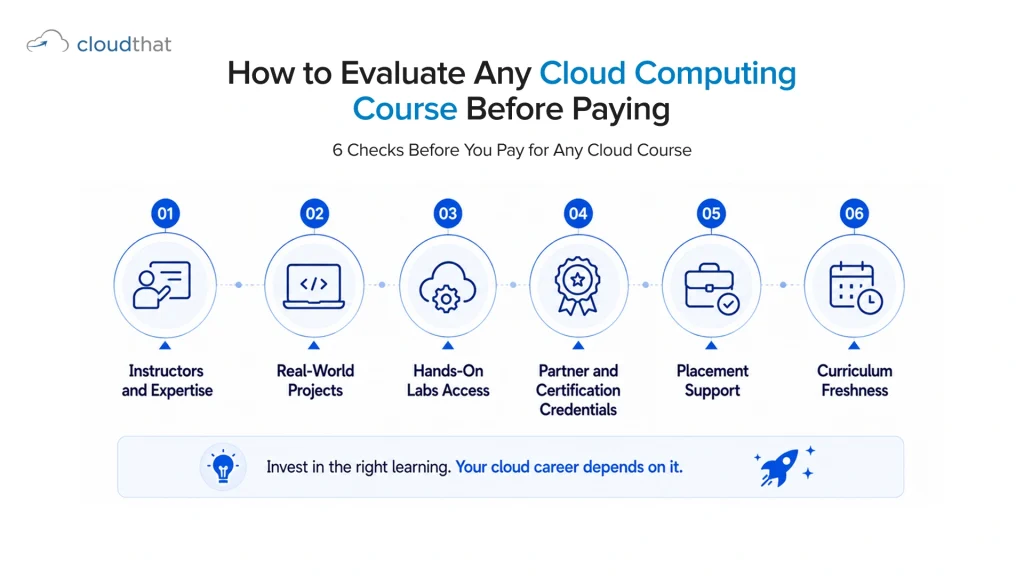
How to Evaluate Any Cloud Computing Course Before Paying?
Six checks. Run them on every course you are considering.
- Who teaches it. Named instructors with LinkedIn profiles you can verify. Real consulting or engineering backgrounds, not just teaching careers.
- What you build. At least three GitHub-ready projects. If the deliverables are only quizzes, walk away.
- Hands-on lab depth. Sandboxed cloud environments with real services. Not just screen-recorded walkthroughs.
- Partner credentials. AWS Premier Tier, Microsoft Partner, and Google Cloud Partner status. These are audited, not bought.
- Placement structure. If a course claims placement, ask for a defined process and a recent placement record. Vague claims fail this check.
- Curriculum freshness. A 2026 cloud course must include Terraform, Kubernetes, observability, and at least one module on cloud-native AI services. If the curriculum still ends at EC2 and S3, it is dated.
The 2025 Stanford AI Index report tracks the cloud and AI engineering talent market closely. The signal across both: employers in 2026 buy engineers with shipped work, not engineers with certificates alone.
Free vs Paid Cloud Computing Courses: The Honest Comparison
Free courses are excellent for one thing. Testing whether cloud is your space without spending money.
The free courses worth your time:
- Microsoft Learn modules for Azure
- AWS Skill Builder free tier
- Google Cloud Skills Boost free path
- DeepLearning.AI introductory courses
- The CloudThat free cloud courses portal
Paid courses are worth it when:
- You are committing to a job outcome and need structure
- You need live instructor support, not just videos
- You need a sandboxed lab environment, not your own AWS account bleeding money
- You need placement support tied to the program
If you have already burned through three free courses and still feel stuck, you are not the problem. Self-paced free content lacks the feedback loops that make an engineer job-ready.
How Long Does It Realistically Takes?
Be honest about the numbers.
If you are already in tech with engineering, IT support, or developer experience, six to seven months of focused learning at 10 to 12 hours a week.
If you are switching from a non-tech background, nine to twelve months.
Anyone selling a “land a cloud job in 30 days” guarantee is overselling. Cloud engineering work cannot be compressed that hard without breaking the learning process. Pick a program with realistic timelines and stick with it.
Why CloudThat Offers the Most Job-Ready Cloud Computing Courses Online?
If you are picking between cloud computing courses online and you want a job-ready path, not just a certificate sticker, the Job Ready Cloud Operations Engineer Program is structured for that. Live cohorts, hands-on labs across AWS, IAM, VPC, EC2, EKS, CloudWatch, Terraform, and CI/CD, capstone projects modeled on real enterprise patterns, and placement assistance built in.
If you would rather buy a year of self-paced cloud training across the full AWS catalog, the AWS Mastery Pass is ₹1,14,900 for 35+ AWS courses, including Solutions Architect Associate, SysOps Administrator, and DevOps Engineer Professional. EMI starts at ₹4,999 a month. The Azure Mastery Pass at ₹49,900 covers 17 Azure certifications. The DevOps Mastery Pass at ₹74,900 covers the full DevOps track.
Specifically for exam preparation, testprep.cloudthat.com offers practice tests and mock exams for AWS, Azure, and Google Cloud certifications. Used by candidates who want to validate readiness before booking the exam slot.
For learners testing the waters, the free cloud courses portal offers introductory tracks on AWS, Azure, and Google Cloud at no cost.
If your company is upskilling a cohort of 50 or 500 engineers, the Capability Development Framework takes them from baseline to billable in 1 to 60 days. Pre-training assessment first. Custom learning paths per role next. Hands-on labs, weekly evaluation, and a project-readiness check at the end. No batch size minimum.
If you would rather hire job-ready cloud engineers than train them, Hire From Us connects you to engineers who have already finished the same training stack and shipped real projects.
Everything sits atop AWS Premier Tier Services Partner status, plus partnerships with Microsoft, Google Cloud, and NVIDIA. These aren’t badges you buy. They are audited.
Conclusion
Picking among cloud computing courses online is not about brand recognition. It is about matching the course type to your goal. Free for exploration. Marketplace for filling specific gaps. Subscription libraries for self-paced depth. Outcome-based programmes for landing a job.
To see how a job-ready cloud computing course online is actually structured, explore the Job Ready Cloud Operations Engineer Program on the CloudThat training page.
Key Takeaways:
- Most cloud computing courses online are built for watch time, not job outcomes. Pick courses that map to a job-ready path.
- The four types of courses (free, marketplace, subscription library, outcome-based program) serve different goals. Match the type to your goal.
- A job-ready path takes six to twelve months and covers foundations, cloud core, automation, and projects.
- AWS certifications dominate demand among Indian recruiters, followed by Azure and Google Cloud.
- Free courses are useful for exploration. Paid programs with a placement structure are useful for outcomes.
- Audit any course on six checks: instructors, projects, labs, partner credentials, placement structure, and curriculum freshness.
Already in IT? Switch to Cloud & Earn 55% More
- Weekend Batches
- Dedicated Career Support
- Official AWS Labs
About CloudThat
FAQs
1. Are cloud computing courses online enough to land a job?
ANS: – Only if the course is built around job outcomes. Free or marketplace courses can teach you concepts, but outcome-based programs with hands-on labs, capstone projects, and placement support are what actually lead to roles.
2. Can I self-learn cloud computing for free?
ANS: – Yes, partly. Microsoft Learn, AWS Skill Builder, Google Cloud Skills Boost, and freecloudcourses.com all offer free content. You will still need a vendor certification and three real projects to convert that learning into a job.
3. Can I learn cloud computing in 3 months?
ANS: – You can learn the foundations in three months. Becoming job-ready takes six to seven months if you are already in tech, and nine to twelve months if you are switching from non-tech. Anything shorter is overselling.
4. Which cloud is easiest to learn first?
ANS: – AWS for Indian audiences. It dominates enterprise cloud adoption in India and is the most asked-for skill on Indian JDs. Add Azure or Google Cloud after one to two years.
5. Is AI replacing cloud engineers?
ANS: – No. AI is changing what cloud engineers do, not eliminating the role. The boring parts are getting automated. The hard parts, architecture, security, and migration, still need humans.
6. Is cloud computing a high-paying career in India?
ANS: – Yes. Freshers with certifications and projects start between ₹6 LPA and ₹12 LPA. Mid-level engineers earn ₹14 LPA to ₹28 LPA. Senior engineers cross ₹30 LPA, often higher in product companies.
7. Do online cloud computing courses come with placement?
ANS: – Some do, most don’t. Outcome-based programmes like the Job Ready Cloud Operations Engineer Program build placement assistance in. Avoid courses with vague “placement support” claims and no defined process.

WRITTEN BY Himisha Raval
Himisha Raval is a Digital Marketing Manager at CloudThat with a strong command of search engine optimization, web analytics, link building, and content strategy. She brings a data-driven approach to digital marketing, helping IT companies strengthen their online presence, improve search rankings, and generate consistent leads across channels. Beyond execution, she plays an active role in ideation, campaign strategy, and website performance optimization. Outside of work, she balances her analytical side with a love for travel, nature painting, and dancing.


 PREV
PREV











Comments