

 Login
Login


 June 5, 2026
|
Voiced by Amazon Polly |
Introduction
Every working professional I know has a half-finished GenAI course sitting somewhere.
A Coursera tab pinned for three months. A Udemy purchase from a Black Friday sale. A YouTube playlist that never got past the third video. And the recurring guilt of “I should really learn GenAI before it changes my job description.”
Here’s the honest part. Most GenAI courses out there are not built for you.
They are built for a generic learner who has time to start from scratch. All you need is a GenAI course that respects your existing experience and teaches the specific things that map to your day job.
This blog is for cloud engineers, software developers, and DevOps professionals trying to figure out what to learn, what to skip, and what a GenAI course should actually cover in 2026.
No Job After Graduation? Cloud Engineering is Your Answer
- Beginner Friendly
- 92% Placement Rate
- Live Instructor-Led
Why Most GenAI Courses Don’t Work for Working Professionals?
Open any “best GenAI courses” list. Same names show up. Same structure. Module 1 is “What is Generative AI.” Module 2 is “Brief History of LLMs.” Module 3 is “Demo with ChatGPT.”
You need to know how to embed your company’s data into a vector store. How to evaluate retrieval quality. How to wire an agent into your existing API. How to ship this without your security team blocking the deployment.
Before you enrol anywhere, audit the syllabus. If more than 30 percent of the modules are conceptual, that course is not for you.
What a GenAI Course Should Look Like for Cloud Engineers?
You already understand IAM, VPCs, S3, Lambda, and the difference between a managed service and a self-hosted one. Good. That is a head start.
What you need from a GenAI course:
- Hands-on with Amazon Bedrock, Sagemaker, and the AWS GenAI service stack
- How to provision a Bedrock knowledge base on top of your own data
- How to set up guardrails for prompt injection and data exfiltration
- How to design retrieval-augmented generation pipelines that actually scale
- How to think about cost. GenAI workloads bill differently from compute workloads, and that catches teams off guard
If you are still building your cloud foundation, starting with the AWS Certified Cloud Practitioner or Azure Fundamentals (AZ-900) before moving into GenAI-specific tracks is the cleanest path. The GenAI layer sits on top of those foundations, not beside them.
For a baseline on how AWS frames production GenAI design, the AWS Generative AI Lens for the Well-Architected Framework is the most useful reference document on the internet right now.
What a GenAI Course Should Look Like for Software Developers?
If you write code for a living, the bar is different. You already speak APIs, async patterns, error handling, and integration testing.
What actually matters in your GenAI training:
- Prompt engineering for structured outputs, not for marketing copy
- Function calling and tool use, because that is where most production GenAI features live
- LangChain, LlamaIndex, and how to evaluate whether you need them at all
- Evaluation frameworks. How do you know your LLM feature is regressing across versions?
- Building RAG into existing applications without rewriting your stack
A good GenAI course for developers will have you ship at least three working applications, not screenshots. If the deliverables are quizzes and a slide-deck capstone, you are paying for the wrong thing.
The official Microsoft Generative AI for Beginners curriculum is a reasonable free starting point if you want to test whether this is your space before paying for anything serious.
What a GenAI Course Should Look Like for DevOps Professionals?
This is the role where GenAI is changing the fastest, and almost no course actually addresses it well.
What you should be learning:
- LLMOps. Deployment patterns, versioning, A/B testing for prompts
- Observability for GenAI applications. Hallucination tracking, latency, token usage, cost per request
- Building CI/CD pipelines that include LLM evaluation gates
- Infrastructure-as-code for GenAI workloads on AWS, Azure, or GCP
- Security and compliance. Prompt injection is a real attack surface, and most DevOps teams are not ready
You need a program that includes specific DevOps and MLOps modules, not GenAI bolted onto a developer track. Whether you are targeting an Azure DevOps certification (AZ-400) or AWS Certified DevOps Engineer, the underlying LLMOps patterns are the same. Learn the engineering first.
The CloudThat AWS Mastery Pass and its DevOps Mastery Pass are structured to cover this overlap, because the trainers also run live GenAI consulting engagements for enterprise clients. Which means the LLMOps content is built from real production patterns, not borrowed from a textbook.
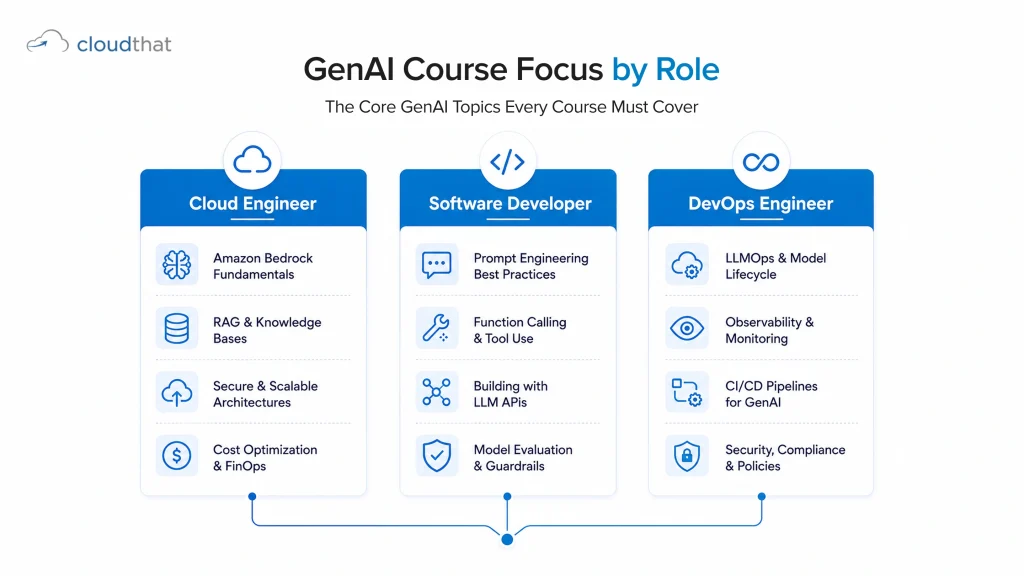
The Core GenAI Topics Every Course Must Cover
Regardless of your role, a GenAI course in 2026 must include these. If even one is missing, pick a different course.
- Foundation models and what makes them different from each other
- Prompt engineering, beyond basic prompting tricks
- Retrieval-augmented generation, end-to-end
- Fine-tuning with parameter-efficient methods like LoRA and QLoRA
- Agentic workflows, action groups, and multi-step reasoning
- Evaluation. The single most ignored topic and the one that separates serious engineers from prompt hobbyists
- Security, guardrails, and responsible AI patterns
- Cost optimization and inference economics
If a course only covers the first three points, it is a rebadged 2023 GenAI course.
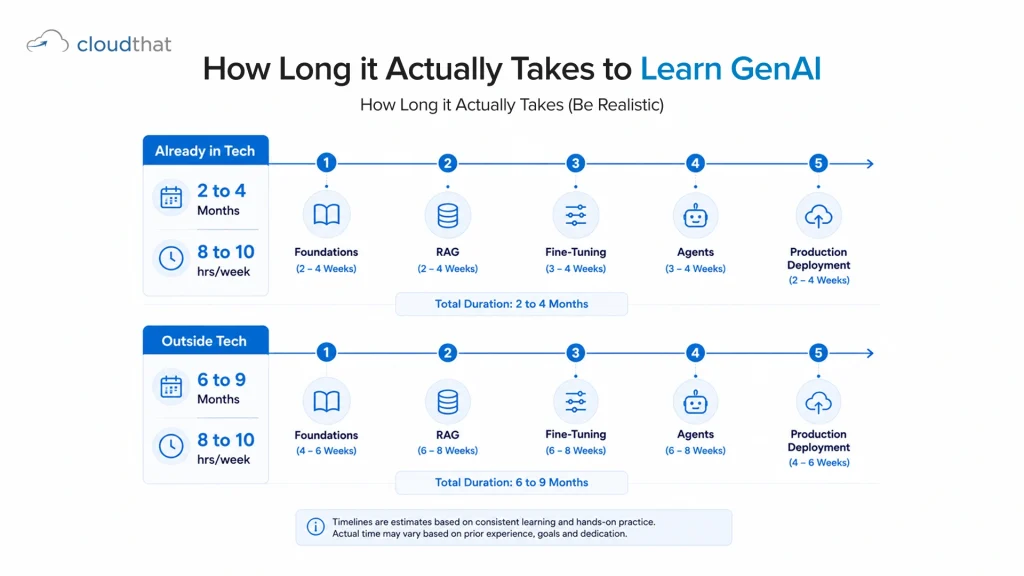
How Long Does It Actually Take (Be Realistic)?
People ask this every week. The honest answer depends on your starting point.
If you are already a cloud engineer or an experienced developer, two to four months of focused learning, around 8 to 10 hours a week, will get you to a working GenAI engineer level. Not an expert. Working level. Enough to ship features and contribute to production work.
If you are starting from outside tech, plan for six to nine months. You need to build cloud and coding foundations first.
How to Evaluate a GenAI Course Before Paying?
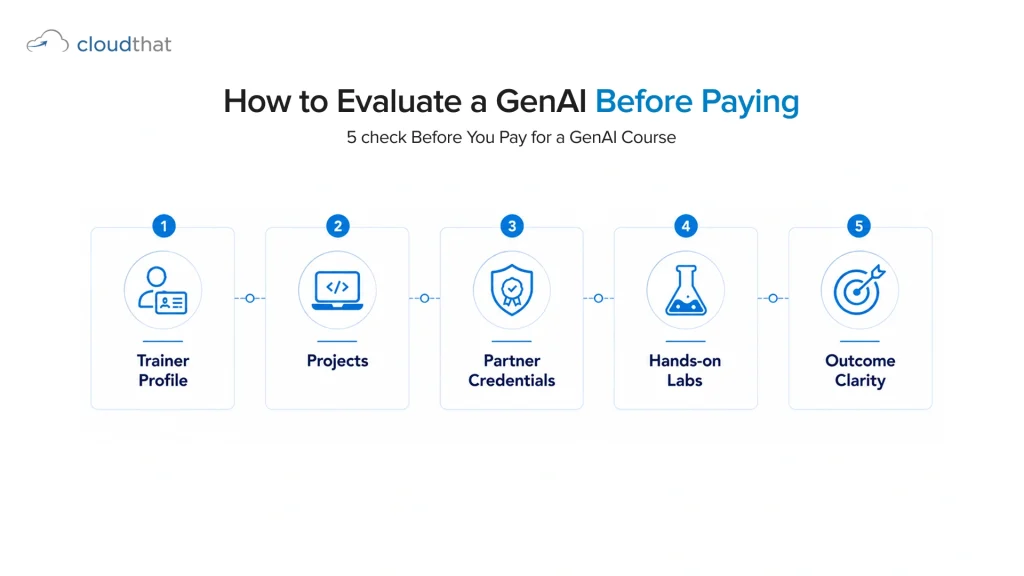
Five checks before you spend any money.
Who teaches it. Real practitioners with named profiles and live consulting work. Not anonymous content teams.
What you build. At least three projects you can put on a public GitHub. RAG, fine-tune, agent. Anything less is incomplete.
Partner credentials. AWS Premier Tier, Microsoft Partner, and NVIDIA Training Partner status are not optional vanity. They get audited. A cloud computing course provider that holds these has cleared a bar that most training companies cannot.
Hands-on lab depth. Sandboxed cloud environments with real services, not local notebook simulations.
Outcome clarity. What can you do after the course that you couldn’t before? If the answer is unclear, the course is unclear.
The 2025 Stanford AI Index report tracks global trends in GenAI talent and training. The signal is consistent. Employers in 2026 are not buying certificates.
Why CloudThat Is the Best GenAI Course Provider for Cloud, DevOps, and Software Professionals?
If you are a working professional trying to upskill without taking a sabbatical, the AWS Mastery Pass is the practical option. 35+ AWS courses for a year, at ₹1,14,900, with EMI from ₹4,999 a month. The Bedrock workshops, SageMaker tracks, and agentic workflow labs are included in the subscription. So is the AWS Machine Learning Specialty prep.
If your stack is Microsoft, the Microsoft Security Mastery Pass and the Azure-focused GenAI tracks are structured similarly. Annual subscription, hands-on labs, real cohorts. Whether you are preparing for Azure AI-102, AZ-400, or AZ-900, the learning paths are mapped to the certifications that hiring managers actually shortlist.
CloudThat’s cloud computing courses also cover NVIDIA AI tracks for teams building GPU-intensive GenAI workloads, DevOps training and certification that includes LLMOps modules, Google Cloud certification, and full-stack development tracks. The training calendar lists all upcoming live cohorts across all platforms, so you can pick a schedule that fits your workweek.
The reason these work for senior engineers is the trainers. The same team that ships Bedrock implementations, RAG pipelines, and fine-tuning rollouts through the GenAI Innovation Center runs the live classes. The lab patterns are the patterns being delivered to enterprise clients right now. Not last year’s. Not a Coursera reshoot.
For exam prep at your own pace, testprep.cloudthat.com covers the AWS, Azure, and Google Cloud GenAI certifications.
For corporate L&D heads upskilling cohorts of cloud and DevOps engineers, the Capability Development Framework takes them from baseline to billable on GenAI projects in 1 to 60 days. Pre-training assessment, a custom learning path per role, hands-on labs, weekly evaluation, and a project-readiness check at the end. No batch size minimum. It is the same framework used for corporate training programs at Accenture, Deloitte, HCL, and Protiviti.
And if you would rather hire GenAI-ready talent than build it, Hire From Us connects you to engineers who have already gone through the same training stack.
Conclusion
A GenAI course in 2026 is not a generic purchase. The right one depends on what you already do for a living and what you want to build next. Audit the syllabus, check the trainers, look at the projects you walk away with, and ignore any program that compresses real engineering work into two weeks.
To see the GenAI training tracks built specifically for cloud, software, and DevOps professionals, explore the AWS Mastery Pass and live cohorts on the CloudThat training calendar. If your organization needs a structured path to upskill a full team, the Capability Development Framework is where to start.
Key Takeaways:
- Most GenAI courses are built for beginners and waste a working professional’s time on conceptual modules.
- Cloud engineers should focus on Bedrock, Sagemaker, guardrails, RAG, and cost design.
- Software developers should focus on function calling, tool use, RAG integration, and evaluation frameworks.
- DevOps professionals should look specifically for LLMOps, observability, and CI/CD-for-GenAI content. This is the rarest combination on the market.
- A real GenAI course in 2026 must cover RAG, fine-tuning, agentic workflows, evaluation, security, and cost. Anything less is outdated.
- Two to four months for experienced engineers. Six to nine months if starting from outside tech.
Already in IT? Switch to Cloud & Earn 55% More
- Weekend Batches
- Dedicated Career Support
- Official AWS Labs
About CloudThat
FAQs
1. Which GenAI course is best for a working professional in 2026?
ANS: – The one that matches your existing role. A cloud engineer needs Bedrock and AWS GenAI services. A developer needs function calling, RAG, and evaluation. A DevOps engineer needs LLMOps and observability. The AWS Mastery Pass covers all three under one subscription.
2. Can anyone learn GenAI without an ML background?
ANS: – Yes. Modern GenAI engineering is more about API integration, prompt design, retrieval, and evaluation than classical ML theory. You can pick this up alongside your existing job without going back to first principles.
3. Is a GenAI course worth it in 2026?
ANS: – Yes, if it includes hands-on labs and ships you with real projects. No, if it is a series of conceptual videos with quizzes. Audit the syllabus before paying.
4. How long does it take to learn GenAI seriously?
ANS: – Two to four months at 8 to 10 hours a week if you are already in tech. Six to nine months if you are starting from outside tech.
5. Is there a GenAI course for Java developers specifically?
ANS: – Most good GenAI courses are language-agnostic and use Python for examples, but Java developers transition cleanly once they understand API patterns. The function-calling and RAG modules port directly.
6. Do I need to learn machine learning before learning GenAI?
ANS: – Not necessarily. You can learn working GenAI engineering without deep ML theory. Add ML fundamentals later if you want to move into research or model development.
7. Are free GenAI courses good enough?
ANS: – For awareness, yes. For employability, no. Free courses are useful starting points, but rarely include the hands-on lab depth that hiring managers shortlist on.

WRITTEN BY Himisha Raval
Himisha Raval is a Digital Marketing Manager at CloudThat with a strong command of search engine optimization, web analytics, link building, and content strategy. She brings a data-driven approach to digital marketing, helping IT companies strengthen their online presence, improve search rankings, and generate consistent leads across channels. Beyond execution, she plays an active role in ideation, campaign strategy, and website performance optimization. Outside of work, she balances her analytical side with a love for travel, nature painting, and dancing.


 PREV
PREV











Comments