

 Login
Login


 May 22, 2026
|
Voiced by Amazon Polly |
Overview
Modern cloud security platforms are highly effective at detecting threats, but the real challenge lies in reducing the time between detection and response. Autonomous security agents introduce an intelligent response layer that can investigate findings, assess context, execute containment actions, and escalate incidents continuously without waiting for human intervention. This article covers how AWS Security Agent can be used alongside Amazon GuardDuty, AWS Security Hub, and AWS CloudTrail to build always-on security operations with automated containment, investigation playbooks, phased implementation strategies, and operational guardrails.
Pioneers in Cloud Consulting & Migration Services
- Reduced infrastructural costs
- Accelerated application deployment
Introduction
Detection isn’t the problem anymore. Amazon GuardDuty identifies threats in minutes. Security Hub aggregates findings across accounts. CloudTrail captures every API call. The tooling works.
The problem is what happens next. IBM’s 2025 Cost of a Data Breach Report reports an average detection-to-containment gap of 67 days in cloud environments. Even mature SOC teams take 45+ minutes for initial triage during business hours, and after hours, that stretches further. Attackers exploit this gap. Autonomous security agents close it by shifting humans from the response path to the review path.
How Autonomous Security Monitoring Differs from Traditional SIEM
Traditional security monitoring follows a linear pipeline: collect logs → correlate events → generate alerts → wait for human action. The human is the bottleneck.
Autonomous security agents introduce a reasoning layer between detection and response:
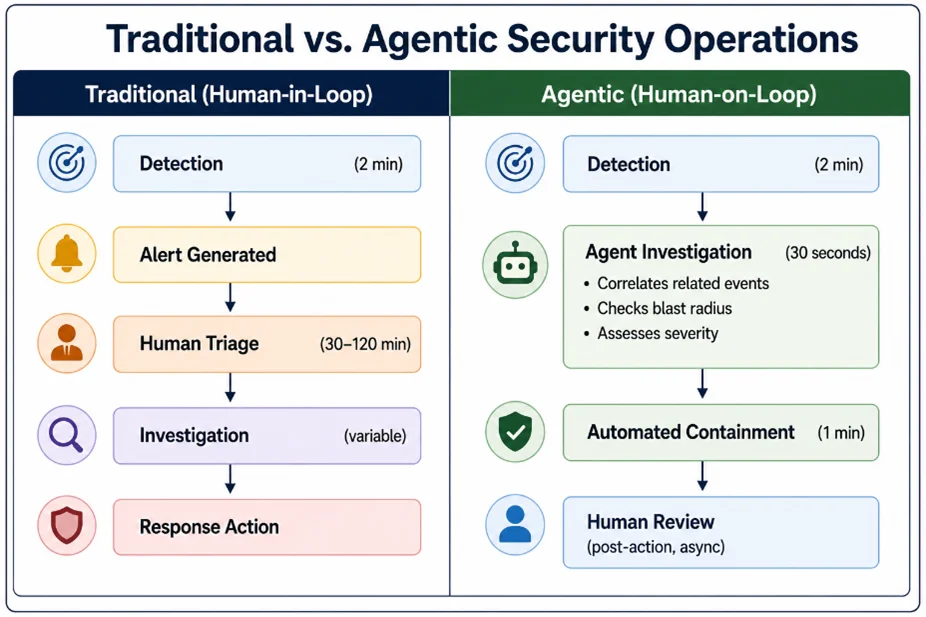
The key distinction: humans shift from the critical response path to the review path. The agent contains the threat immediately; the security team validates the action afterward.
Architecture: Building Continuous Monitoring with AWS Security Agent
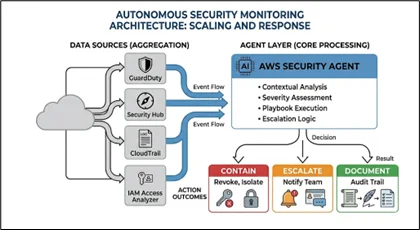
Automated Response Actions by Severity
Not every finding warrants the same response. The agent operates on a tiered model:
Critical Findings — Immediate Automated Containment
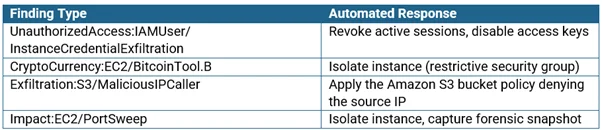
High Findings — Automated Investigation + Conditional Response
The agent investigates context before acting:
- Was an authorized pipeline responsible for this AWS IAM change?
- Is this network pattern consistent with a known deployment?
- Does the source IP belong to a corporate VPN range?
If context confirms the threat, the agent contains. If ambiguous, it escalates with its investigation summary.
Medium/Low Findings — Enrichment and Queuing
The agent enriches the finding with additional context (related AWS CloudTrail events, resource tags, historical patterns) and queues it for human review during business hours.
Implementation: A Phased Approach
Phase 1: Foundation (Week 1-2)
Enable the detection layer across all accounts:
- Amazon GuardDuty with Amazon S3 protection, Amazon EKS audit logs, and Lambda monitoring
- AWS Security Hub with AWS Foundational Security Best Practices standard
- AWS CloudTrail organization trail with management and data events
- AWS EventBridge rules routing findings to a central security account
Phase 2: Automated Response for High-Confidence Scenarios (Week 3-4)
Start with responses that have near-zero false positive risk:
- Compromised credential revocation (Amazon GuardDuty credential exfiltration findings have >99% true positive rate)
- Cryptocurrency mining instance isolation
- Known-malicious IP blocking via AWS WAF
Phase 3: Agent-Driven Investigation (Week 5-8)
Deploy Security Agent with investigation playbooks:
- Privilege escalation analysis (correlate AWS IAM changes with AWS CloudTrail actor history)
- Lateral movement detection (map network flows against expected service communication)
- Data exfiltration assessment (compare Amazon S3/database access patterns against baselines)
Phase 4: Continuous Improvement (Ongoing)
- Review agent decisions weekly, adjust thresholds based on false positive rates
- Expand automated response to new finding types as confidence builds
- Integrate with ticketing systems for audit trail and compliance documentation
Essential Amazon Guardrails
Autonomous response without constraints creates operational risk. These guardrails are non-negotiable:
Blast Radius Limits — The agent can modify security groups on individual resources, but cannot alter VPC-level network ACLs or organization-wide SCPs.
Dry-Run Period — Every new playbook runs in observation mode for 30 days. The agent logs what it would have done, but does not execute.
Automatic Rollback — Every containment action has a time-limited revert. If a human doesn’t confirm the action within 4 hours, the change reverts automatically.
Audit Trail — Every agent decision is logged with: the finding that triggered it, the investigation steps taken, the reasoning for the chosen action, and the action executed.
Measuring Effectiveness
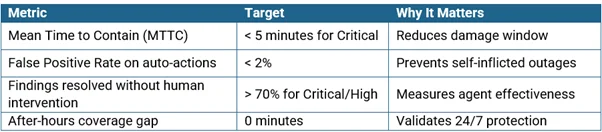
Conclusion
The value of autonomous security agents isn’t replacing security engineers, it’s eliminating the response latency that attackers exploit. Start with the phased approach: enable detection, automate high-confidence responses, then expand to agent-driven investigation.
Drop a query if you have any questions regarding Security Agents and we will get back to you quickly.
Empowering organizations to become ‘data driven’ enterprises with our Cloud experts.
- Reduced infrastructure costs
- Timely data-driven decisions
About CloudThat
FAQs
1. What's the false positive risk of automated containment?
ANS: – For the recommended starting scenarios (credential exfiltration, cryptocurrency mining), Amazon GuardDuty’s true positive rate exceeds 99%. The phased approach, starting with only high-confidence findings, minimizes the impact of false positives. The automatic rollback mechanism provides a safety net for the rare false positive.
2. Does this satisfy compliance requirements for incident response?
ANS: – Yes. The agent generates complete audit trails documenting detection, investigation, decision-making, and actions taken, meeting requirements for SOC 2, PCI-DSS, and HIPAA incident response documentation. Human review of agent actions satisfies the “management oversight” requirement in most frameworks.
3. How does this integrate with existing SIEM tools like Splunk or Datadog?
ANS: – AWS Security Hub findings and agent action logs can be exported to any SIEM via AWS EventBridge → Kinesis Firehose → your SIEM’s ingestion endpoint. The agent doesn’t replace your SIEM, it adds an automated response layer between detection and your existing investigation workflows.
4. What's the cost of running Security Agent?
ANS: – Pricing is based on findings processed and actions executed. For a typical enterprise account generating 500-1000 findings/month, expect $200-$500/month for the agent layer, significantly less than the cost of one additional SOC analyst for after-hours coverage.


WRITTEN BY Vignesh J
Vignesh Jagadeesan is the Head of Presales at CloudThat with 12+ years of experience driving digital transformation for Public Sector, SMB, and Enterprise customers across India and the USA. He specializes in Cloud Consulting, Data Management, MDM, Analytics, and enterprise modernization. Vignesh has led transformation engagements spanning cloud adoption, analytics, managed services, and enterprise solutioning across government, BFSI, healthcare, retail, manufacturing, and energy sectors, partnering with business stakeholders and cloud partners to deliver scalable, outcome-driven solutions.


 PREV
PREV









Comments