

 Login
Login


 May 22, 2026
|
Voiced by Amazon Polly |
In the era of AI, the demand for machine learning engineers and data scientists has increased significantly, leading to a surge in ML courses. However, many of these programs present machine learning as a collection of algorithms: linear regression, decision trees, neural networks, clustering, and more. Most courses begin with mathematics, Python, and model implementation. While these are essential, starting here often creates a gap between learning and real-world application.
In industry, machine learning professionals are expected to solve business problems, not just implement algorithms. Organizations ask questions such as: How can fraudulent transactions be detected? Strong technical knowledge alone cannot answer this. Before choosing any algorithm, one must identify, frame, and clearly define the problem. This step determines whether the solution will be useful or not.
Start Learning In-Demand Tech Skills with Expert-Led Training
- Industry-Authorized Curriculum
- Expert-led Training
The Algorithm First Approach
The traditional approach to learning machine learning emphasizes mathematics, coding, and model optimization. While this builds technical depth, it does not always lead to meaningful solutions because it often overlooks problem clarity. For instance, if a company experiences a decline in sales, a learner trained in this approach may immediately think of applying regression. However, important questions should come first: Is the problem descriptive, predictive, or prescriptive? What exactly should be predicted? Which factors influence the outcome? Without answering these questions, even a highly accurate model may fail to deliver value. Machine learning is not just about applying algorithms; it is about solving the right problem effectively.
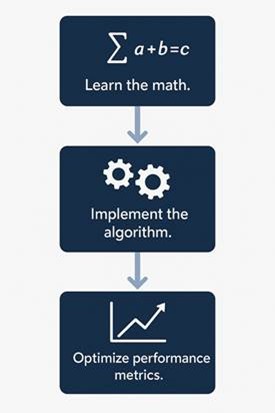
Fig 1: Traditional learning path of machine learning.
Problem-Finding in Machine Learning?
Problem-finding is the structured process of transforming a business challenge into a well-defined machine learning task. It includes:
- Understanding stakeholder objectives
- Defining measurable outcomes
- Evaluating data availability and quality
- Selecting appropriate success metrics
For example:
“Reduce customer churn” becomes → “Predict probability of churn within 30 days.”
Only after achieving this clarity should one decide whether to use classification, regression, clustering, or deep learning. Problem-finding converts vague ideas into a structured analytical direction.
Why Problem-Finding Builds Better ML Professionals
- It Aligns Models with Business Value
A model that solves the wrong problem creates no value, even if it is technically accurate. Starting with problem-finding helps learners connect outputs to real decisions. For example, predicting churn with high accuracy is not useful if the prediction comes too late to act on it. Timing and usability matter as much as performance. A problem-first approach ensures models support actionable outcomes.
- It Encourages Data Awareness
Before selecting algorithms, important questions must be asked:
- Is enough data available?
- Is the data labelled?
- Are there biases and privacy concerns?
This mindset prevents unrealistic expectations and unnecessary complexity. It also introduces learners to data governance and compliance early on. Even when using platforms like Amazon SageMaker to build and deploy models, meaningful results depend on proper problem framing.
- Reduces Over-Reliance on Complex Models
Beginners often assume that more complex models, such as deep learning, are always better. In reality, simpler models can perform just as well when the problem is clearly defined. A well-framed problem might reveal that logistic regression is sufficient. Poor problem definition, on the other hand, leads to unnecessary complexity and higher costs. Problem-finding promotes efficiency and clarity.
- Develops Communication Skills
Machine learning professionals work with diverse teams, including business stakeholders and engineers. The ability to ask the right questions and clearly explain the problem is often more valuable than technical expertise alone.
A problem-first approach helps learners:
- Translate business needs into ML tasks
- Set realistic expectations
- Define measurable success criteria
These skills are essential for long-term career growth.
Real-World ML Projects Start with Questions
In practice, successful ML projects follow a structured approach:
- Define the business objective from an ML perspective
- Assess data readiness
- Select modelling approach
- Deploy and monitor
Algorithm selection is not the starting point; it comes later in the process.
When learners adopt this mindset, they evolve from simply building models to designing solutions. Cloud platforms support this workflow with tools for data handling, training, and deployment.
How to Learn the Problem-Finding Approach
Developing a problem-first mindset requires practice and structured learning. It cannot be achieved through algorithm tutorials alone.
- Start with Business Case Studies
Instead of focusing on coding first, analyse real-world scenarios. Practice converting vague statements into measurable tasks.
Example:
“Customers are unhappy” → Could this be sentiment analysis, churn prediction, or service quality scoring?
This improves analytical thinking and clarity.
- Practice Framing Before Modelling
Before writing code, consider:
- What decision will the model influence?
- How will success be measured?
- What are the risks of incorrect predictions?
In some cases, simple statistical or rule-based approaches may be sufficient. Recognizing this reflects strong problem understanding.
- Learn Through Structured, Industry-Aligned Courses
An effective machine learning course should:
- Start with business problem identification
- Emphasize data understanding
- Teach model selection based on problem type
While many courses still follow the traditional path, some organizations now adopt a problem-first approach. These programs not only teach machine learning but also enable learners to apply it effectively in real-world scenarios and drive innovation.
The Future of ML Education
As machine learning becomes more widespread, the demand is shifting. Organizations no longer need professionals who understand only algorithms. They need individuals who can:
- Identify impactful problems
- Evaluate feasibility
- Design scalable solutions
- Align ML initiatives with business goals
Education must evolve to meet these needs. Courses that begin with problem-finding produce professionals who are adaptable and capable of delivering measurable results.
Why Problem Definition Matters
Machine learning is not just a collection of algorithms; it is a structured approach to solving real-world problems using data. Starting with algorithms builds technical knowledge, but it often lacks direction. Beginning with problem definition develops clarity, strategic thinking, and practical impact. The most effective ML professionals succeed not by using the most complex models, but by asking the right questions first. The real advantage lies in defining the right problem from the beginning.
Upskill Your Teams with Enterprise-Ready Tech Training Programs
- Team-wide Customizable Programs
- Measurable Business Outcomes
About CloudThat


WRITTEN BY Vijayanand K V
Vijayanand K V is a Senior Research Associate at CloudThat, specializing in Machine Learning. With 4 years of experience in Machine Learning, he has trained over 1000 students to upskill in Machine Learning, Deep Learning, and Generative AI. Known for simplifying complex concepts with hands-on practical, helping students to use technologies to develop creativity, he brings deep technical knowledge and practical application into every learning experience. Vijayanand's passion for learn everyday reflects in his unique approach to learning and development.


 PREV
PREV












Comments