

 Login
Login


 February 10, 2026
|
Voiced by Amazon Polly |
Overview
As content libraries grow, including documents, blogs, knowledge bases, and product pages, manual review quickly becomes a bottleneck. A multi-agent workflow scales content review by dividing the task among specialized AI agents that work in sequence. One agent scans the content and extracts what needs to be checked; the next verifies accuracy against trusted sources, and the last provides clear suggestions for improvements. AWS shows this method using Strands Agents, an open-source agent SDK, deployed on Amazon Bedrock AgentCore. This platform offers the infrastructure to deploy and manage agents at scale. The aim is not to replace reviewers but to automate repetitive validation. This allows humans to concentrate on important editorial and policy decisions.
Pioneers in Cloud Consulting & Migration Services
- Reduced infrastructural costs
- Accelerated application deployment
Introduction
Content review traditionally involves a single reviewer or a single large language model prompt to verify all aspects of content simultaneously: facts, tone, compliance, formatting, and brand voice. This does not scale well because it involves multiple tasks with different verification requirements and failure modes.
This design can be extended to other types of content by modifying the prompts, tools, and verification sources while maintaining the same design structure.
Why multi-agent review works?
Multi-agent workflows improve throughput and quality by design:
- Specialization reduces prompt complexity. Each agent has a narrow role, so outputs are more consistent than a single “do everything” prompt.
- Evidence-based verification becomes a first-class step. The verification agent checks claims against authoritative sources rather than relying on model memory.
- Outputs are structured and auditable. Each stage produces intermediate artifacts (claim lists, verification notes, fix suggestions) that teams can store for compliance and traceability.
- Humans shift to exception handling. Reviewers spend time on edge cases and policy calls, not on repetitive checks.
Practical example
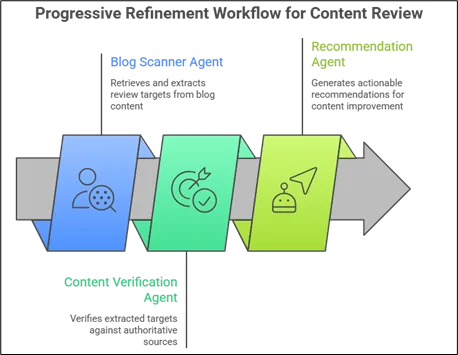
The AWS solution consists of a coordinated pipeline of three specialized agents, developed using Strands Agents and launched on Amazon Bedrock AgentCore, where each agent passes its results to the next. Amazon Bedrock AgentCore is promoted as a platform for deploying and managing agents at scale, helping teams run these processes smoothly.
To apply the design in your setup, you would add:
- A scheduler or trigger to scan new drafts or periodically re-scan evergreen pages.
- An artifact store (such as Amazon S3 or a database) for scanner results, verification evidence, and recommendation reports (useful for audit trails).
- A source-of-truth layer for verification: product docs, release notes, internal policy pages, runbooks, or knowledge bases.
- A human approval gate to confirm high-risk changes before publishing.
Even if you begin with a straightforward “URL in -> report out” pipeline, the multi-agent approach provides a clear way to add enterprise-class governance by naturally separating detection, verification, and remediation.
Scaling strategies and operating model
With your workflow up and running, scaling is easy:
- Parallelize across documents: Execute the 3-agent cycle on each document, but work on multiple documents concurrently.
- Cache verification results: When the same claim appears on multiple pages (pricing, regions, service limits), use the same evidence and only re-verify when sources update.
- Risk-based routing: Forward “high confidence” fixes directly to a reviewer’s queue and submit “low confidence/conflicting evidence” cases to experts.
- Measure outcomes: Monitor time saved for reviewers, acceptance rate of corrections, stale-content identification rate, and the percentage of claims with evidence links.
AWS points out that the process can be extended to other content areas marketing, product descriptions, and knowledge bases, with changes to agent prompts, tools, and verification sources, but the same workflow.
Common use cases
This method is particularly useful for:
- Technical blogging and documentation where APIs, regional support, defaults, and best practices are constantly changing.
- Knowledge bases that need to keep up with the latest product behaviour and support policies.
- Enterprise content governance where there is a need for repeatable validation, evidence, and recommendations.
Conclusion
It’s not only about scaling content review faster, but also about developing a process that is repeatable and maintains content accuracy as your business evolves. The multi-agent process: scanner to verifier to recommender establishes a robust “progressive refinement” pipeline with accuracy checks and evidence gathering as clear steps. AWS shows how to achieve this using Strands Agents on Amazon Bedrock AgentCore, enabling validation and recommendations while leaving strategic decisions to humans. This leads to increased throughput and improved consistency.
Drop a query if you have any questions regarding Amazon Bedrock AgentCore and we will get back to you quickly.
Empowering organizations to become ‘data driven’ enterprises with our Cloud experts.
- Reduced infrastructure costs
- Timely data-driven decisions
About CloudThat
FAQs
1. What is a multi-agent workflow in content review?
ANS: – It’s a pipeline where multiple specialized AI agents work together, usually scanning content, checking claims against sources, and making recommendations, rather than using a single massive prompt to accomplish all tasks.
2. Why use three agents instead of one model call?
ANS: – AWS’s example illustrates a progressive refinement pipeline, where each agent handles a single task and passes structured results to the next, making the process more reliable and auditable.
3. What AWS services and tools can support this pattern?
ANS: – AWS illustrates the architecture using Strands Agents (open-source SDK) running on Amazon Bedrock AgentCore, which is characterized as infrastructure for deploying and managing AI agents at scale.


WRITTEN BY Nekkanti Bindu
Nekkanti Bindu works as a Research Associate at CloudThat, where she channels her passion for cloud computing into meaningful work every day. Fascinated by the endless possibilities of the cloud, Bindu has established herself as an AWS consultant, helping organizations harness the full potential of AWS technologies. A firm believer in continuous learning, she stays at the forefront of industry trends and evolving cloud innovations. With a strong commitment to making a lasting impact, Bindu is driven to empower businesses to thrive in a cloud-first world.


 PREV
PREV










Comments