

 Login
Login


 February 6, 2026
|
Voiced by Amazon Polly |
Overview
For years, chatbots were little more than digital FAQ machines. They answered predefined questions, followed rigid scripts, and often frustrated users more than they helped. But the landscape is changing rapidly. Today’s conversational agents, powered by large language models (LLMs) and increasingly by agentic AI, are evolving from simple responders into intelligent digital partners.
One of the most significant breakthroughs behind this evolution is memory.
A conversational agent with memory doesn’t just process the words in front of it. It remembers past interactions, adapts based on context, and builds an understanding of users over time. This ability, known as persistent intelligence, is redefining the way businesses automate tasks, enhance customer engagement, and streamline operations.
In this blog, we will break down what conversational memory is, how it works, why businesses should care, and how organizations in 2025 and beyond are already using memory-powered AI agents to achieve remarkable productivity gains.
Start Learning In-Demand Tech Skills with Expert-Led Training
- Industry-Authorized Curriculum
- Expert-led Training
What Are Conversational Agents With Memory?
Traditional chatbots are short-sighted. They treat every conversation like the first one. Ask them to recall something you said two minutes ago? Impossible. Want them to remember your preferences from past interactions? Not happening.
Conversational agents with memory are different. They are AI-driven systems designed to:
- Understand the current context
- Recall relevant past information
- Apply these memories to produce better, personalized, and more efficient responses
These agents can “remember” things like:
- User preferences
- Previous conversations
- Task history
- Profile information
- Past issues or complaints
- Long-term goals or projects
- Tone preferences and communication style
This memory is persistent, meaning it can persist across multiple sessions, days, or even months, just as human memory does.
Why Does Memory Matter?
Think about human interactions. You don’t want to explain your preferences every time you talk to someone. You don’t want to repeat the same stories, give the same instructions, or rehash the same data.
Memory builds:
- Efficiency
- Trust
- Personalization
- Continuity
- Intelligence
When conversational agents gain memory, they begin operating more like reliable colleagues rather than generic tools.
Here’s why memory matters for businesses:
- Faster Workflows
Agents don’t have to be retrained during every conversation. They recall past tasks, preferences, and instructions, making daily work faster and smoother.
- Reduced Human Effort
Employees don’t need to explain processes or repeat the same details. The agent understands their working style and supports them proactively.
- More Personalized Customer Experience
When a customer reaches out repeatedly, the system already knows their history, issues, and preferences. No more repeating ticket numbers or re-explaining problems.
- Higher Trust in AI Systems
Users trust AI more when it remembers them and responds intelligently over time.
- Better Decision Making
Context over time gives AI agents deeper insight into tasks, processes, and user behavior.
How Do Memory-Based Conversational Agents Work?
To understand the magic, let’s break down the essentials of AI memory.
- Short-Term Working Memory
This is like a temporary notepad. It holds information from the ongoing conversation.
Example:
If you ask, “Send the report, and after that upload the file,” the agent uses short-term memory to follow both steps correctly.
- Long-Term Memory
This is where persistent intelligence lives.
The agent stores high-value information such as:
- User profiles
- Frequently used files
- Preferred tools
- Work patterns
- Previous tasks
- Special instructions
This memory can last indefinitely.
- Retrieval Mechanisms
Modern agents use vector databases like Pinecone, FAISS, or OpenSearch to store and recall memories. These memories are retrieved based on semantic meaning, not keywords, making the system incredibly smart.
- Reasoning Layer
Memory alone is not enough.
The agent must reason with it.
AI models like GPT-5, Claude, Llama 3, and Gemini have been trained to apply retrieved memories intelligently.
- Guardrails & Quality Filters
Memory can get messy.
Businesses enforce guardrails to ensure:
- No storing of sensitive personal data unless allowed
- No storing incorrect or irrelevant data
- No hallucinations or false historical context
- Personalization Layer
This layer uses memory to shape the experience:
- Adopt a preferred tone
- Offer relevant suggestions
- Anticipate user needs
- Automate repetitive steps
Combined, these layers create a conversational agent that feels intuitive and genuinely helpful.
Real-World Applications Across Industries
Let’s explore how memory-enabled agents are boosting productivity across sectors.
- Customer Support
The agent remembers:
- Previous issues
- Purchase history
- Repeated complaints
- Preferred communication style
Instead of a customer explaining problems repeatedly, the agent can say:
“I see you were facing payment errors last week. Would you like to continue troubleshooting that issue?”
This significantly reduces resolution time and improves satisfaction.
- Sales & CRM
Sales agents need instant context.
An AI assistant with memory can:
- Recall last calls
- Keep track of leads
- Summarize past emails
- Recommend follow-ups
- Store objections and preferences
It’s like giving every sales rep a dedicated digital analyst.
- Healthcare
AI assistants can maintain memory about:
- Patient history
- Doctor’s instructions
- Ongoing treatments
- Appointment preferences
This ensures continuity and accuracy in care.
How Persistent Intelligence Improves Productivity?
Let’s break down the direct productivity impact.
- Eliminates Repetitive Conversations
Memory removes redundancy.
Employees and customers no longer repeat data in each interaction.
- Reduces Context Switching
Agents track ongoing projects across days or weeks.
This eliminates disruptions and boosts focus.
- Delegates More Tasks Automatically
Once the agent learns user preferences, it starts performing tasks proactively.
- Provides Hyper-Personalization
Personalization becomes fully dynamic:
- Tailored recommendations
- Customized summaries
- Adaptive tone and style
- Priority-based suggestions
- Speeds Up Problem-Solving
The agent instantly recalls the history of a problem, leading to faster resolution.
- Enhances Decision-Making
With a memory of past actions, agents:
- Spot behavioral patterns
- Highlight bottlenecks
- Suggest improvements
- Builds Long-Term Intelligence
Every interaction makes the agent smarter.
This compounds productivity over time.
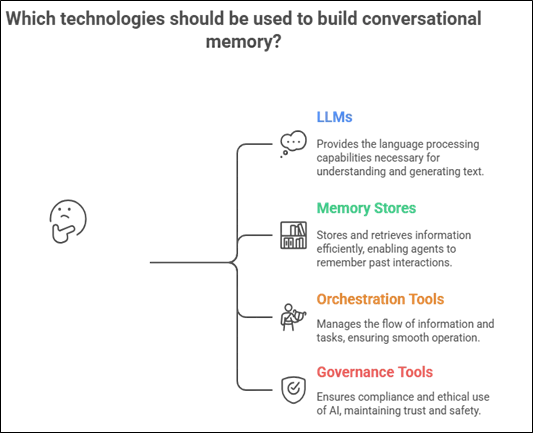
Challenges & How Businesses Can Address Them
- Privacy & Compliance
Not everything should be remembered.
Businesses must define:
- What to store
- How long
- Where
- With what safeguards
- Memory Overload
Too much memory = confusion.
A cleaning mechanism is essential.
- Hallucinations
AI may misinterpret memories.
Guardrails + human validation help.
- User Trust
Transparency matters:
Users should know what the AI remembers.
The Future: Autonomous, Personalized, Persistent AI Agents
The next evolution of conversational agents is self-improving intelligence.
Future agents will:
- Build structured memory graphs
- Learn across teams
- Update knowledge bases
- Create long-term strategies
- Automate workflows without prompts
- Collaborate with other agents
- Train themselves based on user interactions
This shifts AI from a reactive assistant to a proactive co-worker.
Conclusion
Conversational agents with memory are not just a technological upgrade, they are a productivity revolution. By preserving context, learning continuously, and applying persistent intelligence, these agents reduce repetitive tasks, accelerate workflows, and elevate both employee and customer experiences.
We are entering an era where AI doesn’t just respond.
It remembers.
It learns.
It adapts.
It works with you.
And that is exactly why memory-enabled conversational agents are transforming business productivity across every industry.
Drop a query if you have any questions regarding Conversational agents and we will get back to you quickly.
Upskill Your Teams with Enterprise-Ready Tech Training Programs
- Team-wide Customizable Programs
- Measurable Business Outcomes
About CloudThat
FAQs
1. What exactly is “memory” in conversational AI systems?
ANS: – Memory refers to an AI agent’s ability to store, recall, and use past interactions to improve future conversations. This includes user preferences, task history, previous chats, work patterns, and relevant context.
2. How is memory different from regular context in AI chats?
ANS: – Context lasts only during a single conversation, while memory persists across sessions, days, or even months. Memory allows the agent to maintain long-term understanding, leading to continuity and personalized assistance.
3. Do memory-enabled agents require more computational power?
ANS: – Not always. Long-term memory is usually stored in vector databases or knowledge stores, not in the model itself. This makes memory scalable without significantly increasing model cost.


WRITTEN BY Modi Shubham Rajeshbhai
Shubham Modi is working as a Research Associate - Data and AI/ML in CloudThat. He is a focused and very enthusiastic person, keen to learn new things in Data Science on the Cloud. He has worked on AWS, Azure, Machine Learning, and many more technologies.


 PREV
PREV












Comments