

 Login
Login


 December 15, 2025
|
Voiced by Amazon Polly |
In today’s rapidly evolving digital landscape, cybersecurity is no longer a “nice-to-have”, it’s a business imperative. Organizations face an increasing number of threats, from phishing attacks to sophisticated ransomware campaigns. As enterprises move toward hybrid work and cloud-first operations, traditional perimeter-based security models fall short. This is where Microsoft 365 Security Training steps in- not just as a learning path, but as a roadmap to a Zero Trust ecosystem.
Start Learning In-Demand Tech Skills with Expert-Led Training
- Industry-Authorized Curriculum
- Expert-led Training
Understanding Zero Trust: The New Security Mindset
The concept of Zero Trust is simple yet revolutionary: Never trust, always verify. Instead of assuming everything inside the corporate network is safe, Zero Trust treats every access request as a potential threat.
Microsoft’s Zero Trust framework revolves around three key principles:
- Verify explicitly – Always authenticate and authorize based on all available data points.
- Use least-privilege access – Limit user access to only what’s necessary for their role.
- Assume breach – Design security systems under the assumption that attackers are already inside.
With Microsoft 365, these principles are not theoretical; they’re built into the tools businesses use every day.
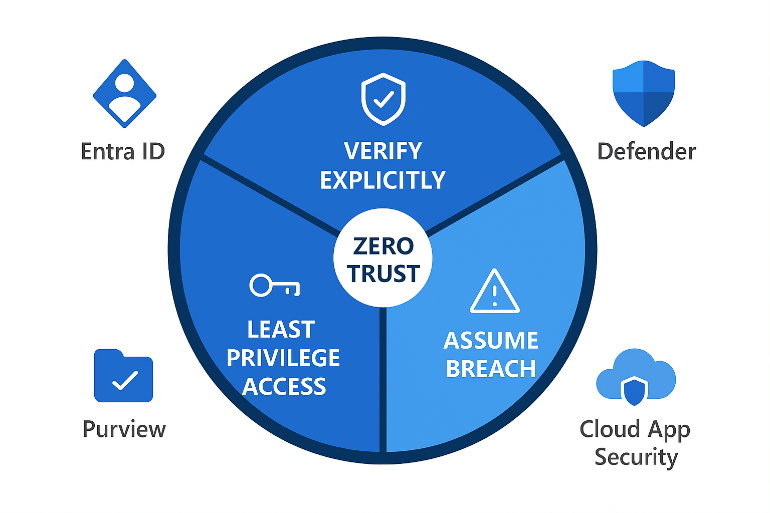
Source: Microsoft Learn
Microsoft 365 Security: Beyond the Basics
Microsoft 365 offers a unified suite that brings together identity, endpoint and data protection under one roof.
Here’s how the platform reinforces Zero Trust through its security layers:
- Identity and Access Management (IAM) – Services like Microsoft Entra ID (formerly Azure AD) ensure secure user identities, multi-factor authentication (MFA) and conditional access policies.
- Device and Endpoint Protection – Microsoft Defender for Endpoint continuously monitors devices, detects threats and isolates compromised assets.
- Information Protection and Compliance – Microsoft Purview (formerly Compliance Center) classifies and protects data across environments.
- Cloud App Security – Defender for Cloud Apps provides visibility into shadow IT and helps enforce app governance.
Training employees to use these tools effectively turns your Microsoft 365 environment into a living, adaptive security ecosystem.
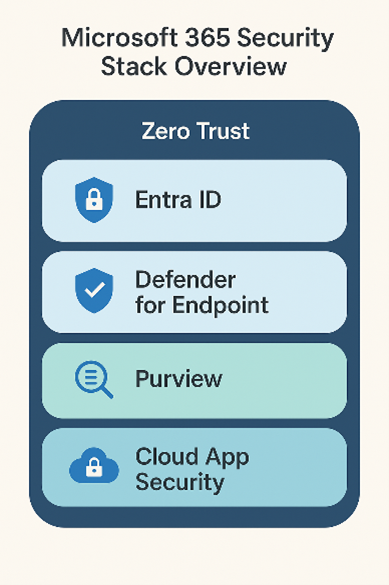
Fig 2: Microsoft 365 Security Stack Overview
Why Microsoft 365 Security Training Matters
Technology alone cannot achieve Zero Trust. People are the strongest, and sometimes the weakest, link in the chain. Security training empowers employees, IT admins and decision-makers to align technology with human vigilance.
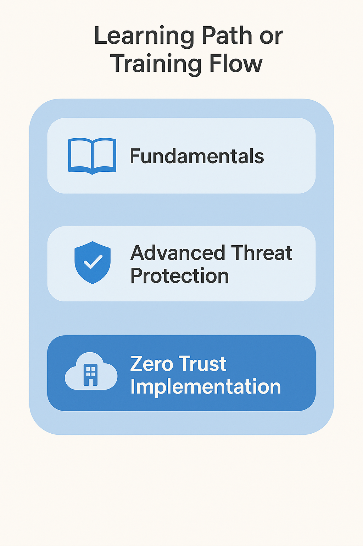
Fig 3: Learning Path or Training Flow
Building a Culture of Continuous Vigilance
Zero Trust isn’t a one-time setup: it’s an evolving culture. Regular security awareness sessions, simulation-based learning and policy audits help organizations stay ahead of threats.
A well-trained workforce ensures that identity verification, device protection and data governance are not just IT checkboxes but daily habits.
When employees understand the why behind every security policy, compliance transforms from obligation to ownership.

Fig 4: Security Culture in Action
The Future is Trustless and That’s a Good Thing
Enterprises that invest in Microsoft 365 Security Training don’t just adopt new tools- they adopt a new mindset. The Zero Trust model ensures that every identity, device and data interaction is protected. It transforms security from a reactive stance to a proactive shield.
Ultimately, hardening the enterprise is not about building taller walls; it’s about building smarter, more adaptive defences. And that begins with the right training.
Upskill Your Teams with Enterprise-Ready Tech Training Programs
- Team-wide Customizable Programs
- Measurable Business Outcomes
About CloudThat


WRITTEN BY Reshu Goyal
Reshu Goyal is a Microsoft Certified Trainer and Subject Matter Expert at CloudThat with over 10 years of experience in data analytics and visualization. She has trained 1,000+ professionals across Power BI, Microsoft Fabric, Advanced Excel and Tableau, delivering sessions for top clients like Microsoft, Deloitte and TCS. Reshu is known for her hands-on, learner-focused approach and her ability to turn complex data into actionable insights.


 PREV
PREV











Comments