

 Login
Login


 September 25, 2026
|
Voiced by Amazon Polly |
Not every RAG pipeline that nails its test set survives a real enterprise archive. Microsoft’s engineering team has watched this play out repeatedly: retrieval holds up fine at a small scale, then quietly falls apart once the document count climbs past the tens of thousands. This post walks through why that happens and the specific fixes that close each gap, drawing on guidance from Microsoft, AWS, and Gartner.
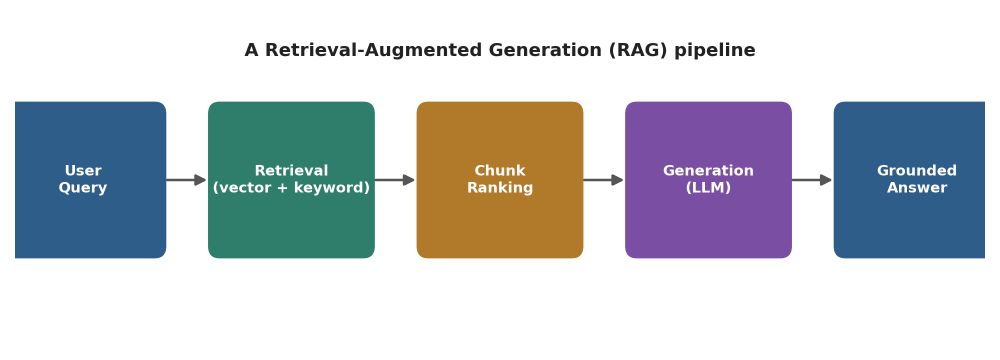
Fig 1: A retrieval-augmented generation pipeline, from query to grounded answer.
Start Learning In-Demand Tech Skills with Expert-Led Training
- Industry-Authorized Curriculum
- Expert-led Training
Why Does Retrieval Accuracy Drop as the Document Set Grows?
Most of the time, it isn’t the language model that breaks; it’s the retrieval layer. Similarity search starts surfacing documents that sound related rather than those that actually answer the question, and that gap widens as the corpus grows larger and more repetitive. Gartner’s research on generative AI adoption found that organizations abandoned at least half of their generative AI projects after proof of concept, citing weak data foundations as a major reason. Microsoft’s own engineering guidance is just as direct: systems built on a few hundred documents work reliably, but once a collection reaches hundreds of thousands or millions of documents, latency climbs and precision drops.
Three patterns drive the decline:
Vocabulary mismatch. Someone asks about a “PTO policy for remote workers,” but the source documents say “time off” and “telecommute.” Pure vector search can miss the connection entirely.
Duplicate content. Large archives accumulate multiple versions of similar policies, splitting relevance scores across them rather than pointing to a single clear source.
Index growth without retuning. Approximate nearest neighbor search trades some precision for speed, and that trade-off compounds as the index scales unless someone actively monitors and retunes it.
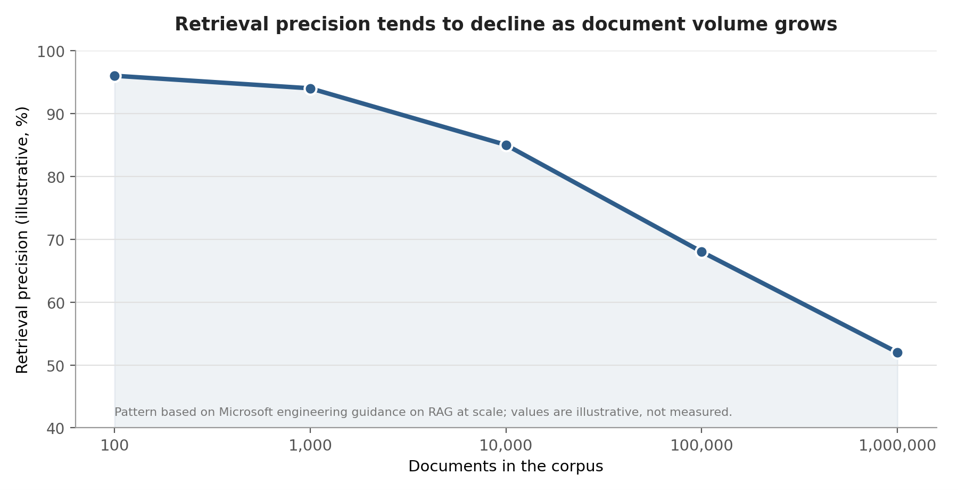
Fig 2: Retrieval precision tends to fall as the document corpus grows. Values shown are illustrative, not measured benchmarks.
How Does Document Structure Affect RAG Accuracy?
A retriever can only return what a chunk boundary lets it see, so a messy source document produces messy chunks no matter how good the retrieval algorithm is. AWS’s prescriptive guidance for RAG applications says this directly: clear headings and subheadings help a RAG system navigate a document, and that improves response quality. Picture a policy document where the general rule sits in one paragraph, and the exception sits in the next. If a chunk boundary falls between them, the system returns the general rule alone, and the answer sounds complete, yet it misses the one detail a compliance reader actually needed. Splitting text at natural section and heading boundaries, rather than at a fixed token count, eliminates much of this before it ever reaches the model.
Why Do RAG Systems Still Give Wrong Answers When Retrieval Works?
Even when retrieval does its job, the model can still get it wrong, because it is built to sound fluent and complete, not to admit that the context it received doesn’t fully cover the question. Retrieval cuts down hallucination; it doesn’t eliminate it. This shows up most often in synthesis questions, where an answer draws on more than one chunk. A model comparing numbers across two related documents can blend a figure from one source with a claim from another and present the mix as a single cited fact, even though no single source actually says that. Two fixes help: instructing the model to answer only from retrieved text and say so when the context falls short, and evaluating generated answers against the source text itself, not just how fluent they sound.
Why Does a Pipeline That Works in Staging Fail After Launch?
Staging rarely reproduces what real production traffic looks like: growing content, shifting user behavior, and live access requirements. Three things tend to break here. Embedding drift sets in when a team updates its embedding model or re-indexes part of the archive with a different version, so old and new vectors stop living in a comparable space, and search quality degrades quietly. Content can also outpace the index: a vector index only reflects what it was last indexed to, so it needs a defined refresh strategy, or it keeps citing a policy that no longer exists. Finally, many deployments treat the vector store as one flat searchable index without carrying over the source system’s permissions. Applying access control at retrieval time and treating retrieved content as untrusted input closes that gap before an authenticated user can pull a document they were never authorized to see.
How Do You Fix a RAG Pipeline That Keeps Failing in Production?
Fixing this usually comes down to four changes, worth doing in this order since each one is cheaper than the next and reinforces the one before it:
- Restructure chunking around document sections rather than token counts, so that a rule and its exception stay together.
- Combine keyword search with vector search. A hybrid approach captures exact terms, such as product names or policy codes, that pure semantic search can miss.
- Add a reranking stage: first pull a wider set of candidates, then reorder them by actual relevance before the model sees them.
- Evaluate on a fixed schedule. Score retrieval precision and answer faithfulness against a labeled test set on a recurring cadence tied to content or model updates, not just once before launch.
Building Reliable RAG Pipelines
RAG evaluation pipeline guide walks through building that scoring loop, and the team’s overview of how RAG evolved from keyword search to agentic retrieval gives useful context for where these fixes fit into the bigger picture. Teams weighing whether to add autonomous decision-making on top of a fixed pipeline can also see a breakdown of agentic RAG architectures for what that next step actually involves.
RAG pipelines rarely fail because of the language model itself. They fail because retrieval, chunking, indexing, and access control were built for a demo, not for a live archive that keeps growing and changing. The teams whose RAG systems keep working are the ones who treat retrieval as core infrastructure, not an afterthought.
Upskill Your Teams with Enterprise-Ready Tech Training Programs
- Team-wide Customizable Programs
- Measurable Business Outcomes
About CloudThat
FAQs
1. What's the single most common reason RAG pipelines fail in production?
ANS: – Weak retrieval quality. When the retriever pulls the wrong chunk, or an incomplete one, the model works from bad evidence, no matter how capable it is.
2. Does a bigger or newer language model fix a failing RAG pipeline?
ANS: – Rarely. Most production RAG failures start upstream of the model, in chunking, indexing, or retrieval logic. Swapping the model without fixing those layers just leaves the same problem in place.
3. How often should a RAG index refresh?
ANS: – It depends on how fast the source content changes, but any system serving policy, pricing, or compliance content needs an automated refresh tied to source updates, not an occasional manual one.


WRITTEN BY Vamsi Kundeti
Vamsi Kundeti serves as a Senior Research Associate – GenAI at CloudThat and is an AI Technical Trainer and Developer with 3+ years of experience in AI development, applied research, and professional training. He is a Microsoft Certified Azure AI Apps and Agents Developer and an AWS Certified Machine Learning Engineer. His expertise spans Generative AI, Large Language Models, RAG, Vector Databases, AI Agents, Machine Learning, Deep Learning, Data Science, and Cloud-based AI solutions. He has designed and developed practical AI solutions across predictive analytics, document intelligence, healthcare AI, NLP, and enterprise AI agents. He has trained and mentored 1,000+ learners and professionals globally through instructor-led training, workshops, and bootcamps.


 PREV
PREV












Comments