

 Login
Login


 June 18, 2026
|
Voiced by Amazon Polly |
Most organizations invest heavily in training content, presentations, videos, and certification courses. However, simply delivering content does not guarantee learning outcomes.
What truly matters is whether employees are gaining the right skills at the right time.
This is where modern Corporate Training Programs must evolve. Instead of focusing only on content delivery, organizations need to track and guide employees as they progress through their learning journey.
By using data to map skill development, companies can move toward more structured and effective Skill-Based Learning that delivers measurable results.
Start Learning In-Demand Tech Skills with Expert-Led Training
- Industry-Authorized Curriculum
- Expert-led Training
The Problem with Content-First Training
Traditional training approaches are often content-driven. Organizations focus on “what to teach” rather than “how skills are built.”
This leads to common challenges:
- Employees attend sessions but don’t apply what they learn.
- No visibility into skill progression
- Same training for all, regardless of individual needs
- Limited impact on real business outcomes
For example, two employees may attend the same data analytics training. One might grasp it quickly, while the other struggles. Without tracking their progress, both are treated the same. This lack of personalization reduces the effectiveness of Corporate Training Programs.
Why Skill Journeys Matter
A skill journey focuses on how an employee progresses from beginner to expert over time.
Instead of one-time training sessions, learning becomes a continuous, structured process.
A well-defined skill journey includes:
- Current skill assessment
- Learning milestones
- Hands-on practice
- Performance tracking
- Continuous improvement
According to McKinsey & Company, organizations that focus on capability building outperform those that rely only on traditional training.
This makes Skill-Based Learning essential for long-term success.
From Content Delivery to Data-Driven Training
Modern training programs are shifting from content delivery to data-driven learning models.
Instead of just tracking course completion, organizations now track:
- Skill proficiency levels
- Time taken to complete tasks.
- Hands-on performance in labs
- Improvement over time
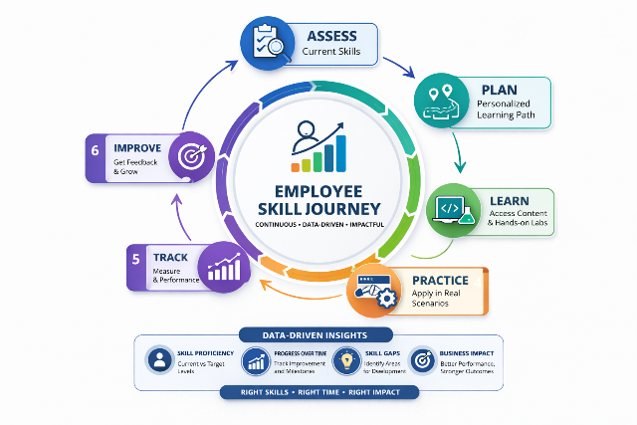
Fig 1: Mapping employee skill journey using data-driven insights.
This data helps organizations identify gaps, personalize learning paths, and ensure employees are progressing effectively.
It transforms Corporate Training Programs into measurable, outcome-driven initiatives.
The Role of Hands-On Practice in Skill Mapping
Data alone is not enough; it must be supported by practical learning. Hands-on exercises, coding labs, and real-world scenarios provide measurable indicators of skill development.
For example:
- Can an employee build a dashboard independently?
- Can they debug errors in a pipeline?
- Can they optimize a process without guidance?
These practical outcomes provide real data points for evaluating progress. Research on experiential learning shows that individuals learn more effectively when they actively engage in real-world tasks and reflect on their experience.
Academic perspectives further emphasize that combining experience with reflection strengthens learning outcomes. This reinforces the importance of combining Skill-Based Learning with practical execution.
Key Components of Data-Driven Training Programs
To successfully map skill journeys, organizations should focus on a structured approach.
- Skill Assessment: Identify current capabilities before starting training.
- Personalized Learning Paths: Design learning journeys based on individual skill levels.
- Continuous Tracking: Monitor progress through quizzes, labs, and real tasks.
- Feedback and Improvement: Provide regular feedback to help employees improve.
Real-World Application
Ensure employees apply their learning to real projects. Structured programs can support this approach. For example, teams working on analytics can build measurable skills through the Power BI Training Program. These programs focus on real datasets, dashboard creation, and practical applications, making it easier to track skill progression.
Aligning Skill Development with Business Outcomes
Training becomes more effective when it aligns with business goals. Instead of generic learning, organizations should focus on skills that directly impact performance.
For instance:
- Analytics teams → data storytelling and dashboards
- Engineering teams → modern data platforms and pipelines
- Business teams → data-driven decision-making
Organizations adopting modern data platforms can also explore Microsoft Fabric Training
This enables teams to build end-to-end data solutions while continuously improving their skills in real scenarios. By aligning learning with outcomes, Corporate Training Programs become more strategic and impactful.
Challenges in Implementing Skill-Based Training
Shifting to a data-driven approach is not without challenges.
Organizations may face:
- Difficulty in defining skill metrics.
- Lack of tools to track progress
- Resistance to change from traditional methods.
- Limited access to practical environments
However, these challenges can be addressed through structured frameworks, cloud-based lab environments, and a strong learning culture.
The Future of Corporate Training
The future of training lies in personalization and data.
Organizations will increase:
- AI-driven learning recommendations
- Real-time skill tracking dashboards
- Adaptive learning paths
- Continuous assessment models
These advancements will make Skill-Based Learning more precise, measurable, and aligned with business needs.
Data-Driven Learning Evolution
Training programs can no longer rely only on content delivery. To truly build capable teams, organizations must track how skills are developed over time. Mapping employee skill journeys using data ensures that learning is not just completed but applied.
By combining structured learning, hands-on practice, and data insights, companies can transform their Corporate Training Programs into powerful tools for growth.
The focus must shift from “what was taught” to “what was learned and applied.”
Upskill Your Teams with Enterprise-Ready Tech Training Programs
- Team-wide Customizable Programs
- Measurable Business Outcomes
About CloudThat


WRITTEN BY Reshu Goyal
Reshu Goyal is a Microsoft Certified Trainer and Subject Matter Expert at CloudThat with over 10 years of experience in data analytics and visualization. She has trained 1,000+ professionals across Power BI, Microsoft Fabric, Advanced Excel and Tableau, delivering sessions for top clients like Microsoft, Deloitte and TCS. Reshu is known for her hands-on, learner-focused approach and her ability to turn complex data into actionable insights.


 PREV
PREV











Comments