

 Login
Login


 June 22, 2026
|
Voiced by Amazon Polly |
Overview
In the modern world, data has become one of the most critical resources. From online payments and private conversations to sensitive corporate records, information flows constantly through digital systems. As cyber threats continue to grow, ensuring the safety of this data is more important than ever. This is where encryption plays a vital role. But how does encryption actually work, and what part do ciphers play in it? Let’s break it down simply and engagingly.
Pioneers in Cloud Consulting & Migration Services
- Reduced infrastructural costs
- Accelerated application deployment
Encryption
Encryption is a method of securing data by transforming it into a format that cannot be easily understood. The original data, known as plaintext, is converted into ciphertext using mathematical processes and a key.
The purpose of encryption is straightforward: only authorized individuals with the correct key should be able to access the original data. To restore the encrypted information to its readable form, a process called decryption is used.
Consider a simple example. If you change each letter in the word “HELLO” by shifting it two places forward in the alphabet, it becomes “JGNNQ.” Without knowing the shift value, the message appears meaningless. While this is a basic example, modern encryption relies on far more advanced techniques.
Understanding Ciphers
A cipher is essentially the rule or algorithm that performs the transformation between plaintext and ciphertext. It defines how encryption and decryption occur.
Over time, ciphers have evolved significantly, from basic manual methods used centuries ago to highly sophisticated algorithms designed for modern computing systems. The strength of an encryption system largely depends on the robustness of its cipher.
Types of Encryption
Encryption techniques are mainly divided into two categories depending on how keys are used.
- Symmetric Encryption
In symmetric encryption, the same key is used for both locking (encryption) and unlocking (decryption) the data. Because the same key is shared between the sender and receiver, it must be kept confidential.
Examples include:
- AES (Advanced Encryption Standard)
- DES (Data Encryption Standard)
- Blowfish
This approach is fast and works well for handling large volumes of data. However, securely sharing the key between parties remains a challenge.
- Asymmetric Encryption
Asymmetric encryption uses two different keys: a public key and a private key. The public key is used to encrypt data, while the private key is used to decrypt it.
Examples include:
- RSA (Rivest–Shamir–Adleman)
- ECC (Elliptic Curve Cryptography)
- DSA (Digital Signature Algorithm)
This method is more secure for communication and authentication, although it is generally slower than symmetric encryption.
Different Types of Ciphers
Ciphers have a long history and come in various forms. Some important types include:
- Substitution Cipher
This method replaces each character in the message with another character based on a fixed rule. One famous example is the Caesar Cipher, where a specific number of positions shifts letters.
For instance, with a shift of three, “HELLO” turns into “KHOOR.” Although simple, this technique was widely used in ancient times.
- Transposition Cipher
Instead of changing characters, this cipher rearranges their positions according to a pattern. For example, reversing “HELLO” results in “OLLEH.” The message remains the same letters but in a scrambled order.
- Stream Cipher
A stream cipher processes data one bit or byte at a time, making it suitable for real-time communication, such as audio or video transmission. RC4 is a well-known example, though it is no longer widely used due to vulnerabilities.
- Block Cipher
Block ciphers handle data in fixed-size chunks, such as 128 bits. Each block is encrypted as a single unit. AES is one of the most widely trusted block ciphers used today.
Where is Encryption Used in Everyday Life?
Encryption is so deeply embedded in the digital routines that we often don’t notice it. Some common applications include:
- Online Transactions: Ensures financial details are protected during payments.
- Messaging Apps: Platforms like WhatsApp and Signal use end-to-end encryption to keep conversations private.
- Secure Storage: Files on devices can be encrypted to prevent unauthorized access.
- Email Security: Tools like PGP safeguard email communication.
- VPN Services: Encrypt internet traffic to enhance privacy and security.
Modern Encryption Technologies
Several encryption standards are widely used today to maintain data security:
- AES: Known for its speed and reliability, used in Wi-Fi security and file encryption.
- RSA: A key method in secure browsing (HTTPS) and digital signatures.
- SHA (Secure Hash Algorithm): Used for ensuring data integrity, even though it is technically a hashing method.
In many real-world systems, a combination of encryption methods, called hybrid encryption, is used. For example, websites use asymmetric encryption to exchange keys securely and then switch to symmetric encryption for faster communication.
Challenges Associated with Encryption
Despite its importance, encryption faces several challenges:
- Key Management: Safely storing and distributing keys is complex.
- Performance Impact: High-level encryption can reduce system speed.
- Quantum Computing Risks: Future technologies may render current encryption methods obsolete.
- Privacy vs Regulation: Governments sometimes raise concerns about strong encryption limiting investigations.
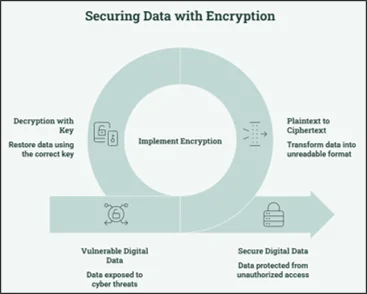
Figure: Illustration of how encryption transforms vulnerable data into secure information through plaintext-to-ciphertext conversion and decryption using keys.
Conclusion
Encryption and ciphers play a crucial role in securing today’s digital environment. They protect everything from personal chats to sensitive government data. Over time, encryption has evolved from simple letter substitution to powerful algorithms such as AES and RSA.
Drop a query if you have any questions regarding Encryption, and we will get back to you quickly.
Empowering organizations to become ‘data driven’ enterprises with our Cloud experts.
- Reduced infrastructure costs
- Timely data-driven decisions
About CloudThat
FAQs
1. How is encryption different from hashing?
ANS: – Encryption is reversible, meaning the original data can be recovered with the correct key. Hashing, however, is a one-way process used to verify data integrity and cannot be reversed.
2. Can encryption stop all cyber attacks?
ANS: – No, encryption significantly improves data security but does not eliminate all threats. A strong security system also requires measures like secure passwords, firewalls, and regular updates.


WRITTEN BY Manjunath Raju S G
Manjunath Raju S G works as a Research Associate at CloudThat. He is passionate about exploring advanced technologies and emerging cloud services, with a strong focus on data analytics, machine learning, and cloud computing. In his free time, Manjunath enjoys learning new languages to expand his skill set and stays updated with the latest tech trends and innovations.


 PREV
PREV











Comments