

 Login
Login


 June 22, 2026
|
Voiced by Amazon Polly |
Introduction
Today’s Power Platform differs significantly from what the majority of professionals started with.
Power Platform has evolved from a low-code toolset into an AI-first, agent-driven platform with Copilot, Copilot Studio, Microsoft Fabric, and Azure AI Foundry. This shift changes how solutions are built, used, and governed, requiring skills focused on accuracy and scalability rather than just speed.
Pioneers in Cloud Consulting & Migration Services
- Reduced infrastructural costs
- Accelerated application deployment
Power Platform Evolution: What Changed vs What It Is Today
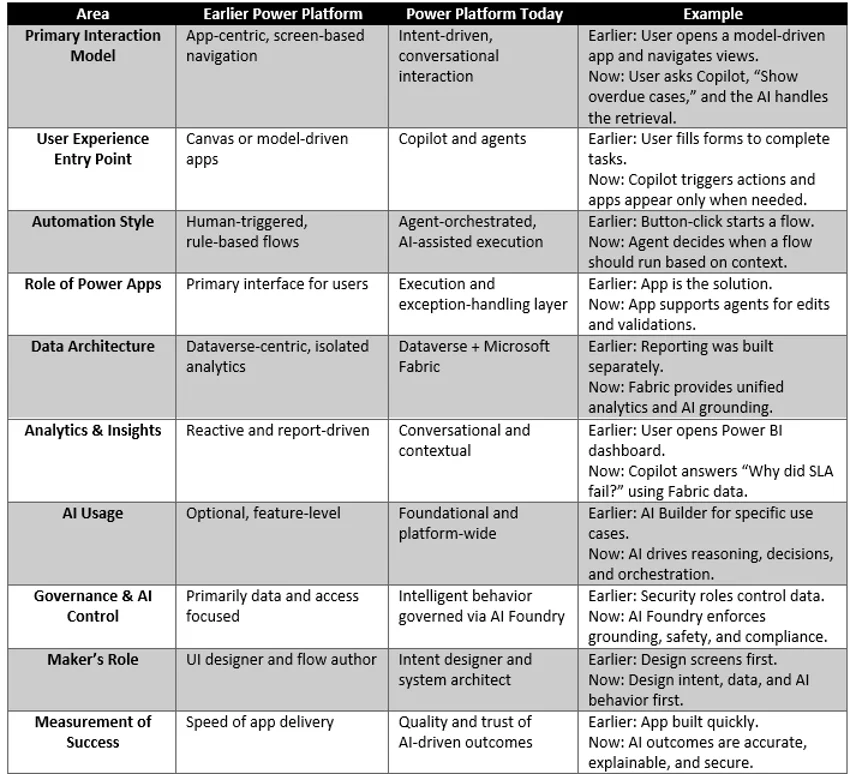
Copilot Everywhere: Redefining the Maker Experience
Copilot is now embedded across Power Apps, Power Automate, Dataverse, and governance, not a standalone tool. It shifts development from manual UI setup to intent-driven creation, using natural language to build logic, generate schemas, and automate outcomes.
This reduces manual effort, but increases the need for strong architecture. Copilot works best with clear security, reliable data, and traceable logic; without which it becomes unstable. The focus shifts from UI speed to secure, predictable execution, enabling agent-driven orchestration.
To ensure that AI-assisted execution is expected, secure, auditable, and controlled, platform architecture moves beyond optimizing UI building speed. This paves the way for agent-driven orchestration, which is the platform’s next natural step.
Microsoft Fabric: The New Data Backbone for Power Platform
AI solutions rely on data, and Microsoft Fabric makes it a core foundation with analytics, integration, real-time insights, and OneLake. Dataverse still handles transactions, while Fabric supports analytics and AI. Without it, solutions risk poor insights, weak AI, and governance issues, so modern architectures assume Fabric, even if unseen by users.
Azure AI Foundry: Making AI Enterprise‑Ready
Azure AI Foundry controls how intelligence operates across Power Platform offerings, while Microsoft Fabric provides the unifying data foundation. To ensure AI-driven reasoning is predictable and business-ready, Foundry oversees model orchestration, rapid lifecycle management, enterprise data provisioning, and enforcement for safety, compliance, and observability.
Copilot & Copilot Studio agents rely on Foundry to continuously implement Responsible AI policies, manage data exposure, and maintain the auditability and reliability of AI-driven actions. Because of this change, Power Platform experts must stop building automations and start creating AI-enabled systems in which governance, data grounding, and model behavior are deliberate architectural choices rather than implementation details.
Real‑World Solution Example: From Apps to Agents
Financial Services Industry Callout: AI-First Case Management
In a financial services case management setup, users navigate model-driven apps, Power Automate flows for escalations, and SLA reports to assess cases. With an AI-first Power Platform approach, Copilot becomes the primary interface, letting users ask, “Which cases are breaching SLA?” or “Why was this complaint delayed?”. Azure AI Foundry ensures compliant, auditable AI, while Dataverse and Microsoft Fabric provide governed data. Copilot Studio interprets intent, and Power Automate executes actions. Power Apps shift to supporting execution and exception handling, enabling faster decisions with less effort.
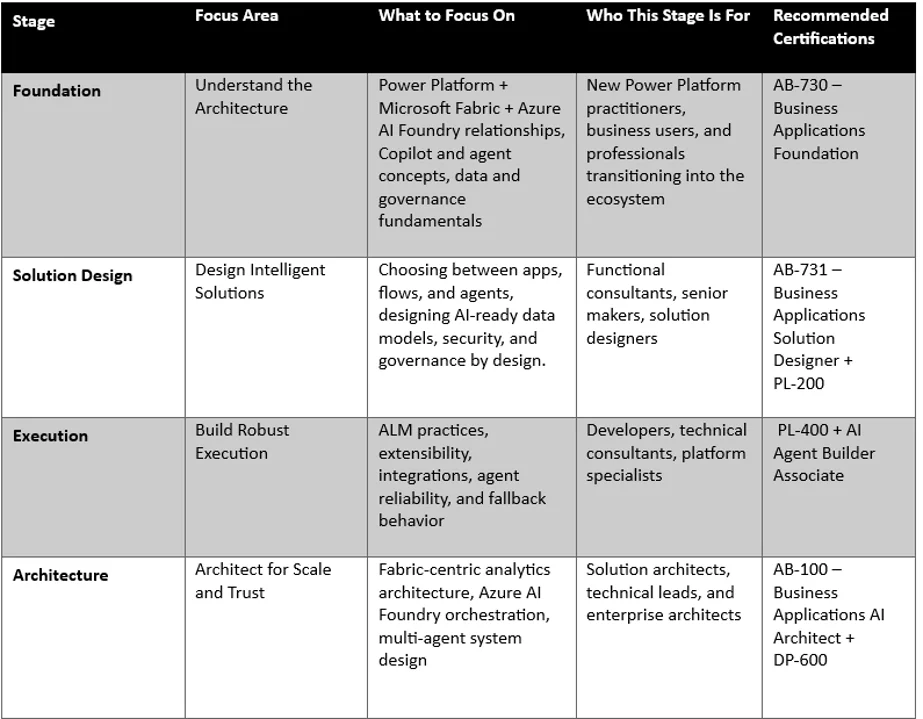
Learning Path to Excellence (Aligned with Platform Evolution)
Conclusion
Power Platform must evolve from a simple app-building tool into a platform for intelligent, AI-driven solutions. The quality and trust of outcomes now depend on strong data modeling, agent design, and governance. Organizations that adapt their skills and delivery approach will gain value, while others risk falling behind.
Drop a query if you have any questions regarding Power Platform, and we will get back to you quickly.
Empowering organizations to become ‘data driven’ enterprises with our Cloud experts.
- Reduced infrastructure costs
- Timely data-driven decisions
About CloudThat
FAQs
1. If Copilot & agents are available, do I require Power Apps?
ANS: – Power Apps are still important, but their role has shifted. They now act as controlled execution points, admin/exception interfaces, and structured data entry surfaces, supporting Copilot-driven workflows rather than being the main user interface.
2. With the existence of Microsoft Fabric, where would Dataverse fit in?
ANS: – Microsoft Fabric enhances Dataverse with analytics, insights, and AI-ready models via OneLake, while Dataverse handles operational and transactional data. Fabric focuses on analytics and AI, and Dataverse on real-time business processes.
3. Do most Power Platform solutions now require familiarity with Azure AI Foundry?
ANS: – Not needed at first, but as solutions grow, Azure AI Foundry becomes important for controlling behavior, data, and reliability, while basic Copilot simplifies quick adoption.


WRITTEN BY Ranjani Iyer Srikrishnan
Iyer Ranjani Srikrishnan is a Power Platform Developer at CloudThat, specializing in low-code business solutions using Power Apps, Power Automate, and Power BI. She builds responsive applications, automated workflows, and insightful dashboards that drive efficiency and enable data-driven decision-making. Ranjani is also skilled in JavaScript, HTML, and Power Fx, working extensively with Dataverse, SharePoint, and SQL to deliver customized, user-friendly solutions. Passionate about creating impactful digital experiences, she actively explores emerging tools such as AI Builder, Power Virtual Agents, and Azure Logic Apps to continuously enhance her expertise in the Power Platform ecosystem.


 PREV
PREV











Comments