

 Login
Login

 December 12, 2025
|
Voiced by Amazon Polly |
In the world of modern cloud applications, the shift towards microservices architecture has introduced a paradigm where decoupled, independently deployable services communicate primarily through events. This is where Azure Cosmos DB’s Change Feed steps in, transforming a globally distributed NoSQL database into a powerful, real-time event source. It’s the engine that powers true event-driven architectures (EDA) atop your data layer.

Source: Microsoft Azure
Start Learning In-Demand Tech Skills with Expert-Led Training
- Industry-Authorized Curriculum
- Expert-led Training
What is the Azure Cosmos DB Change Feed?
The Change Feed is a persistent, append-only log of all the changes (inserts and updates) made to your Cosmos DB container, sequenced in the order in which they occur. Think of it as a transaction log that is readily available for consumption. It’s enabled by default on all Azure Cosmos DB accounts and doesn’t incur an extra cost beyond the Request Units (RUs) consumed when reading from it.
Unlike traditional database polling, which is inefficient and introduces latency, the Change Feed offers a low-latency, pull-based model for accessing data changes. This continuous, ordered stream of data serves as the perfect backbone for creating responsive and scalable microservices.
Why the Change Feed is Crucial for Event-Driven Microservices
Microservices thrive on the separation of concerns. The Change Feed enables this by adhering to the Event Sourcing pattern, where the primary database serves as the source of truth, and its changes generate events that are consumed by downstream services.
- Real-Time Data Synchronization and Denormalization
A common microservices challenge is keeping data consistent across multiple services or creating Materialized Views for fast querying.
- A service updates a record in the main container (e.g., an Orders container).
- The Change Feed captures this update.
- A dedicated consumer microservice (often an Azure Function) reads the change, denormalizes the data and automatically writes the updated view to another container (e.g., an OrdersByCustomer container). This ensures that secondary views are updated asynchronously and in near real-time, removing the need for complex joins or direct cross-service communication.
- Decoupled Business Logic
The Change Feed acts as a message bus, minimizing direct dependencies between microservices. For instance:
- A Payment microservice inserts a new payment record into its container.
- The Change Feed triggers a separate Notification microservice.
- The Notification microservice reads the payment event and sends an email or push notification to the customer, completely unaware of the Payment service’s internal logic. This high degree of decoupling makes services easier to develop, test and deploy independently.
- Scaling and Reliability with the Change Feed Processor
Handling a massive stream of changes requires robust scaling, which is where the Change Feed Processor (CFP) comes in. The CFP is a component built into the Azure Cosmos DB SDK that provides:
- Load Balancing: It automatically distributes the change processing workload across multiple worker instances (e.g., multiple instances of an Azure Function or a VM-based host). It does this by leasing partitions of the monitored container to different workers, ensuring parallel processing.
- State Management: It uses a separate Lease Container to reliably track the last processed point in the change stream for each partition. If a worker fails, another can pick up the lease and resume processing exactly where the previous one left off, guaranteeing an “at least once” delivery of events.
By leveraging the CFP, you can focus purely on your business logic (the delegate code) without manually managing partition assignment or checkpoints. This serverless approach, often implemented via the Azure Functions trigger for Cosmos DB, drastically simplifies the operational complexity of your event-driven pipeline.
Getting Started: Practical Integration
The simplest way to consume the Change Feed is using Azure Functions. The Cosmos DB trigger handles the CFP configuration for you:
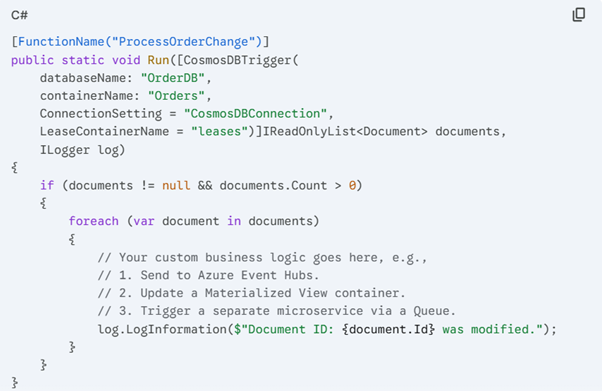
Azure Function using Cosmos DB trigger to handle change feed and apply custom business logic.
This minimal configuration abstracts away the complexity of parallelizing, coordinating and checkpointing the change stream, allowing for rapid development of reactive microservices.
Cosmos DB Wrap-Up
The Azure Cosmos DB Change Feed is more than just a data log; it’s a foundational capability for building scalable, resilient and highly decoupled microservices. By enabling real-time event-driven patterns like Event Sourcing and Materialized Views, it helps you move beyond traditional monolithic database dependencies into the modern era of cloud-native architecture. Harnessing the power of the Change Feed is essential for any enterprise looking to build next-generation applications with Cosmos DB.
Upskill Your Teams with Enterprise-Ready Tech Training Programs
- Team-wide Customizable Programs
- Measurable Business Outcomes
About CloudThat


WRITTEN BY Madhavi S Salunkhe
Madhavi Salunkhe is a Vertical Head at CloudThat, specializing in Azure Dev/DevOPs. With 10+ years of experience in training, she has trained over 2000+ professionals/students to upskill in Azure technologies. Known for simplifying complex concepts, hands-on teaching, industry insights, she brings deep technical knowledge and practical application into every learning experience. Her areas of expertise include Azure solution architect, cloud native, DevOps, Cosmos DB, FinOps. Madhavi's passion for teaching and learning reflects in her unique approach to learning and development.


 PREV
PREV





Comments