

 Login
Login


 February 3, 2026
|
Voiced by Amazon Polly |
Introduction
As Kubernetes adoption matures, organizations move beyond basic container orchestration toward managing complex microservices architectures. While Kubernetes excels at scheduling, scaling, and networking containers, it does not provide deep application-level traffic management, security, or observability by default. This gap is where service mesh comes into play.
A service mesh is a dedicated infrastructure layer that manages service-to-service communication in a microservices environment. Solutions such as Istio and Linkerd have become popular for addressing challenges around traffic control, security, and observability in Kubernetes clusters.
Pioneers in Cloud Consulting & Migration Services
- Reduced infrastructural costs
- Accelerated application deployment
Why Service Mesh Is Needed in Kubernetes?
In a typical microservices architecture, applications consist of dozens or hundreds of services communicating over the network. As this complexity grows, teams commonly face problems such as:
- Inconsistent retries and timeouts are implemented in each service
- Limited visibility into inter-service traffic
- Manual and error-prone service-to-service security
- Difficulty implementing advanced deployment strategies (canary, blue‑green)
- Tight coupling between application code and networking logic
While Kubernetes handles service discovery and basic load balancing, it does not natively offer fine-grained traffic routing, mutual TLS (mTLS), or distributed tracing. A service mesh solves these problems without modifying application code.
Core Concepts of a Service Mesh
At a high level, a service mesh consists of two main components:
- Data Plane
The data plane is responsible for handling service-to-service traffic. It typically uses sidecar proxies (e.g., Envoy in Istio) injected into each application pod. These proxies intercept inbound and outbound traffic and enforce mesh policies.
- Control Plane
The control plane configures and manages the data plane. It distributes routing rules, security policies, and telemetry configuration to the proxies.
Together, these components enable centralized control over east-west traffic inside the cluster.
Key Capabilities Provided by Service Mesh
CIS Benchmarks for Cloud Providers
Traffic Management
Service meshes allow fine-grained traffic control, including:
- Weighted traffic routing
- Traffic mirroring
- Fault injection
- Retries, timeouts, and circuit breaking
Example: Route 10% of production traffic to a new service version for canary testing while keeping 90% on the stable version.
Security (Zero Trust Networking)
Service meshes enable mutual TLS (mTLS) between services, ensuring that:
- All service communication is encrypted
- Services authenticate each other automatically
- Identity is based on workload, not IP addresses
This aligns well with modern zero-trust architectures.
Observability
Service meshes provide consistent telemetry across all services, including:
- Request latency
- Error rates
- Throughput
- Distributed tracing
Because this data is generated at the proxy layer, teams gain visibility without adding instrumentation to every application.
Istio: Feature Rich and Enterprise Grade
Istio is one of the most widely adopted service mesh platforms. It is designed for complex, large-scale environments that require advanced networking and security features.
Istio Architecture Highlights
- Uses Envoy as the sidecar proxy
- Centralized control plane managing networking and security
- Policy-driven configuration using custom resources
Strengths of Istio
- Advanced traffic routing (A/B testing, canary deployments)
- Strong security defaults with automated mTLS
- Fine-grained authorization and authentication policies
- Rich observability integrations (metrics, logs, tracing)
Challenges
- Steep learning curve
- Higher operational overhead
- Requires careful planning for production rollout
Istio is often chosen by organizations running large, regulated, or mission-critical platforms that need maximum control.
Linkerd: Simple, Lightweight, and Kubernetes Native
Linkerd focuses on simplicity and ease of use. It is designed specifically for Kubernetes and emphasizes a lightweight operational model.
Linkerd Architecture Highlights
- Written in Rust for performance and safety
- Minimal configuration and opinionated defaults
- Simpler control plane compared to Istio
Strengths of Linkerd
- Fast installation and low resource overhead
- Built‑in mTLS enabled by default
- Excellent performance for latency-sensitive workloads
- Easier adoption for smaller teams
Trade‑offs
- Fewer advanced traffic management features
- Less flexibility compared to Istio
Linkerd is well-suited for teams that want service-to-service security and visibility without complexity.
Istio vs Linkerd: When to Use Which?
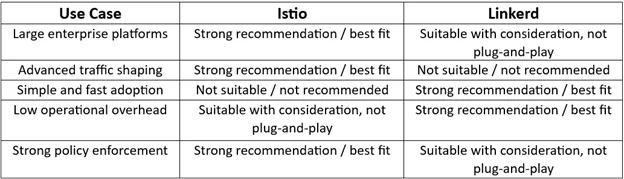
There is no universal “best” choice,the decision depends on scale, expertise, and operational goals.
Service Mesh and Kubernetes Best Practices
To successfully adopt a service mesh:
- Start small: Enable mesh for non-critical services first.
- Avoid over-meshing: Not every service needs to be meshed.
- Monitor performance: Sidecars add latency and resource usage.
- Integrate with CI/CD: Manage mesh configuration as code.
- Align with platform teams: A service mesh is a platform concern, not just an app feature.
Future of Service Mesh
The service mesh ecosystem is evolving. Emerging trends include:
- Sidecar-less architectures (eBPF-based meshes)
- Closer integration with Kubernetes networking APIs
- Simplified operational models
Despite these changes, the core value remains the same: abstracting networking and security concerns away from application code.
Final Thoughts
Kubernetes solves container orchestration, but service mesh addresses a deeper problem, reliable, secure, and observable service communication at scale. Tools like Istio and Linkerd provide powerful mechanisms to manage microservices complexity without burdening developers.
Drop a query if you have any questions regarding Kubernetes and we will get back to you quickly.
Making IT Networks Enterprise-ready – Cloud Management Services
- Accelerated cloud migration
- End-to-end view of the cloud environment
About CloudThat
FAQs
1. What is a service mesh in Kubernetes?
ANS: – A service mesh is an infrastructure layer that manages service-to-service communication, handling traffic, security, and observability without changing application code.
2. Why is a service mesh needed if Kubernetes already provides networking?
ANS: – Kubernetes offers basic networking, but a service mesh adds fine-grained traffic control, mTLS, retries, circuit breaking, and deep observability.
3. What problems does a service mesh solve?
ANS: – It solves inconsistent network logic, a lack of service-level visibility, manual security enforcement, and complex deployment strategies.


WRITTEN BY Ayush Agarwal
Ayush Agarwal works as a Subject Matter Expert at CloudThat. He is a certified AWS Solutions Architect Professional with expertise in designing and implementing scalable cloud infrastructure solutions. Ayush specializes in cloud architecture, infrastructure as code, and multi-cloud deployments, helping organizations optimize their cloud strategies and achieve operational excellence. With a deep understanding of AWS services and best practices, he guides teams in building robust, secure, and cost-effective cloud solutions. Ayush is passionate about emerging cloud technologies and continuously enhances his knowledge to stay at the forefront of cloud innovation. In his free time, he enjoys exploring new AWS services, experimenting with technologies, and trekking to discover new places and connect with nature.


 PREV
PREV












Comments