

 Login
Login


 June 17, 2026
|
Voiced by Amazon Polly |
The role of AI architects is changing rapidly. A year ago, most AI discussions focused on prompt engineering and chatbot integrations. In 2026, enterprise AI systems are becoming significantly more complex – combining multi-agent orchestration, structured tool usage, context management, governance, and autonomous workflows.
This shift is reflected in Anthropic’s new Claude Certified Architect – Foundations certification, which focuses less on theoretical AI concepts and more on designing production-ready AI systems. According to the official exam guide, the certification validates the ability to make architectural and operational decisions across Claude APIs, Claude Code, Model Context Protocol (MCP), and agentic workflows.
Start Learning In-Demand Tech Skills with Expert-Led Training
- Industry-Authorized Curriculum
- Expert-led Training
Why This Certification Matters
Unlike traditional AI certifications that rely heavily on theoretical or isolated conceptual questions, the Claude Certified Architect – Foundations exam is built around production-oriented architectural decision-making.
According to the official exam guide, the certification presents candidates with 4 out of 6 possible enterprise scenarios, randomly selected during the exam. Each scenario places candidates in realistic production environments where they must evaluate tradeoffs, reliability considerations, orchestration strategies, and architectural implementation decisions for Claude-based systems.
The six enterprise scenarios include:
- Customer Support Resolution Agents
- Code Generation with Claude Code
- Multi-Agent Research Systems
- Developer Productivity Workflows
- Claude Code for CI/CD Pipelines
- Structured Data Extraction Systems
This scenario-driven format is significant because it reflects how modern AI systems are deployed in real enterprise environments. Rather than testing memorization, the certification evaluates practical architectural judgment across:
- orchestration,
- tool integration,
- structured output design,
- escalation handling,
- reliability engineering,
- and governance workflows.
The 5 Core Skills Modern AI Architects Need
Anthropic structures the certification around five major domains, each representing a critical capability for production AI systems.
- Agentic Architecture & Orchestration
One of the strongest themes in the certification is agentic orchestration.
The exam focuses heavily on:
- Multi-agent coordination
- Task decomposition
- Subagent delegation
- Agentic loop management
- Human escalation workflows
Modern AI systems increasingly operate as coordinated agents rather than single prompts. For example, a coordinator agent may delegate:
- research tasks,
- document analysis,
- synthesis,
- and reporting
to specialized subagents.
The certification also emphasizes architectural reliability, ensuring workflows terminate correctly using mechanisms such as:
- tool_use
- end_turn
- structured escalation logic
This reflects how enterprise AI systems are moving toward autonomous decision-making with controlled orchestration patterns.
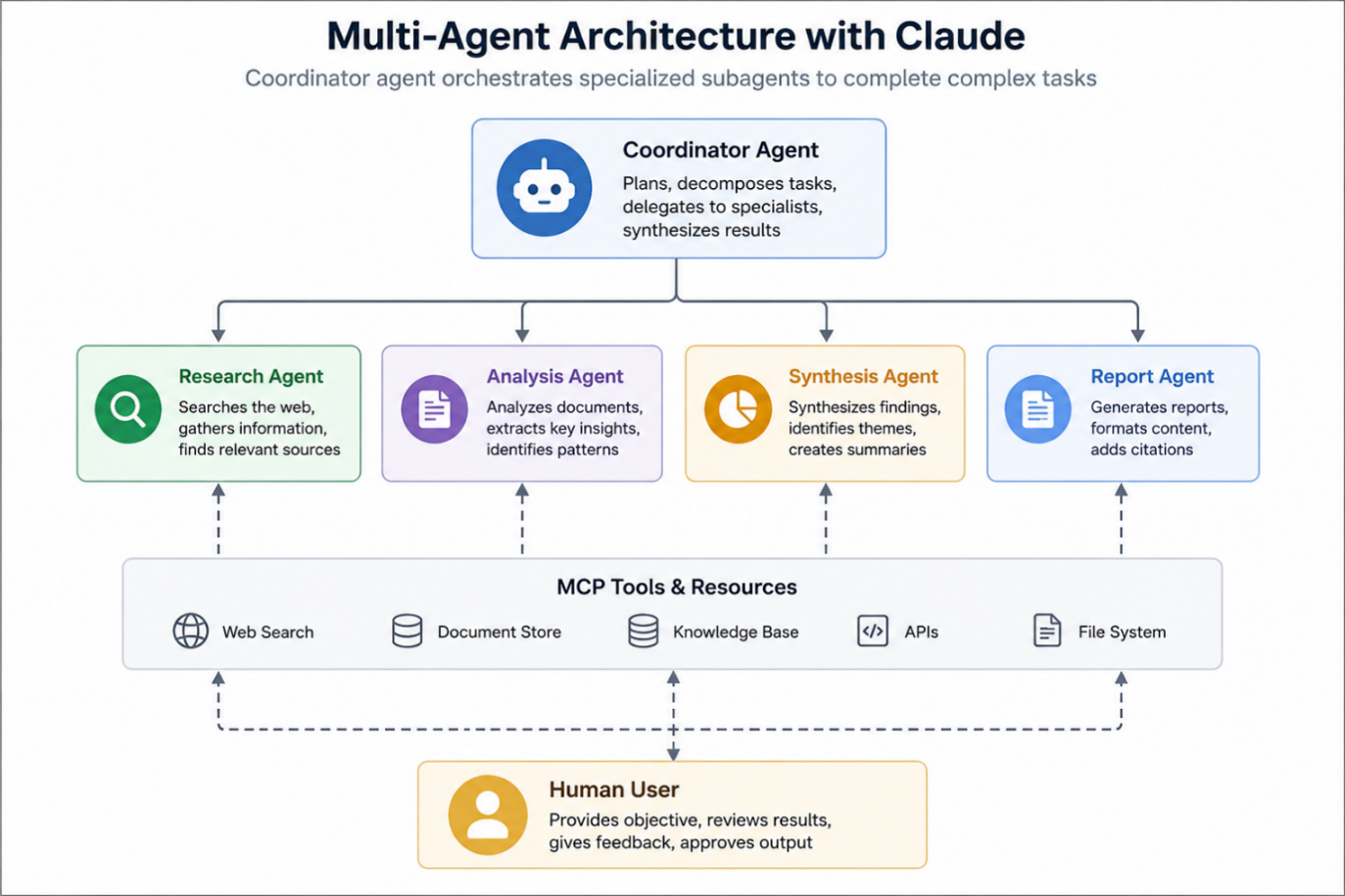
Fig 1: Coordinator-subagent architecture pattern used in modern Agentic AI systems.
- MCP Integration and Tool Design
Another major focus area is the Model Context Protocol (MCP).
The certification expects architects to understand:
- MCP server integration
- structured tool interfaces
- scoped tool access
- environment-variable-based credential handling
- project-level and user-level MCP configurations
This is important because enterprise AI systems increasingly depend on external tools and internal services.
Instead of responding only with text, modern AI agents interact with:
- ticketing systems,
- APIs,
- CI/CD platforms,
- databases,
- and enterprise workflows.
The certification strongly emphasizes well-designed tool descriptions, structured error propagation, and reliability-focused integration patterns-all essential for scalable AI architecture.
- Claude Code and AI-Assisted Development
Anthropic also places significant attention on Claude Code, highlighting how AI-assisted development is becoming part of enterprise engineering workflows.
The exam includes:
- md hierarchy design
- path-based rules
- custom slash commands
- skill configuration
- CI/CD integration patterns
One particularly important concept is determining when to use:
- direct execution,
- versus plan mode for large-scale architectural changes.
This aligns closely with modern DevOps workflows, where AI tools are increasingly integrated into:
- automated code reviews,
- pull request analysis,
- test generation,
- and developer productivity systems.
The certification demonstrates that AI architects now require operational understanding of AI-enabled software engineering, not just AI theory.
- Structured Output and Prompt Engineering
Unlike generic prompt-engineering discussions, Anthropic’s framework focuses on structured reliability.
The certification expects candidates to work with:
- JSON schemas,
- tool-based structured output,
- validation-retry loops,
- few-shot prompting,
- and semantic validation workflows.
This is a major shift from consumer AI usage.
In enterprise systems, outputs must be:
- machine-readable,
- validated,
- traceable,
- and integrated into downstream workflows.
- Context Management and Reliability Engineering
Perhaps the most underrated skill area in modern AI systems is context management.
The certification covers:
- long-context handling,
- progressive summarization risks,
- human escalation patterns,
- structured state persistence,
- and reliability-focused workflow design.
As AI systems become more autonomous, architects must design systems that:
- preserve critical context,
- recover from failures,
- maintain provenance,
- and handle uncertainty safely.
The exam also highlights:
- confidence calibration,
- structured error propagation,
- and human-in-the-loop review systems.
These are not traditional “prompt engineering” topics-they are core production engineering concerns.
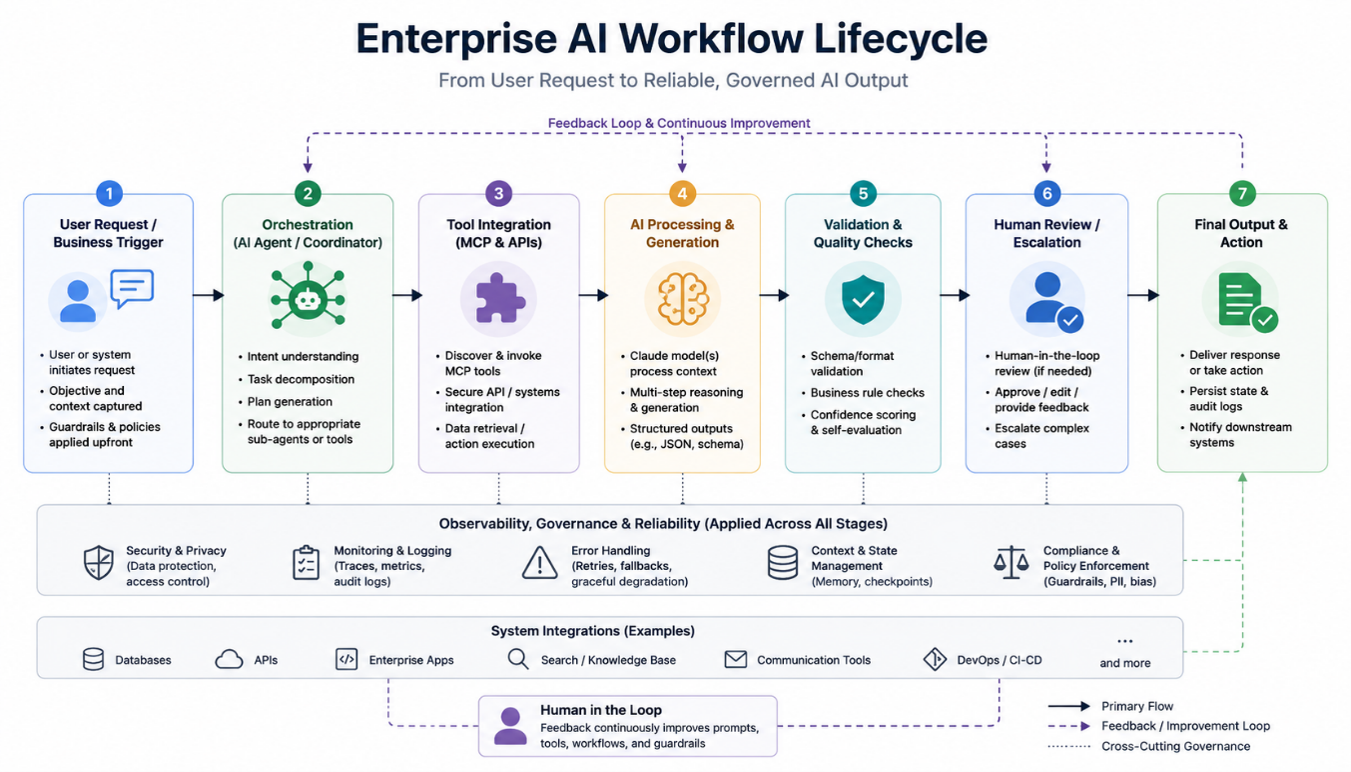
Fig 2: Enterprise AI workflow showing orchestration, tool integration, validation, and human review stages.
Why This Signals a Shift in AI Careers
One of the most important takeaways from this certification is that the AI industry is moving toward AI systems engineering.
Modern AI architects are increasingly expected to understand:
- orchestration patterns,
- governance models,
- reliability engineering,
- DevOps integration,
- structured outputs,
- and autonomous workflows.
This is a very different skill set from traditional AI roles focused solely on model usage or prompt writing.
For professionals exploring enterprise AI implementation, the official Anthropic Learn Platform provides foundational resources around Claude ecosystems, agentic workflows, and AI system design.
Organizations looking to build practical AI implementation capabilities can also explore structured learning paths such as the AI and Machine Learning Certification Course for hands-on exposure to AI integration, governance, and enterprise adoption strategies.
Advancing AI Architecture Skills
The Claude Certified Architect certification represents more than a new credential; it reflects the evolution of enterprise AI engineering itself.
Anthropic’s framework moves beyond isolated prompting into:
- Agentic Orchestration,
- AI-Assisted Development,
- MCP-Based Integration,
- Structured Reliability,
- and Production-Scale AI Governance.
As organizations continue integrating AI into critical workflows, the demand for professionals who can architect reliable, scalable, and governable AI systems will continue to grow.
For modern AI architects, the future is no longer just about interacting with models; it is about engineering intelligent systems that operate safely and effectively at scale.
Upskill Your Teams with Enterprise-Ready Tech Training Programs
- Team-wide Customizable Programs
- Measurable Business Outcomes
About CloudThat


WRITTEN BY Rohit Tiwari
Rohit Tiwari is a Senior Subject Matter Expert (SME) at CloudThat, specializing in Multi-Cloud Infrastructure, Solutions Architecture, DevOps and Generative AI. A Microsoft Certified Trainer (MCT) and Google Cloud Authorized Trainer (GCI), Rohit is recognized among the Top 100 MCT Quality Award winners (January 2025) for excellence in All Courses and Microsoft Data & AI Courses. With 19+ years of global experience in training, software development, and quality assurance, he has trained over 20,000 professionals globally across Azure, AWS, GCP, and modern cloud-native architectures. He holds 65+ industry certifications, in Azure, AWS, GCP, Oracle Cloud (OCP), and in Databricks, demonstrating his unmatched expertise in cloud infrastructure design, security, and cost optimization. Known for simplifying complex multi-cloud and AI concepts with hands-on, real-world insights, Rohit brings deep technical expertise and practical application into every learning experience. His passion for mentoring and building transformative cloud learning journeys reflects in his dedication to enabling professionals and enterprises to innovate with confidence.


 PREV
PREV











Comments