

 Login
Login


 May 25, 2026
|
Voiced by Amazon Polly |
Introduction
Modern application development has rapidly shifted toward microservices architecture, where applications are broken into smaller, independent services. This approach offers flexibility, scalability, and faster development cycles. However, as the number of services increases, managing communication between them becomes a major challenge.
In a microservices ecosystem, services constantly interact with one another over the network. This raises several important concerns: How can communication be secured? How can traffic be controlled during deployments? How can teams monitor what is happening across dozens or even hundreds of services? To address these challenges, organizations are increasingly adopting a service mesh.
A service mesh introduces a dedicated layer for managing communication between services, allowing developers to focus solely on business logic. Among the available solutions, Istio has emerged as a powerful, widely adopted platform for implementing a service mesh in Kubernetes environments.
Pioneers in Cloud Consulting & Migration Services
- Reduced infrastructural costs
- Accelerated application deployment
Service Mesh
A service mesh is an infrastructure layer designed specifically to handle service-to-service communication in distributed systems. Instead of embedding networking logic directly into each microservice, this functionality is offloaded to the mesh.
In a typical setup without a service mesh, each service is responsible for implementing features such as service discovery, secure communication, retry logic, and monitoring. This results in repetitive code and inconsistent implementations across services.
A service mesh simplifies this by centralizing these responsibilities and providing them as built-in capabilities. These include:
- Advanced traffic routing and load balancing
- Secure communication using mutual TLS (mTLS)
- Observability through metrics, logs, and tracing
- Resilience features like retries, timeouts, and circuit breaking
By abstracting these concerns away from application code, a service mesh improves maintainability, consistency, and scalability across the system.
Istio
Istio is an open-source service mesh platform that enhances the way microservices communicate with each other. It provides a robust set of features for traffic management, security, and observability without requiring any modifications to existing application code.
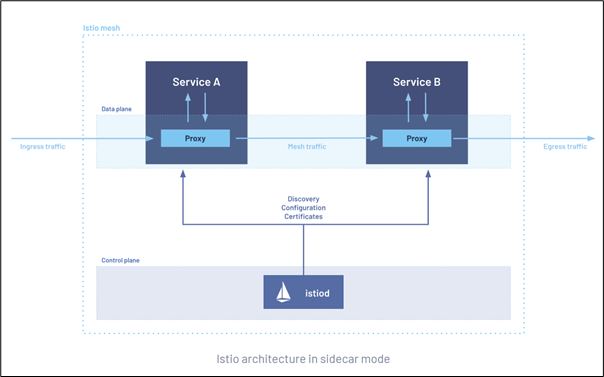
Istio operates using two main components: the data plane and the control plane. The data plane consists of Envoy proxies that handle service traffic, while the control plane (Istiod) is responsible for managing configurations, policies, and security settings.
This architecture allows Istio to enforce consistent policies across all services, making it easier to manage complex microservices environments.
How Does Istio Work?
Istio uses a sidecar proxy model to manage communication between services. In this approach, a lightweight proxy (Envoy) is deployed alongside each application container within the same Kubernetes pod. All incoming and outgoing traffic flows through these proxies.
Istio Sidecar Architecture Diagram:
Source: Istio / Architecture
As shown in the diagram, each service has its own proxy that intercepts requests. These proxies are responsible for enforcing security, routing, and observability rules.
The control plane, known as Istiod, communicates with these proxies to distribute configuration updates, manage certificates, and enforce policies across the system.
This setup enables several key capabilities:
- Secure communication: Istio automatically enables mutual TLS (mTLS), ensuring that all service interactions are encrypted and authenticated.
- Flexible traffic control: Traffic can be routed based on rules such as headers, user identity, or request content.
- Detailed observability: Metrics, logs, and traces are collected automatically, providing deep insights into system behavior.
By managing these aspects externally, Istio ensures consistent behavior across services without requiring changes to application code.
Key Features of Istio
Traffic Management
Istio provides fine-grained control over how traffic flows between services. This is especially useful for managing deployments and testing new features.
With Istio, teams can:
- Perform canary deployments by routing a small percentage of traffic to a new version
- Implement blue-green deployments for seamless updates
- Mirror traffic to test new services in production without affecting users
- Apply intelligent routing rules based on request attributes
These capabilities enable safer and more controlled application releases.
Example: Canary Deployment with Istio
Example:
Suppose your e-commerce application has a new version of its checkout service. Instead of sending all users to the new version immediately, Istio allows routing only 10% of traffic to the new version while 90% continues using the stable version. If no issues are detected, traffic can gradually increase to 100%.
This makes deployments safer and reduces production risk.
- Security
Security is a critical aspect of distributed systems, and Istio provides strong built-in security features.
It enables mutual TLS (mTLS), ensuring that all communication between services is encrypted and authenticated. This eliminates the need for developers to implement encryption manually.
Additionally, Istio supports Role-Based Access Control (RBAC), allowing teams to define fine-grained authorization policies. It also provides secure ingress and egress gateways to manage traffic entering and leaving the system.
These features align with modern zero-trust security principles, which require every interaction to be verified and secured.
Example: Secure Communication
Example:
In a banking application, payment and authentication services exchange sensitive customer data. Istio automatically enables mutual TLS (mTLS), so all communication is encrypted and authenticated without changing application code.
- Observability
In a distributed system, visibility is essential for troubleshooting and performance optimization. Istio provides comprehensive observability by capturing telemetry data at the proxy level.
This includes:
- Distributed tracing to track requests across services
- Metrics such as latency, error rates, and throughput
- Integration with tools like Prometheus, Grafana, and Jaeger
- Visualization of service interactions using tools like Kiali
Because this data is collected automatically, teams gain deep insights without adding instrumentation to individual services.
- Resilience
Istio improves system reliability by providing mechanisms to handle failures gracefully.
Key resilience features include:
- Circuit breaking to prevent cascading failures
- Automatic retries and configurable timeouts
- Fault injection to test system behavior under failure conditions
- Advanced load balancing strategies
These capabilities ensure that applications remain stable and responsive even in challenging scenarios.
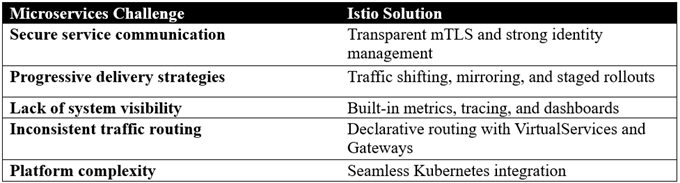
Why Choose Istio for Your Service Mesh?
Conclusion
Istio simplifies microservice networking by handling traffic management, security, and observability outside your application code. With its seamless Kubernetes integration, Istio helps teams build resilient, secure, and manageable service architectures.
In an era where scalability, security, and rapid delivery are key, Istio plays a vital role in enabling modern DevOps practices, progressive delivery strategies, and zero-trust architectures, making it an essential component of a robust service-mesh strategy.
Drop a query if you have any questions regarding Istio, and we will get back to you quickly.
Empowering organizations to become ‘data driven’ enterprises with our Cloud experts.
- Reduced infrastructure costs
- Timely data-driven decisions
About CloudThat
FAQs
1. What makes Istio a reliable choice for managing microservice traffic?
ANS: – Istio simplifies traffic control with routing, load balancing, retries, timeouts, and circuit breakers. It keeps your services reliable, even during failures or traffic spikes, without changing your app code.
2. Why is Istio recommended for secure communication between microservices?
ANS: – Istio secures service communication with automatic mTLS encryption, authenticating and encrypting traffic by default. It also manages service identities and access policies, enabling a Zero Trust security approach in Kubernetes environments.


WRITTEN BY Sidda Sonali
Sidda Sonali is a Research Associate at CloudThat with a strong passion for DevOps and cloud-native technologies. She is committed to mastering modern DevOps practices and staying abreast of the latest advancements in cloud services. Sonali has hands-on experience with tools such as Terraform, Amazon EKS, Kubernetes, and Docker, and is proficient in implementing CI/CD pipelines, managing Infrastructure as Code (IaC), and automating cloud deployments. Her expertise extends to container orchestration, deployment automation, and building secure, scalable infrastructures across diverse cloud environments.


 PREV
PREV










Comments