

 Login
Login


 December 8, 2025
|
Voiced by Amazon Polly |
Introduction
As more organizations adopt SaaS (Software as a Service) delivery models, multi-tenancy has emerged as a crucial architectural pattern. In a multi-tenant architecture, a single application instance serves multiple customers (tenants), allowing businesses to achieve cost efficiency and operational scalability.
However, when these SaaS applications rely on traditional relational databases, such as Amazon RDS, scaling database connections to handle unpredictable tenant workloads can be challenging. Enter Amazon RDS Proxy, a fully managed, highly available database proxy that helps SaaS providers handle massive numbers of database connections more efficiently and securely.
In this blog, we’ll explore how Amazon RDS Proxy can help you scale your multi-tenant SaaS application without compromising performance, security, or cost-effectiveness.
Pioneers in Cloud Consulting & Migration Services
- Reduced infrastructural costs
- Accelerated application deployment
The Challenge: Database Connection Overload in Multi-Tenant SaaS
In a typical multi-tenant SaaS setup, each tenant might represent dozens or hundreds of concurrent users. These users generate frequent and sometimes bursty application requests, which translate into numerous database connections.
Key challenges include:
- Connection storms: Sudden surges in demand can overwhelm database connection limits, leading to throttling or failures.
- Inefficient resource usage: Maintaining idle or underutilized connections consumes database memory and CPU.
- Complex connection management logic: Developers often implement connection pooling in the application layer, which can be difficult to optimize and maintain.
Amazon RDS Proxy
Amazon RDS Proxy serves as an intermediary layer between your application and your Amazon RDS or Amazon Aurora databases. It manages and pools connections efficiently, reducing the load on the database and improving application resiliency.
Core Benefits:
- Improved scalability: Handles thousands of simultaneous connections without exhausting database resources.
- Better application availability: Supports automatic failover with minimal downtime during database maintenance or failover events.
- Enhanced security: Integrates with AWS IAM and AWS Secrets Manager, enabling secure and dynamic credential management.
- Simplified application code: Removes the need to maintain complex client-side connection pooling logic.
Architecting a Scalable Multi-Tenant SaaS with RDS Proxy
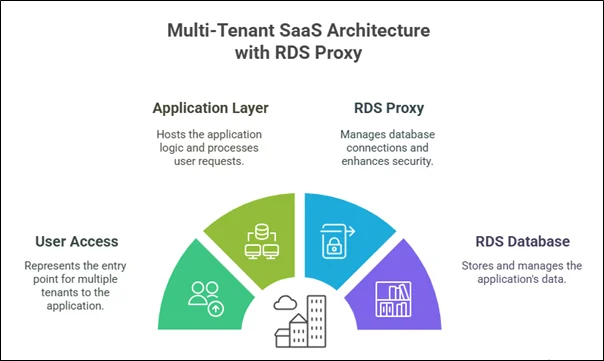
1️. Choose the Right Multi-Tenancy Model:
Common approaches include:
- Shared database, shared schema: All tenants share the same tables and schema, differentiated by a tenant identifier.
- Shared database, separate schema: One database instance, but each tenant gets its own schema.
- Separate databases per tenant: Each tenant has an isolated database instance (higher isolation but higher operational overhead).
Amazon RDS Proxy works effectively in both shared and separate database scenarios, especially where connection limits are a concern.
2️. Integrate Amazon RDS Proxy with Your Application:
- Create an Amazon RDS Proxy in the AWS console or via AWS CloudFormation/Terraform.
- Point your application’s database endpoint to the proxy instead of directly to the Amazon RDS instance.
- Use AWS Secrets Manager to manage credentials and avoid hardcoding passwords.
3️. Manage Connection Pooling Transparently:
Amazon RDS Proxy maintains a pool of established database connections. When an application request arrives, it borrows an existing connection from the pool rather than creating a new one.
This is particularly powerful for multi-tenant SaaS because:
- It reduces connection churn when multiple tenants experience spikes.
- It limits the total number of open database connections, protecting database performance.
- Idle connections can be reused efficiently, improving resource utilization.
4️. Enhance Security & Compliance:
- Amazon RDS Proxy supports AWS IAM authentication, allowing fine-grained access controls without application-side credential storage.
- Combined with AWS Secrets Manager rotation, you can enforce frequent credential changes with zero downtime.
- Connection-level policies and network-level access controls ensure tenant data is isolated and secure.
- Performance & Cost Optimization:
By reducing the number of simultaneous open connections, Amazon RDS Proxy:
- Improves transaction throughput and lowers latency under heavy load.
- Minimizes CPU and memory resource exhaustion on your Amazon RDS or Amazon Aurora database.
- Can help lower operational costs by enabling the use of smaller instance sizes or delaying database scaling events.
Conclusion
Scaling a multi-tenant SaaS application is not just about adding more compute power; it’s about managing resources intelligently and securely.
If your SaaS application is struggling with connection bottlenecks or looking to improve resiliency, it’s time to consider integrating Amazon RDS Proxy into your architecture.
Drop a query if you have any questions regarding Amazon RDS Proxy and we will get back to you quickly.
Empowering organizations to become ‘data driven’ enterprises with our Cloud experts.
- Reduced infrastructure costs
- Timely data-driven decisions
About CloudThat
FAQs
1. Can I use Amazon RDS Proxy with both Aurora and standard Amazon RDS engines?
ANS: – Yes. Amazon RDS Proxy supports Amazon Aurora (both MySQL and PostgreSQL-compatible editions) and Amazon RDS engines for MySQL and PostgreSQL. This flexibility makes it suitable for a wide range of SaaS architectures.
2. How does Amazon RDS Proxy improve database performance in SaaS applications?
ANS: – Amazon RDS Proxy reduces the overhead of frequent connection creation and teardown by maintaining a pool of established connections. This allows your SaaS application to handle sudden spikes in tenant requests without overwhelming the database, resulting in lower latency and higher throughput.
3. Does using Amazon RDS Proxy increase my AWS costs?
ANS: – While there is an additional cost for Amazon RDS Proxy, it can help lower overall database expenses by reducing the need for larger or additional DB instances to handle peak connection loads. By optimizing connection management, many organizations find that the operational savings and performance improvements justify the investment.


WRITTEN BY Yogesh Saidani
Yogesh works as a Research Associate at CloudThat. He is a passionate Cloud and AI/ML enthusiast with a strong interest in building intelligent and scalable solutions. Yogesh is skilled in AWS, Python, and machine learning, and actively explores advanced topics in cloud architecture and data science. With a deep understanding of modern cloud services and AI workflows, he focuses on developing innovative solutions that drive business impact. In his free time, Yogesh enjoys learning about emerging technologies and experimenting with new tools to stay ahead in the rapidly evolving tech landscape.


 PREV
PREV











Comments