

 Login
Login


 June 17, 2026
|
Voiced by Amazon Polly |
So, here is something that bothers me. Today, many organizations have a training budget, a full-fledged LMS, and maybe even a dedicated L&D team. But when you talk to employees, they will tell you the training is either irrelevant, too infrequent, or just something to sit through before getting back to real work.
That very gap between what organizations think they are offering and what employees actually experience is a bigger problem than most leaders realize. And closing that gap is exactly what corporate training and development is all about, if done well.
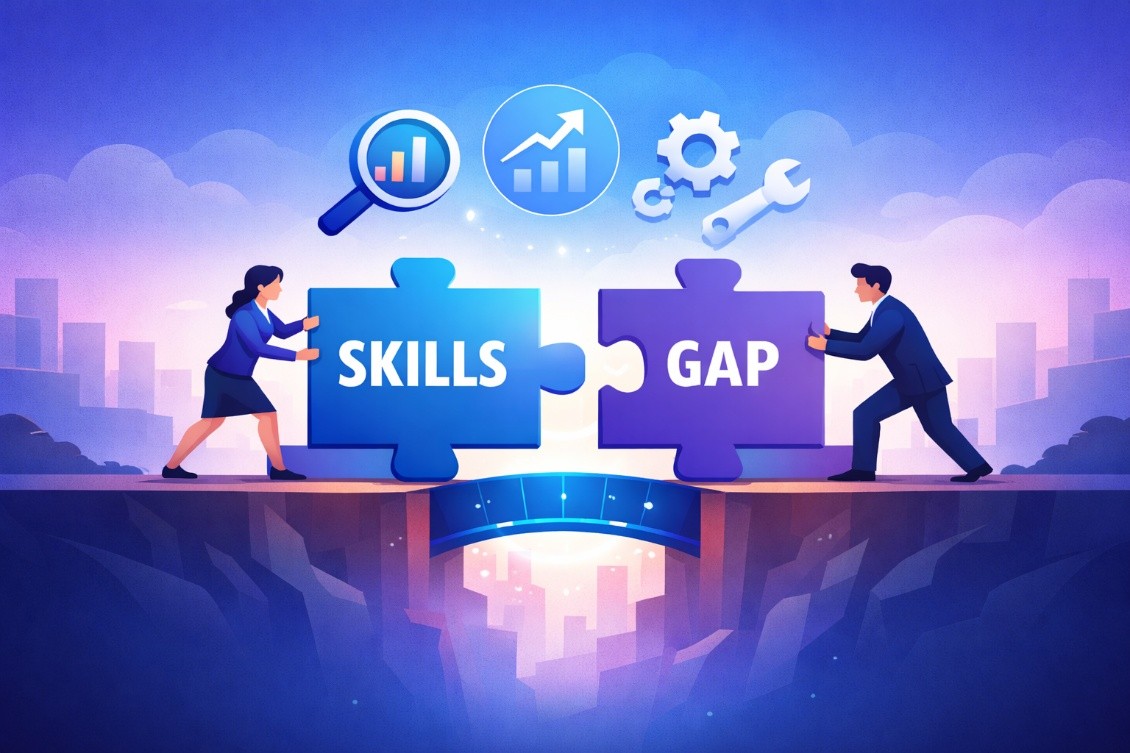
Fig 1: Bridging the gap between training and real employee skills.
Start Learning In-Demand Tech Skills with Expert-Led Training
- Industry-Authorized Curriculum
- Expert-led Training
Leadership Perception And Execution
Leadership attitudes towards corporate training and development are shifting. According to the TalentLMS 2026 L&D Benchmark Report, the share of executives who view L&D as a cost rather than an investment dropped from 54% in 2022 to 41% in 2025. While it is certainly progress, 4 out of every 10 leaders still see training as an expense to manage, not an asset to grow.
Now, leadership perception has a consequence. When workforce development is treated as a cost centre, it is the first thing cut when budgets tighten. And that is exactly the reason why skill gaps widen.
The World Economic Forum’s Future of Jobs Report 2025 shows that 39% of workers’ core skills are expected to be outdated by 2030. And 85% of employers say they plan to prioritize employee upskilling over the next five years. But here is the uncomfortable part. While most organizations agree that employee upskilling is necessary, only 36% of organizations qualify as what researchers call ‘career development champions,’ meaning they have strong, consistent workforce development programs in place. The rest are either just in the initial stage or stuck somewhere in the middle.
The urgency is clear. The intention is there. But in practice, corporate training and development is where most organizations are still falling short.
Spending More Does Not Mean Better Results
US organizations collectively spent $102.8 billion on training in 2025, up from $98 billion the year before. That is a significant number. But spending more does not always mean getting more out of it.
The organizations that actually see results from their corporate training and development investments are those that tie learning directly to business goals and build workforce development into the regular rhythm of work, not as a separate activity. Research shows that organizations that measure the business impact of learning are 27% more likely to report market share growth. Yet, according to Deloitte, 95% of L&D teams still measure activity rather than impact.
Leadership Development- The Area We Keep Getting Wrong
This is perhaps where we see the biggest disconnect in workforce development today. Gartner’s research has identified leader and manager development as the number one HR priority for the third consecutive year. And yet, 70% of organizations admit their leadership programs are not actually equipping managers with the skills they need.
Think about what that means in practice. Managers who are overwhelmed, 75% of them say so in the same Gartner survey, are making decisions every day that affect people’s careers and well-being, without adequate development to support them. Now, that is not a small problem.
According to Gartner, what works is not more of the same. Traditional lecture-based sessions actually hinder leadership development. Peer learning, on-the-job challenges, and shorter, more frequent coaching sessions are what make the real difference in leadership-level corporate training and development.
Three Things Most Training Programs Still Get Wrong
Having looked at some of the relevant data, it is understood that most organizations struggle with the same three things when it comes to corporate training and development:
- They train once and move on. The Ebbinghaus Forgetting Curve shows that 90% of the new skills learned are lost within a year if not reinforced. One workshop, however good, is simply not enough.
- They do not personalize. A software developer and a customer success manager do not need the same employee upskilling, but many organizations still push everyone through the same generic content.
- They neglect managers. Most training investment goes to individual contributors. But if managers are not equipped to reinforce on-the-job workforce development, much of that investment goes to waste.
- Choosing the wrong training partners: Many organizations struggle to find a training partner that truly understands their learning needs and can deliver a tailored training program.
Building Learning Cultures
The conversation around corporate training and development has matured a lot. Most organizations now agree in principle that investing in their people matters. The gap is in the doing.
Building a genuine culture of employee upskilling takes more than a budget line and a platform. It takes intentionality, personalization, consistency, and leadership that actually walks the talk. When those things come together, the results in productivity, retention, engagement, and growth speak for themselves.
As the saying goes, ‘culture eats strategy for breakfast’. I would add, and a ‘learning culture eats skill gaps for lunch’.
Upskill Your Teams with Enterprise-Ready Tech Training Programs
- Team-wide Customizable Programs
- Measurable Business Outcomes
About CloudThat


WRITTEN BY Shahab M
Shahab Muhammed is the Vertical Head of Power BI Team at CloudThat, specializing in Power BI & Data Analysis trainings. With 10 years of experience in training industry, he has trained over 5000 professionals to upskill in technologies like Power BI, Excel and other Power Platform technologies. With an industry experience as a BI Consultant, he brings deep technical knowledge and practical application into every learning experience. Shahab's passion for training and development reflects in his unique approach to learning and development.


 PREV
PREV









Comments