

 Login
Login


 May 25, 2026
|
Voiced by Amazon Polly |
Introduction
Artificial Intelligence is no longer limited to single chatbots answering isolated questions. Modern AI applications increasingly require multiple intelligent agents working together to solve complex tasks efficiently. This is where CrewAI comes in.
CrewAI is an open-source Python framework for orchestrating autonomous AI agents that collaborate like a real-world team. Instead of assigning every responsibility to one large language model, CrewAI allows developers to create specialized agents with distinct roles, goals, tools, and responsibilities. These agents can communicate, delegate tasks, share context, and work together to achieve a common objective.
For example, in a content creation workflow, one agent can research a topic, another can write the article, and a third can review and optimize the final output. This collaborative approach improves accuracy, scalability, and workflow organization.
CrewAI is lightweight, developer-friendly, and highly flexible, making it suitable for applications such as business automation, research systems, coding assistants, customer support, and AI-powered decision-making platforms.
As the demand for autonomous AI systems continues to grow, CrewAI provides a practical framework for building intelligent multi-agent applications that go beyond traditional chatbot capabilities.
Pioneers in Cloud Consulting & Migration Services
- Reduced infrastructural costs
- Accelerated application deployment
Key Features
- Multi-Agent Collaboration – CrewAI enables multiple AI agents to work together within a shared workflow. Instead of depending on a single AI model to handle every task, CrewAI allows agents to specialize in different responsibilities such as research, writing, analysis, or review. This collaborative approach improves efficiency, accuracy, and task organization, making the complex workflow easier to manage.
- Role-Based Agent Architecture – Each agent in CrewAI is designed with a specific role, goal, and backstory that define its behavior and responsibilities. This structured architecture helps agents perform specialized tasks consistently and effectively. Developers can create agents that act like domain experts, enabling more realistic and intelligent task execution.
- Flexible Workflow Management – CrewAI supports both sequential and hierarchical execution processes. In sequential workflows, tasks are completed step-by-step in a fixed order, whereas in hierarchical workflows, manager agents can dynamically assign tasks to other agents. This flexibility makes CrewAI suitable for everything from simple automations to advanced enterprise-level AI systems.
- Tool and API Integration – CrewAI agents can integrate with external tools, APIs, databases, and search engines to access real-time information and perform advanced operations. The framework also supports integrations with LangChain and LlamaIndex tools, enabling developers to expand agent capabilities with minimal effort.
- Memory and Context Retention – Agents in CrewAI can retain memory across tasks and interactions, enabling them to recall previous conversations and decisions. This context retention improves reasoning, enables long-running workflows, and creates more intelligent and coherent AI systems.
- Human-in-the-Loop Support – CrewAI allows human intervention during workflow execution. Users can review outputs, provide feedback, approve decisions, or guide agents when necessary. This feature increases reliability and ensures better control in sensitive or high-accuracy applications.
- YAML-Based Configuration – CrewAI supports YAML-based configuration for defining agents and tasks, making projects more organized and maintainable. This approach improves readability, simplifies updates, and enables teams to manage large AI workflows more efficiently.
- Lightweight and Scalable Framework-CrewAI is lightweight, easy to learn, and highly scalable. Developers can quickly build AI-powered workflows with minimal setup while retaining the flexibility to scale applications for larger, more complex use cases.
Use Case
- Content Creation – CrewAI can automate content workflows where one agent researches topics, another writes articles, and another edits or optimizes the content for SEO and readability.
- Business Process Automation – Organizations can use CrewAI to automate repetitive tasks, including email management, report generation, customer support, and meeting summarization.
- Research and Data Analysis – AI agents can collaborate to collect data, analyze trends, generate insights, and prepare detailed research reports for businesses or academic purposes.
- Software Development – CrewAI can assist development teams by generating code, reviewing pull requests, debugging issues, and creating technical documentation.
- Customer Support Systems – Businesses can build intelligent support systems that enable agents to handle queries, escalate complex issues, and maintain conversation context.
- Financial Analysis – Specialized agents can monitor markets, analyze financial data, generate investment reports, and track economic trends.
- Marketing Automation – CrewAI helps automate campaign planning, audience research, social media content generation, and competitor analysis.
Code Example
Basic CrewAI Workflow
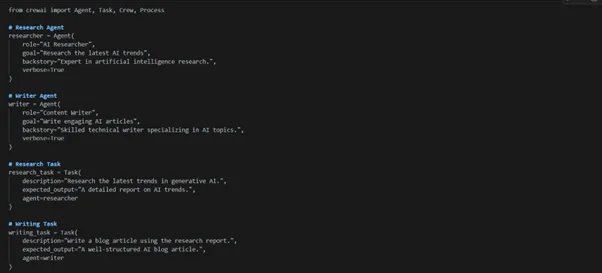

This example demonstrates how two AI agents collaborate to research and write a blog article.
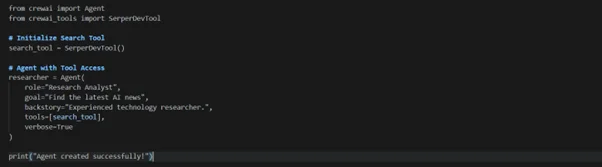
Using Tools with CrewAI
This example shows how an agent can use a web search tool to gather real-time information.
Conclusion
CrewAI is emerging as one of the most powerful frameworks for building autonomous multi-agent AI systems. By enabling multiple AI agents to collaborate, delegate tasks, and share responsibilities, it offers a smarter and more efficient approach to solving complex problems than traditional single-agent workflows.
One of CrewAI’s biggest strengths is its simplicity and developer-friendly design, allowing teams to build intelligent AI workflows with minimal setup quickly. At the same time, its extensibility makes it powerful enough for advanced enterprise-level applications. As AI continues to evolve toward collaborative and autonomous systems, CrewAI provides a strong foundation for creating the next generation of intelligent, scalable, and highly productive AI-driven solutions.
Drop a query if you have any questions regarding CrewAI, and we will get back to you quickly.
Empowering organizations to become ‘data driven’ enterprises with our Cloud experts.
- Reduced infrastructure costs
- Timely data-driven decisions
About CloudThat
FAQs
1. Is CrewAI suitable for beginners?
ANS: – Yes, CrewAI is beginner-friendly and provides a simple Python-based framework with YAML configuration support, making it easy to create and manage AI workflows.
2. What makes CrewAI different from traditional AI systems?
ANS: – Unlike traditional AI systems that rely on a single model, CrewAI uses multiple specialized agents that collaborate and delegate tasks, resulting in more scalable, organized, and efficient workflows.
3. Is CrewAI suitable for enterprise applications?
ANS: – Yes, CrewAI can handle complex enterprise workflows through its scalable multi-agent architecture and automation capabilities.


WRITTEN BY Livi Johari
Livi Johari is a Research Associate at CloudThat with a keen interest in Data Science, Artificial Intelligence (AI), and the Internet of Things (IoT). She is passionate about building intelligent, data-driven solutions that integrate AI with connected devices to enable smarter automation and real-time decision-making. In her free time, she enjoys learning new programming languages and exploring emerging technologies to stay current with the latest innovations in AI, data analytics, and AIoT ecosystems.


 PREV
PREV











Comments