

 Login
Login


 September 7, 2026
|
Voiced by Amazon Polly |
Introduction
Websites and digital platforms can contain thousands or even millions of pages. As the amount of content grows, finding the right page quickly becomes a challenge.
Page indexing helps solve this problem by processing page content and organizing it in a searchable format. However, indexing a large number of pages requires more than simply storing URLs. The system needs to collect content, process it, handle duplicate and updated pages, and make the information available for fast search.
AWS provides several managed services that can be combined to build a scalable page indexing solution. In this architecture, Amazon S3 stores the page data, AWS services handle processing, and Amazon OpenSearch Service provides the searchable index.
Pioneers in Cloud Consulting & Migration Services
- Reduced infrastructural costs
- Accelerated application deployment
Objective
The objective is to build a scalable page-indexing system that can collect pages from various sources, store the original page data, and process and clean the content before indexing. The system should identify duplicate or updated pages, create searchable index documents, and support both batch and real-time indexing. It should also handle failures through retry and reprocessing mechanisms while providing fast and reliable search results to applications.
What Is Page Indexing?
Page indexing is the process of collecting, processing, and storing information about web pages in a structured index so that the pages can be found quickly when someone performs a search.
A simple example is a website with thousands of articles. Instead of searching every article whenever a user enters a query, the system searches an index containing information about those articles.
The index can contain information such as the page title, URL, content, keywords, category, and other metadata.
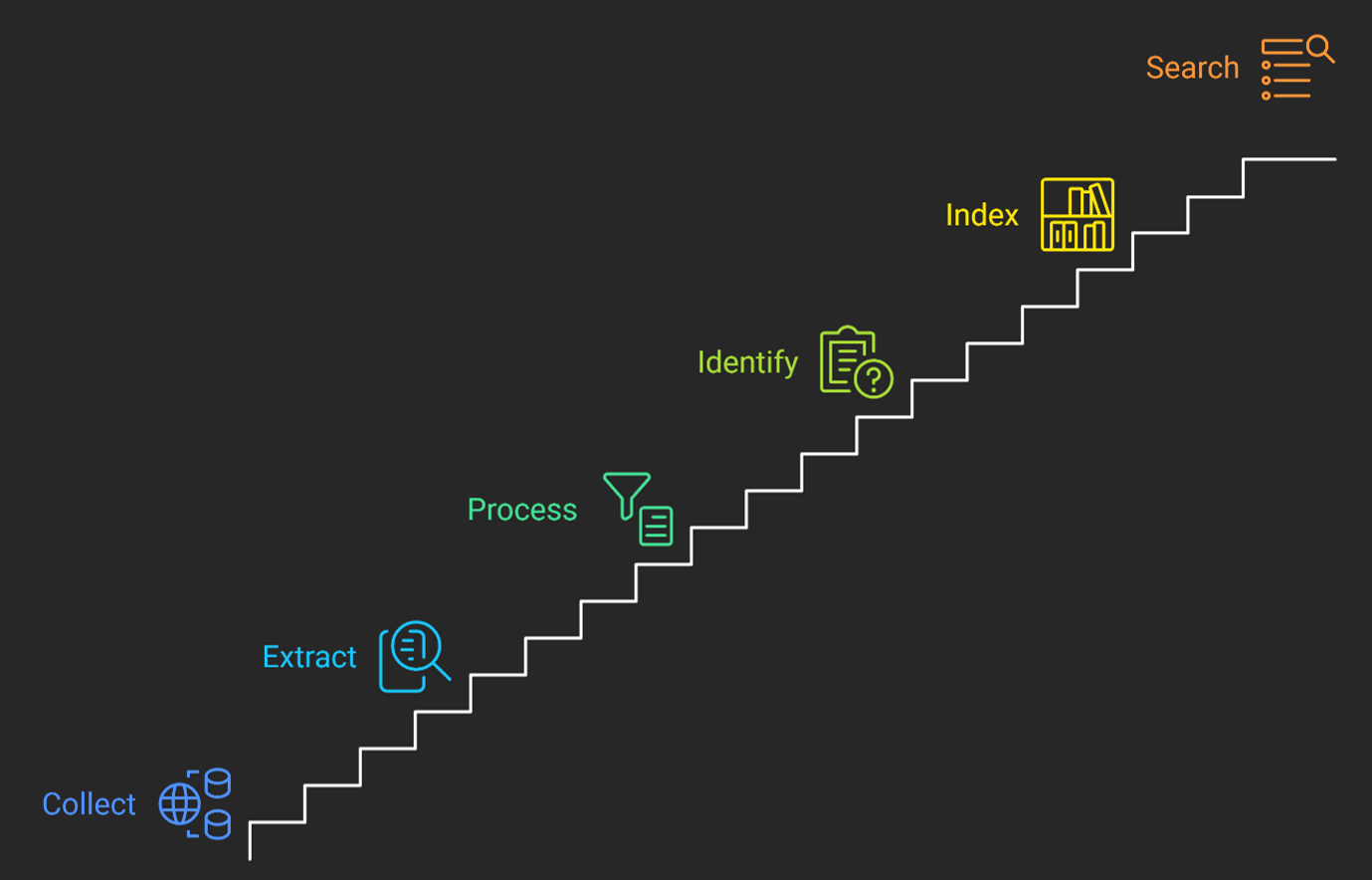
How Does Page Indexing Work?
- Collect
Pages are collected from websites, APIs, CMS platforms, crawlers, or other content sources.
- Extract
Important information, such as the title, text, URL, and metadata, is extracted from each page.
- Process
The content is cleaned and normalized so it can be searched consistently.
- Identify
The system checks whether the page is new, already indexed, or has been updated.
- Index
The processed information is added to a search index.
- Search
When a user searches for something, the search engine uses its index to quickly find relevant pages.
Challenges in Page Indexing at Scale
Indexing a few hundred pages is relatively simple. The challenge becomes much greater when the system needs to handle millions of pages.
Some common challenges are:
- Large Data Volumes
Millions of pages may need to be processed without creating a processing bottleneck.
- Frequently Updated Content
Pages can change regularly, so the index needs to stay up to date.
- Duplicate Content
The same content may appear under different URLs or may be received multiple times.
- Processing Failures
Invalid pages, network failures, or service errors can interrupt processing.
- Re-indexing
Changes to the search structure or processing logic may require that millions of pages be reindexed.
- Search Performance
The final index must support fast queries even when it contains a large number of documents.
These challenges make a scalable, event-driven architecture important.
Page Indexing Workflow on AWS
The AWS workflow follows a straightforward path.
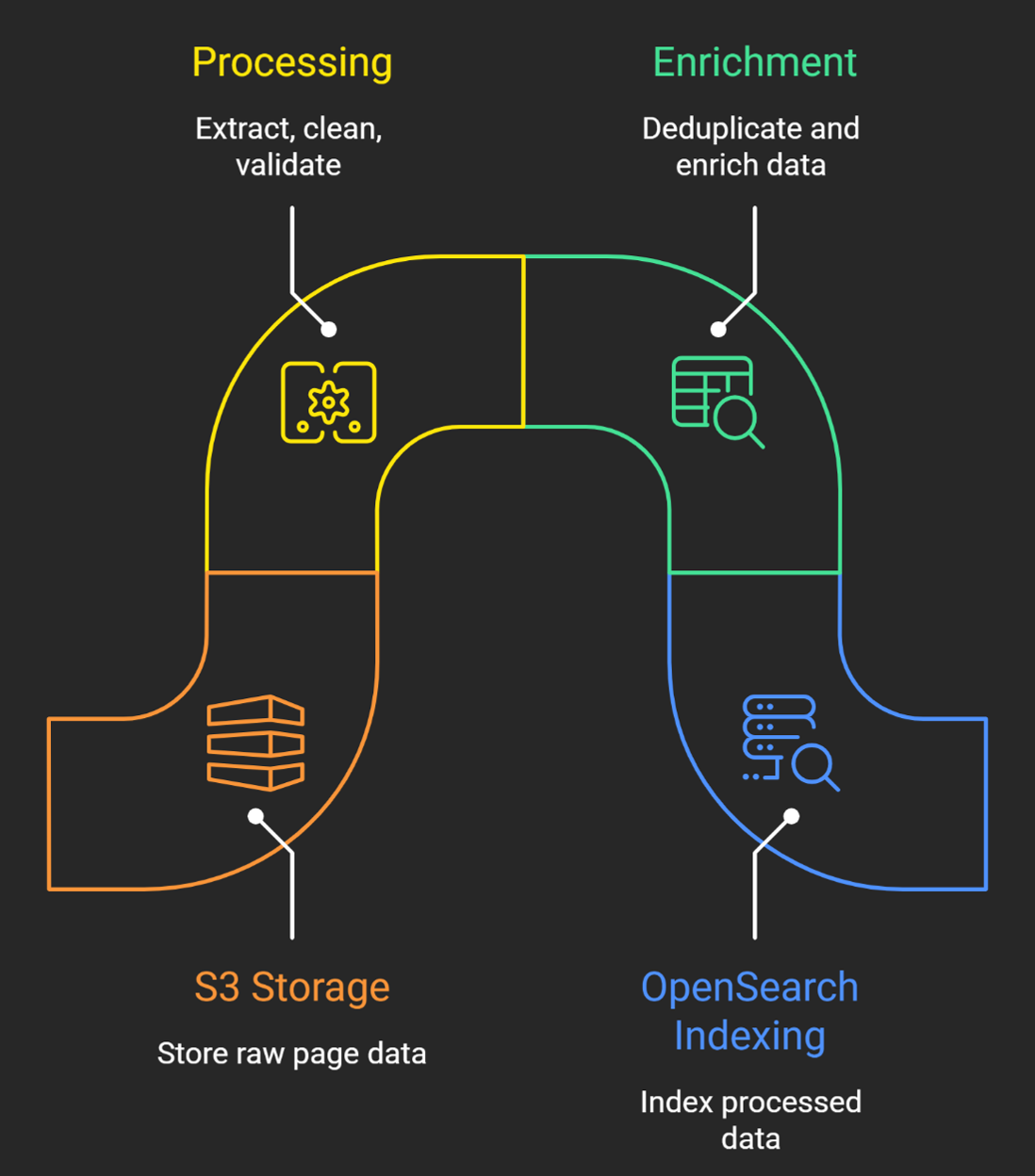
- Page Ingestion
Pages enter the system from websites, APIs, crawlers, or other sources.
The raw content is stored in Amazon S3, providing a durable copy of the original data.
- Content Processing
AWS Lambda, Amazon Fargate, or AWS Glue processes the page and extracts useful information such as:
- Title
- Main content
- URL
- Metadata
- Keywords
- Language
- Validation and Deduplication
The processed content is validated and checked for duplicates before it reaches the search index.
- Enrichment
Additional information, such as categories, keywords, or classification, can be added to improve search results.
- Indexing
The final document is sent to Amazon OpenSearch Service, where it becomes available for search.
- Query
The application sends a search request via an API layer that queries OpenSearch and returns the relevant pages.
Batch and Real-Time Page Indexing
A page indexing system can support both batch and real-time processing.
Batch Indexing
Batch processing is useful when a large number of pages need to be indexed at once.
Real-Time Indexing
Real-time processing is useful when pages are frequently created or updated.
Page Update
↓
Kinesis / SQS
↓
Processing
↓
OpenSearch
This allows changes to be indexed without waiting for a scheduled batch process.
Handling Duplicate and Updated Pages
Duplicate content can increase index size and produce poor search results.
A simple approach is to generate a unique identifier using the page’s canonical URL and calculate a hash of its content.
Canonical URL
↓
Document ID
Page Content
↓
Content Hash
If the document already exists and the content hash has not changed, the page does not need to be indexed again.
If the URL exists but the content has changed, the existing index document can be updated.
This also makes the indexing process idempotent, meaning processing the same page multiple times does not unnecessarily create duplicate records.
Future Enhancements
The architecture can be extended as the application grows.
- Real-Time Indexing
Kinesis or Kafka can provide continuous page updates for near-real-time indexing.
- AI-Based Search
Machine learning can be introduced to improve content classification and search ranking.
- Semantic and Vector Search
Page content can be converted into embeddings to support semantic search and RAG applications.
- Multi-Region Architecture
The search layer can be deployed across multiple AWS Regions to improve global availability and latency.
- Lakehouse Integration
Processed page data can be stored in an S3-based lakehouse using formats such as Apache Iceberg, allowing the same data to support analytics and machine learning.
Conclusion
Page indexing becomes increasingly challenging as the volume and frequency of content updates grow. By combining Amazon S3, Lambda or Fargate, SQS/Kinesis, Step Functions, Glue, DynamoDB, and OpenSearch, AWS provides the building blocks for a scalable indexing pipeline. This approach provides a strong foundation for search today while leaving room for real-time indexing, semantic search, AI, and analytics in the future.
Drop a query if you have any questions regarding Page indexing, and we will get back to you quickly.
Empowering organizations to become ‘data driven’ enterprises with our Cloud experts.
- Reduced infrastructure costs
- Timely data-driven decisions
About CloudThat
FAQs
1. Why is Amazon S3 used in the architecture?
ANS: – S3 stores the original page data. This allows the data to be reprocessed or the search index to be rebuilt when required.
2. Why use Amazon OpenSearch?
ANS: – OpenSearch is designed for fast searching, filtering, and ranking across large collections of documents.
3. How are duplicate pages identified?
ANS: – The system can use the canonical URL to identify a page and a content hash to determine whether its content has changed.

WRITTEN BY Balaji M
Balaji works as a Research Associate in Data and AIoT at CloudThat, specializing in cloud computing and artificial intelligence–driven solutions. He is committed to utilizing advanced technologies to address complex challenges and drive innovation in the field.


 PREV
PREV












Comments