

 Login
Login

 September 21, 2026
|
Voiced by Amazon Polly |
Artificial Intelligence has evolved far beyond chatbots. Modern AI agents can plan tasks, use tools, interact with enterprise applications, collaborate with other agents, and execute complex workflows with minimal human intervention.
While organizations have adopted LLMOps to manage Large Language Models in production, deploying a model alone is no longer enough. Enterprises must now operate autonomous agents that make decisions, interact with multiple systems, recover from failures, and continuously adapt.
This is where AgentOps comes in. Beyond managing language models, AgentOps provides the operational framework for building, deploying, monitoring, securing, and maintaining intelligent AI agents at scale.
Start Learning In-Demand Tech Skills with Expert-Led Training
- Industry-Authorized Curriculum
- Expert-led Training
Why LLMOps Alone Is No Longer Enough
LLMOps was designed to solve challenges related to Large Language Models, including deployment, prompt management, evaluation, versioning, latency, and cost optimization. While these practices remain essential, they address only one part of today’s AI ecosystem.
Enterprise AI agents do far more than generate text. They can retrieve CRM data, check inventory, create service tickets, validate invoices, detect anomalies, and initiate approvals or payments. Managing these actions introduces operational complexity that extends far beyond LLMOps.
An autonomous agent must answer questions such as:
- Which tools should I use?
- What should I do if a tool fails?
- Should I ask another agent for assistance?
- How should I recover from an unexpected error?
- Am I still operating within organizational policies?
Managing these behaviors requires an entirely new operational discipline.
What Is AgentOps?
AgentOps is the practice of operating, monitoring, governing, and continuously improving autonomous AI agents in production environments.
It combines principles from DevOps, MLOps, Site Reliability Engineering (SRE), security, governance, and observability to ensure AI agents remain reliable, scalable, and trustworthy.
Instead of managing only AI models, AgentOps manages complete agent ecosystems.
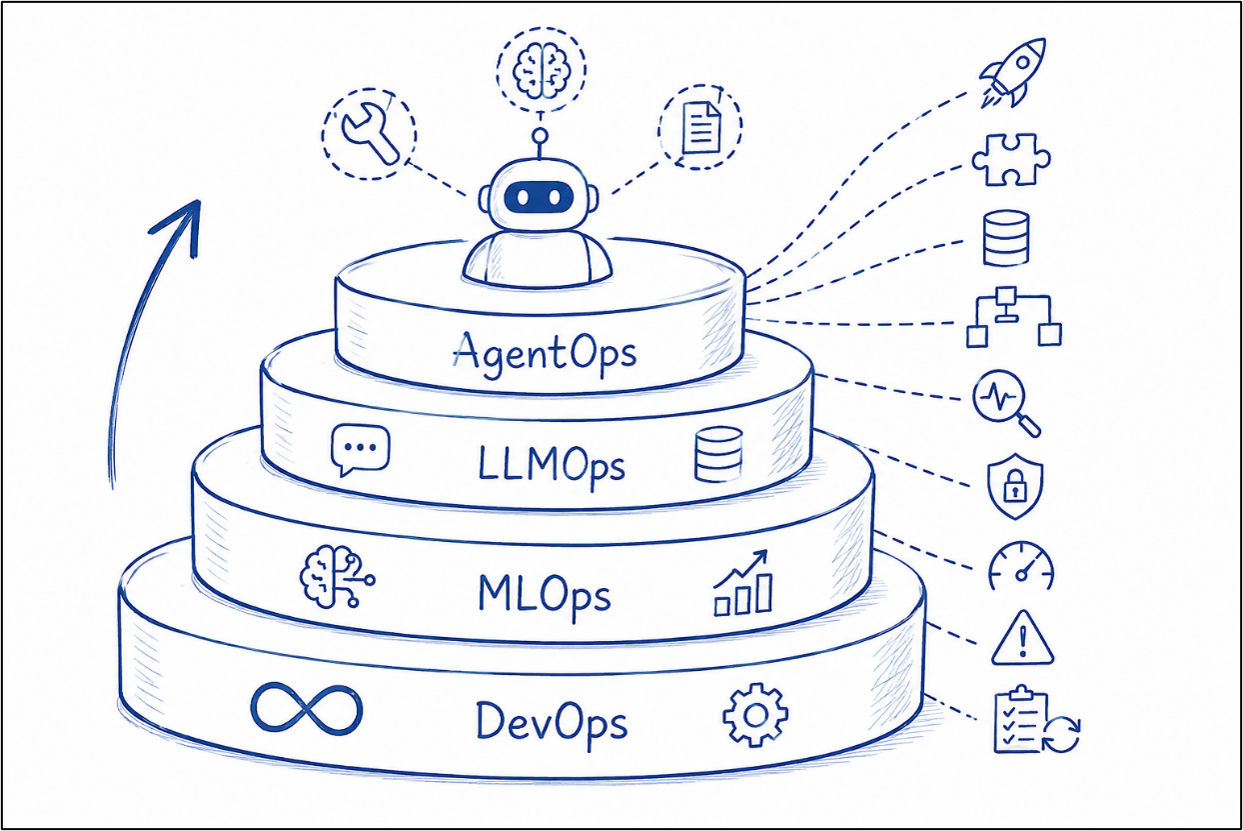
Fig 1: AgentOps extends DevOps and MLOps to manage AI agents in production.
An AgentOps platform typically oversees:
- Agent deployment
- Tool integration
- Memory management
- Planning workflows
- Observability
- Security policies
- Performance optimization
- Incident response
- Continuous evaluation
Think of AgentOps as the operating framework that keeps enterprise AI agents running safely and efficiently.
The Complete AgentOps Lifecycle
Running autonomous agents successfully requires continuous operational management throughout their lifecycle.
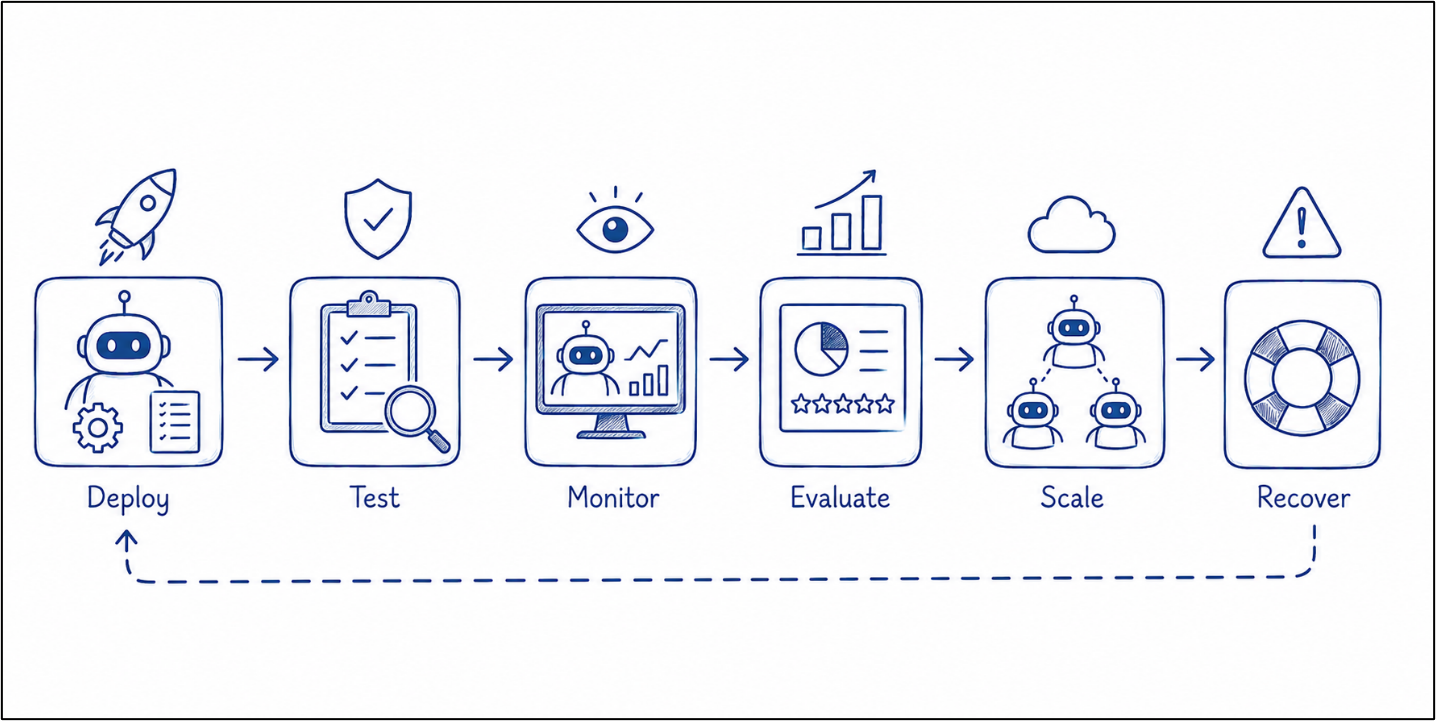
Fig 2: The complete AgentOps lifecycle for managing AI agents in production.
Agent Deployment
Deploying an AI agent goes beyond publishing a model endpoint; it involves prompts, tools, memory, security policies, orchestration, and runtime configurations.
A successful deployment strategy ensures that agents can be updated independently without disrupting business operations.
Agent Testing
Traditional software testing verifies expected outputs. AI agents require additional validation because they make decisions dynamically.
Testing should evaluate:
- Goal completion
- Tool selection accuracy
- Reasoning quality
- Policy compliance
- Hallucination risks
- Multi-step execution reliability
Simulation-based testing has become increasingly important because it allows organizations to evaluate thousands of real-world scenarios before production deployment.
Agent Monitoring
Unlike traditional applications, AI agents execute reasoning chains rather than predefined workflows.
Monitoring should answer questions such as:
- Which decisions did the agent make?
- Which tools were invoked?
- How much time was spent planning?
- Which step caused a failure?
- How many tokens were consumed?
- Was human intervention required?
These insights help teams understand not only what happened but why it happened.
Agent Evaluation
Success for an AI agent cannot be measured by response accuracy alone.
Organizations should evaluate:
- Task completion rate
- Decision quality
- User satisfaction
- Operational cost
- Latency
- Policy adherence
- Reliability over time
Evaluation should become a continuous process rather than a one-time benchmark exercise.
Agent Scaling
As organizations deploy more AI agents, operational complexity increases rapidly.
Instead of managing one assistant, enterprises may operate hundreds of specialized agents supporting HR, finance, sales, IT, customer service, compliance, and engineering.
AgentOps enables centralized management of this growing ecosystem through standardized deployment pipelines, shared governance policies, and operational dashboards.
Incident Management
Failures are inevitable.
An external API may become unavailable.
A planning step may fail.
A tool may return unexpected data.
An AI agent might exceed its execution budget.
Rather than stopping completely, modern AgentOps practices encourage graceful recovery through retries, fallback models, alternative tools, escalation to another agent, or human approval when necessary.
Observability: The Foundation of AgentOps
One of the biggest challenges in autonomous systems is understanding agent behavior.
Traditional logs often fail to capture the reasoning process behind AI-driven decisions.
Modern observability platforms provide visibility into:
- Agent reasoning paths
- Tool execution timelines
- Memory usage
- Token consumption
- Cost analytics
- Execution traces
- Latency breakdowns
- Failure points
This level of transparency helps developers debug complex workflows and gives business leaders confidence in production deployments.
Security and Governance Cannot Be an Afterthought
Autonomous agents often interact with sensitive enterprise systems.
Without proper controls, they may accidentally expose confidential information, execute unauthorized actions, or violate organizational policies.
An effective AgentOps strategy includes:
- Role-based access control
- Secure credential management
- Tool permission policies
- Human approval checkpoints
- Audit logs
- Data governance
- Compliance monitoring
Security becomes even more important when multiple agents collaborate across different business functions.
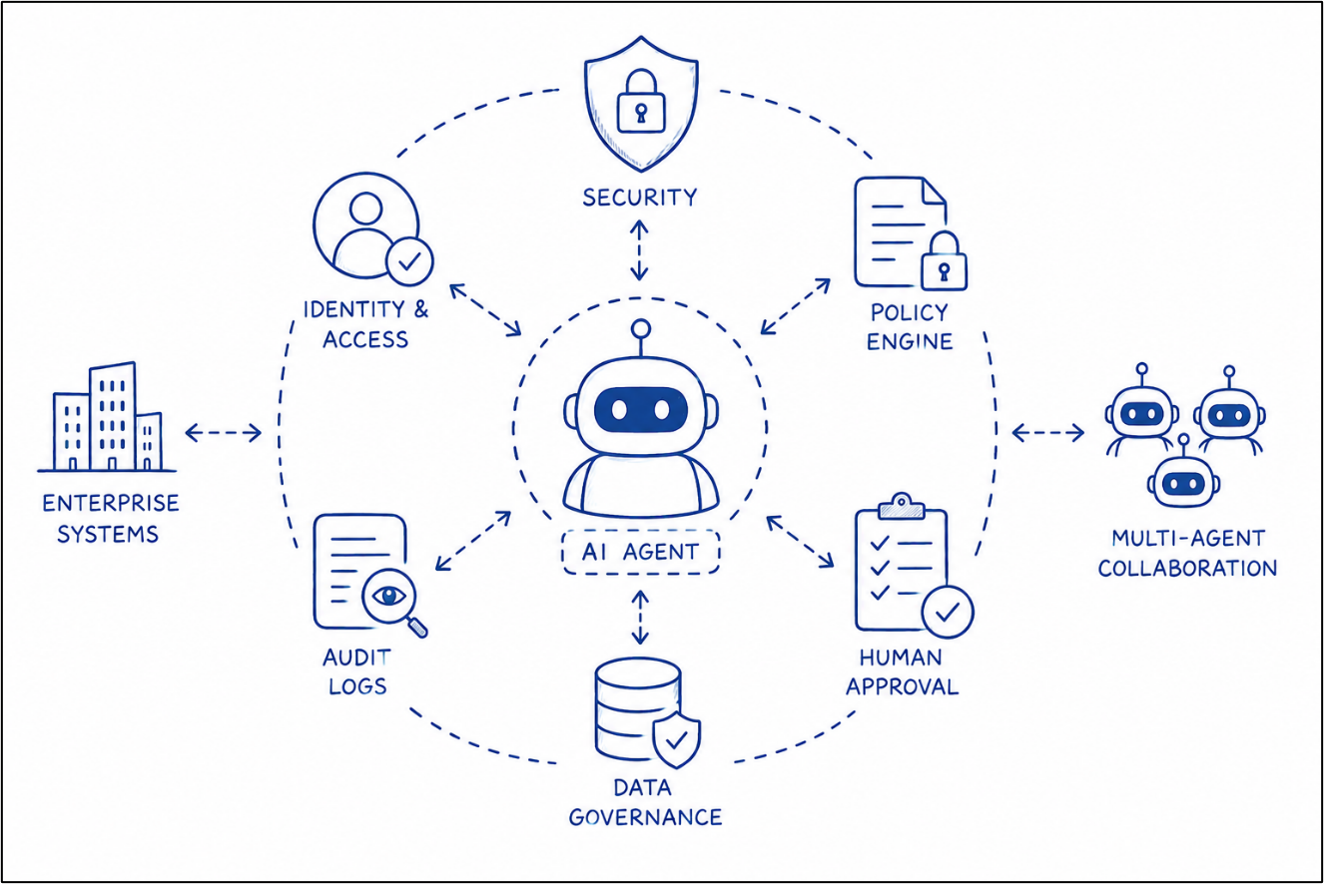
Fig 3: AgentOps security and governance controls for enterprise AI agents.
The Future of Enterprise AI
As enterprises adopt hundreds or even thousands of AI agents, managing them individually will become impractical.
Future AgentOps platforms are expected to provide capabilities such as:
- Centralized agent registries
- Enterprise-wide policy management
- Automated health checks
- Agent version control
- Cross-agent coordination
- Self-healing execution
- Cost-aware orchestration
- Unified operational dashboards
The future of enterprise AI lies not just in larger language models, but in autonomous agents that can make decisions, collaborate with enterprise systems, and execute business processes independently.
Managing these intelligent systems requires more than LLMOps; it requires AgentOps, a comprehensive framework for deployment, testing, monitoring, governance, security, scaling, and continuous improvement. Organizations that adopt AgentOps early will be better positioned to build reliable, secure, and scalable AI solutions as autonomous agents become central to enterprise operations.
Upskill Your Teams with Enterprise-Ready Tech Training Programs
- Team-wide Customizable Programs
- Measurable Business Outcomes
About CloudThat


WRITTEN BY Kiran Dambal
Kiran Dambal is a Microsoft Certified Trainer at CloudThat and a passionate tech enthusiast, with expertise in Python, machine learning, deep learning, and a variety of other technologies. With over 3.5 years of experience in training, he has successfully trained numerous working professionals. Specializing in delivering technical training across diverse topics, he excels in providing personalized training tailored to the specific needs of customers and businesses. He has actively contributed to numerous projects involving machine learning, deep learning, NLP, data science and data analysis in Python, MLOps, Generative AI, Prompt engineering, Fine-tuning LLMs, RAG etc. Additionally, he has created multiple POCs with Azure AI, Azure OpenAI Services, and Azure DevOps.


 PREV
PREV










Comments