

 Login
Login


 June 16, 2026
|
Voiced by Amazon Polly |
What is AWS Private Link?
In today’s cloud-first world, organizations are increasingly concerned about data security, network isolation, and compliance. Traditional methods of accessing services over the internet, even when encrypted, can introduce unnecessary exposure and complexity. This is where AWS PrivateLink becomes a game-changing solution. Offered by Amazon Web Services, AWS PrivateLink enables private connectivity between VPCs, AWS services, and third-party applications without traversing the public internet.
AWS PrivateLink is a service that allows you to access applications and AWS services securely and privately using private IP addresses. Instead of sending traffic through internet gateways or NAT devices, PrivateLink ensures that all communication stays within the AWS backbone network. This reduces exposure to external threats and eliminates the need for complex routing configurations.
Start Learning In-Demand Tech Skills with Expert-Led Training
- Industry-Authorized Curriculum
- Expert-led Training
Key Components of AWS Private Link
- Interface Endpoints (ENIs)
Interface endpoints are essentially Elastic Network Interfaces (ENIs) created within your subnet that act as entry points to the PrivateLink service. Each endpoint is assigned a private IP address, enabling resources in your VPC to communicate securely with supported services. Because these endpoints reside inside your VPC, you can control access using security groups and network ACLs.
- Endpoint Services
Endpoint services are created by service providers who want to expose their applications privately. These services are typically backed by a Network Load Balancer (NLB). The provider can control which consumers are allowed to connect, adding an extra layer of security.
This model is particularly useful for SaaS providers who want to deliver services securely to multiple customers. It allows them to avoid exposing public endpoints.
- Service Consumers & Providers
In the PrivateLink model, there are two roles: service providers and service consumers. Providers host and expose services, while consumers create interface endpoints to access those services. This separation allows organizations to build secure, multi-account architectures without needing full network connectivity.
AWS PrivateLink Architecture
The diagram below illustrates how VPC endpoints enable secure connectivity to SaaS products. The service provider sets up an endpoint service and grants access permissions to their customers. As a service consumer, you then create an interface VPC endpoint in your VPC, which establishes private connections between your subnets and the provider’s endpoint service.
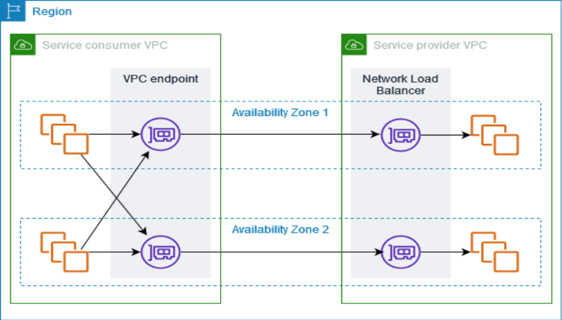
Source: Access SaaS products through AWS PrivateLink – Amazon Virtual Private Cloud
How AWS Private Link Works
A service provider first creates a service using a Network Load Balancer and makes it available via PrivateLink. The consumer then creates an interface endpoint in their VPC, which connects to the provider’s service.
Once the connection is established, all traffic flows privately within the AWS network. There is no need for public IP addresses, internet gateways, or VPN connections. This architecture ensures secure and efficient communication while minimizing operational overhead.
Private Link vs VPC Peering vs VPN
AWS PrivateLink differs significantly from traditional connectivity options such as VPC peering and VPNs. While VPC peering provides full network connectivity, it requires non-overlapping CIDR blocks and can become complex at scale. VPN connections, on the other hand, rely on the public internet and may introduce latency and security concerns.
PrivateLink focuses on service-level connectivity, which makes it more secure and easier to manage. It avoids the complexity of full network exposure while still enabling seamless communication between services. This makes it a preferred choice for many modern cloud architectures.
Common Use Cases
- Access AWS Services Privately
Organizations can use PrivateLink to access AWS services without exposing traffic to the internet. It ensures secure communication while maintaining strict network isolation.
- SaaS Integrations
SaaS providers can expose their applications to customers securely using PrivateLink. Customers can then access these services through private endpoints, eliminating the need for public URLs. This enhances trust and simplifies integration for enterprise clients.
- Multi-Account Architectures
In environments with multiple AWS accounts, PrivateLink enables secure communication without VPC peering. This reduces complexity and avoids issues like CIDR overlap.
- Compliance-Driven Workloads
Industries like banking and healthcare often have strict compliance requirements. PrivateLink helps meet these requirements by ensuring that data does not traverse the public internet.
Building Expertise in AWS Cloud Security
As organizations increasingly prioritize secure cloud architectures, expertise in services such as AWS PrivateLink has become essential for cloud and security professionals. Understanding how to design private connectivity without exposing services to the internet helps engineers build highly secure and compliant environments. Gaining hands-on experience with AWS security services enables professionals to troubleshoot connectivity challenges, strengthen their ability to design secure, scalable solutions in modern cloud ecosystems
Future of Secure Connectivity
AWS PrivateLink is a powerful service that enables secure, private, and scalable connectivity in the cloud. By eliminating the need for public internet exposure, it helps organizations build more secure and compliant architectures. Its simplicity and flexibility make it an essential tool for modern cloud networking.
Whether you’re building a SaaS platform, enabling multi-account communication, or securing sensitive workloads, PrivateLink offers a robust and reliable solution.
Upskill Your Teams with Enterprise-Ready Tech Training Programs
- Team-wide Customizable Programs
- Measurable Business Outcomes
About CloudThat


WRITTEN BY Mahek Tamboli
Mahek is a Senior Subject Matter Expert at CloudThat, specializing in AWS Architecting. With 13 years of experience in IT and education industry, she has trained over 2000 professionals/students to upskill in hardware, network, MCSA, RHCSA and multi cloud. She is an authorized trainer for AWS and GCP. Known for simplifying complex concepts and delivering interactive and hands-on sessions, she brings deep technical knowledge and practical application into every learning experience. Mahek passion for continuous learning reflects in her unique approach to learning and development.


 PREV
PREV












Comments