

 Login
Login


 August 25, 2026
|
Voiced by Amazon Polly |
Introduction
Building AI agents traditionally requires developers to write orchestration code, integrate tools, design prompts, manage workflows, and debug multiple components. AutoAgent, developed by the HKUDS research team, takes a different approach by allowing users to create and manage LLM agents using natural-language instructions.
AutoAgent is an open-source framework designed to simplify agent development through a combination of zero-code workflows and programmatic APIs. It supports agent creation, multi-agent workflows, agentic RAG, tool integration, browser automation, and multiple LLM providers.
The core idea is simple: describe what you want the agent to do, and AutoAgent helps build the underlying agent workflow.
Pioneers in Cloud Consulting & Migration Services
- Reduced infrastructural costs
- Accelerated application deployment
Key Features
- Natural-Language Agent Creation – AutoAgent allows users to describe an agent’s purpose in plain language instead of manually implementing its logic. Users can define the agent’s role, responsibilities, tools, and expected behavior through natural-language instructions.
- Multi-Agent Workflow Creation – AutoAgent enables users to create workflows involving multiple specialized agents. Different agents can handle tasks such as planning, research, data processing, validation, and content generation. This makes it easier to build solutions for complex, multi-step tasks.
- Agentic RAG – AutoAgent provides built-in retrieval-augmented generation capabilities with a native, self-managing vector database. This reduces the need to configure and maintain a separate vector database for retrieval-based applications.
- Multiple LLM Provider Support – AutoAgent supports a wide range of LLM providers and model-serving platforms, including OpenAI, Anthropic, DeepSeek, vLLM, Grok, and Hugging Face. This allows users to select models based on their performance, cost, latency, and deployment requirements.
- Function Calling and ReAct Support – The framework supports both function calling and ReAct-style interactions, allowing agents to reason through tasks and use external tools when required.
- Custom Tool Creation – Users can describe the functionality of a required tool in natural language and integrate it into their agent workflows. This can simplify the process of creating utilities for REST APIs, data processing, and other external services.
- Browser-Based Automation – AutoAgent supports browser environments and can interact with websites as part of an agent workflow. This enables use cases that require agents to retrieve information or perform actions through web interfaces.
- Open Source and Self-Hosted – AutoAgent is available as an open-source project, allowing developers and organizations to experiment with, customize, and run the framework in their own environments.
Code Examples
- Install AutoAgent
Clone the repository, install AutoAgent, and configure your LLM provider credentials.

- Configure API Key

- Launch AutoAgent

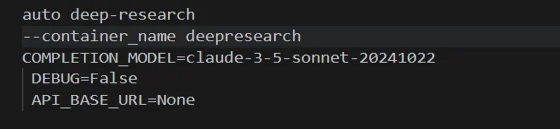
- Launch Deep Research
- Create a Custom Agent
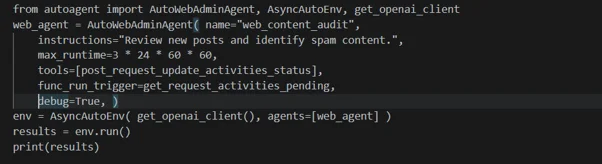
This example demonstrates how developers can define an agent with specific instructions, tools, triggers, and runtime settings. Multiple agents can also be configured within the same execution environment for more complex workflows.
Use Cases
- Deep Research and Report Generation – AutoAgent can automate end-to-end research by gathering information from different sources, analyzing the retrieved content, and generating structured reports. It can be useful for market research, technical analysis, competitive research, and knowledge discovery.
- Multi-Agent Workflow Automation – Complex tasks can be divided among multiple specialized agents, with each agent handling a specific responsibility such as planning, research, validation, data processing, or content generation. This makes large, multi-step workflows easier to manage and automate.
- Custom Tool Creation – Users can describe the functionality of a required tool using natural language and integrate it into an agent workflow. This can be useful for creating tools that interact with APIs, databases, file systems, or other external services.
- Content Moderation and Auditing – AutoAgent can automatically review user-generated content, identify spam or inappropriate material, classify submissions, and trigger predefined actions. This can help organizations reduce manual moderation effort and maintain content quality.
- Website Administration – Agents can automate website-management activities such as reviewing newly submitted content, detecting spam, updating content status, and generating responses. Multiple agents can also be configured to handle different website administration tasks.
- Browser Automation – AutoAgent can interact with websites through browser environments to perform tasks such as information retrieval, navigation, content verification, and web-based process automation. This enables agents to perform tasks that require interaction with web interfaces.
- Personal AI Assistants – AutoAgent can be used to build personalized assistants for everyday productivity tasks, such as summarizing documents, conducting research, drafting content, retrieving information, and automating repetitive workflows. Agents can also be customized based on specific user requirements.
- Agentic RAG Applications – AutoAgent can retrieve relevant information from connected knowledge sources and use that information while generating responses. This is useful for building knowledge assistants, document-based question answering systems, and enterprise information assistants.
- Third-Party API Integration – AutoAgent can retrieve relevant information from connected knowledge sources and use that information while generating responses. This is useful for building knowledge assistants, document-based question answering systems, and enterprise information assistants.
Conclusion
AutoAgent simplifies LLM agent development by allowing users to create agents, tools, and workflows using natural-language instructions. It reduces the need for complex orchestration code while still providing programmatic options for developers who need greater control.
With capabilities such as multi-agent workflows, agentic RAG, multiple LLM providers, custom tool creation, and browser automation, AutoAgent can support applications ranging from deep research and content moderation to business process automation and personal AI assistants.
Its combination of no-code accessibility and developer flexibility makes it suitable for both beginners and experienced developers. However, production implementations still require proper attention to security, monitoring, reliability, privacy, and cost.
Overall, AutoAgent represents a move toward natural-language-driven AI development, enabling users to focus on defining what an agent should accomplish rather than manually building every part of the underlying system.
Drop a query if you have any questions regarding AutoAgent, and we will get back to you quickly.
Empowering organizations to become ‘data driven’ enterprises with our Cloud experts.
- Reduced infrastructure costs
- Timely data-driven decisions
About CloudThat
FAQs
1. What is AutoAgent?
ANS: – AutoAgent is an open-source framework for building LLM agents, tools, and workflows using natural-language instructions.
It also provides programmatic APIs for developers who need greater control.
2. How does AutoAgent reduce the complexity of agent development?
ANS: – It allows users to describe agents, tools, and workflows rather than manually implementing the full orchestration logic. This reduces development effort while still allowing advanced customization through code.

WRITTEN BY Livi Johari
Livi Johari is a Research Associate at CloudThat with a keen interest in Data Science, Artificial Intelligence (AI), and the Internet of Things (IoT). She is passionate about building intelligent, data-driven solutions that integrate AI with connected devices to enable smarter automation and real-time decision-making. In her free time, she enjoys learning new programming languages and exploring emerging technologies to stay current with the latest innovations in AI, data analytics, and AIoT ecosystems.


 PREV
PREV












Comments