

 Login
Login


 June 23, 2026
|
Voiced by Amazon Polly |
Introduction
Authentication is one of the first architectural decisions you make in a new application, and one of the hardest to undo later. For teams building React frontends backed by AWS API Gateway, two paths dominate the conversation: Amazon Cognito User Pools, AWS’s native identity service, and third-party OAuth providers like Auth0, Okta, or Azure AD B2C.
On the surface, both solve the same problem: authenticate a user, issue tokens, and let your API Gateway verify those tokens before forwarding requests to your backend. But the implementation details, operational trade-offs, and long-term flexibility differ significantly. This post goes beyond the basics to compare how each option actually behaves in a production React + API Gateway stack.
Pioneers in Cloud Consulting & Migration Services
- Reduced infrastructural costs
- Accelerated application deployment
How do authentication flows differ in Each Approach?
Amazon Cognito User Pools: The AWS-Native Path
Amazon Cognito User Pools issue JSON Web Tokens (JWTs), an ID token, an access token, and a refresh token, after a successful sign-in via the Hosted UI or Amplify SDK. For a React app, the typical flow uses the Authorization Code Grant with PKCE through the Hosted UI, or the amazon-cognito-identity-js / aws-amplify libraries for a fully custom UI.
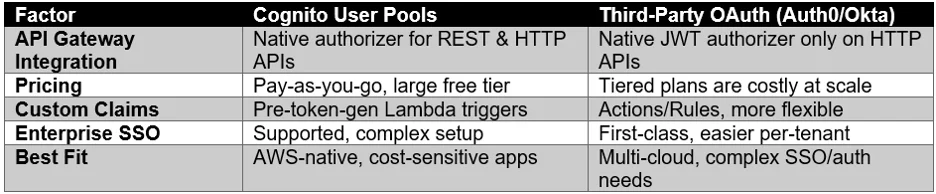
Once authenticated, Amazon API Gateway can validate the access token directly using a built-in Amazon Cognito User Pool Authorizer, no AWS Lambda function is required for basic JWT validation. This is a meaningful operational simplification: Amazon API Gateway checks the token’s signature, expiration, and audience claim natively against the User Pool’s JWKS endpoint.
Third-Party OAuth: The Federated Path
With Auth0, Okta, or similar providers, the React app typically uses the provider’s SDK (e.g., @auth0/auth0-react) to handle the Authorization Code + PKCE flow against the provider’s authorization server. The resulting JWT access token is then sent to the Amazon API Gateway.
Here is the key architectural difference: API Gateway’s built-in JWT authorizer for HTTP APIs can validate tokens from any OIDC-compliant issuer, including Auth0 and Okta, not just Cognito. This means you are not strictly required to use a Lambda authorizer for third-party tokens either, provided you are using an HTTP API (not REST API) and the issuer exposes a standard JWKS endpoint.
However, in practice, teams often add an AWS Lambda authorizer when using third-party providers to enforce custom claims, map external user IDs to internal user records, or apply tenant-specific authorization logic beyond simple signature validation.
Token Refresh and Session Management in React
This is where the two approaches diverge most in day-to-day developer experience.
- Amazon Cognito: The Amplify Auth library handles refresh token rotation automatically, storing tokens securely and refreshing the access token before expiry. However, customizing token expiry times and refresh behavior requires touching User Pool app client settings, which can feel rigid compared to provider-specific SDKs.
- Third-Party OAuth: SDKs like Auth0’s React SDK provide a getAccessTokenSilently() method that transparently handles refreshes via silent authentication (iframe-based) or refresh token rotation, depending on configuration. These SDKs tend to offer more granular hooks into the auth state lifecycle, which is useful for complex apps with role-based UI rendering.
In both cases, storing tokens in memory (not localStorage) and using HttpOnly cookies for refresh tokens, where possible, are recommended security practices to mitigate XSS-based token theft.
Authorization at the Amazon API Gateway Layer
Authentication confirms who the user is; authorization determines what they can do. This is where Amazon Cognito and third-party providers require different strategies.
Using Cognito Groups and Custom Attributes
Cognito allows you to assign users to Groups (e.g., admin, editor, viewer) and attach custom attributes to user profiles. These group memberships are included as claims in the ID token (cognito:groups), which a Lambda authorizer can read to enforce role-based access control before forwarding requests to backend Lambda functions.
Using Custom Claims from Third-Party Providers
Providers like Auth0 allow you to inject custom claims into tokens using Actions or Rules, server-side scripts that run during the authentication flow. This is often more flexible than Cognito’s pre-token-generation AWS Lambda triggers, especially when your authorization logic depends on data from external systems (e.g., a billing service determining a user’s subscription tier).
Multi-Tenant & SSO Considerations
For SaaS apps, third-party providers often have an edge with built-in multi-tenant directories and per-tenant enterprise SSO (SAML/Azure AD). Amazon Cognito supports SAML/OIDC federation too, but scaling this per-tenant usually means multiple User Pools or careful identity provider mapping, more engineering effort to maintain in the long term.
Comparison
Practical Recommendation
- Choose Amazon Cognito for AWS-native, cost-sensitive apps with group-based authorization.
- Choose a third-party provider for rich enterprise SSO, multi-cloud needs, or complex authorization rules.
- Hybrid uses Amazon Cognito as a token issuer while federating enterprise IdPs behind it for partial flexibility.
Conclusion
There’s no universal winner. Amazon Cognito offers a frictionless, cost-effective path with native Amazon API Gateway integration, a strong default for AWS-centric teams. Third-party providers shine when enterprise SSO, multi-cloud strategy, or advanced authorization customization are non-negotiable. Regardless of your choice, validate JWTs at the edge, secure tokens client-side, and design your authorization model early, retrofitting it later is far more costly.
Drop a query if you have any questions regarding Amazon Cognito, and we will get back to you quickly.
Empowering organizations to become ‘data driven’ enterprises with our Cloud experts.
- Reduced infrastructure costs
- Timely data-driven decisions
About CloudThat
FAQs
1. Can Amazon API Gateway's built-in JWT authorizer work with both Amazon Cognito and third-party tokens?
ANS: – Yes, but only on HTTP APIs (v2), which support any OIDC-compliant issuer with a JWKS endpoint. REST APIs (v1) only have a native authorizer for Amazon Cognito; third-party tokens need an AWS Lambda authorizer there.
2. Can I migrate from Amazon Cognito to a third-party provider later?
ANS: – Yes, if your React app wraps auth in an abstraction layer, swapping the SDK is manageable. The harder part is migrating user accounts, password hashes typically can’t be exported, often requiring a forced password reset.
3. How do refresh tokens differ in security between Amazon Cognito and Auth0?
ANS: – Both support rotation. Amazon Cognito lets you configure refresh token expiry (1 hour to 10 years) per App Client. Auth0 adds reuse detection, automatically revoking a token family if a rotated token is reused, a stronger defense against replay attacks.


WRITTEN BY Amisha Naik
Amisha Naik is a Research Associate at CloudThat, working as a Full Stack Developer. She specializes in JavaScript, React.js, Python, Node.js, SQL, and AWS, building scalable web applications and cloud-native solutions. Amisha contributes to designing and developing modern applications, integrating frontend and backend services, optimizing databases, and leveraging AWS services for deployment and scalability.


 PREV
PREV








Comments