

 Login
Login


 June 18, 2026
|
Voiced by Amazon Polly |
Artificial intelligence is changing rapidly, and one of the biggest developments today is Agentic AI. Traditional AI systems mostly respond to commands and stop after generating an answer. In comparison, Agentic AI can understand goals, plan steps, make decisions, and complete actions with limited human involvement. This makes it more useful for real business operations where tasks usually involve multiple connected activities.
The idea behind Agentic AI is simple. Instead of waiting for every instruction, the system can work independently to complete an objective. For example, an AI agent handling customer support may review a complaint, search company records, create a response, and escalate the issue if necessary. This ability to combine reasoning with action is what makes Agentic AI different from older AI models.
Modern AI models also play a major role in improving Agentic AI systems. They can understand natural language better than earlier technologies, allowing users to interact with them more naturally. When these models are connected to APIs, databases, and software tools, Agentic AI can handle real-world workflows rather than just produce text responses.
Start Learning In-Demand Tech Skills with Expert-Led Training
- Industry-Authorized Curriculum
- Expert-led Training
The Growing Need for AI Automation
One major reason companies are investing in AI automation is the need to reduce repetitive work. Employees often spend significant time updating records, preparing reports, processing emails, or managing support tickets. While these tasks are necessary, they also reduce the time available for more meaningful work. With AI automation, businesses can complete routine activities faster and more accurately.
Another important advantage of AI automation is consistency. Human errors naturally increase during repetitive work, especially under pressure or heavy workloads. Automated systems can follow rules and workflows more reliably. In finance departments, for example, AI agents can validate invoices, process transactions, and detect unusual activities. In customer service, AI automation can help organizations provide quicker responses while maintaining service quality.
Many businesses also see AI automation as a support system rather than a replacement for employees. Human creativity, emotional understanding, and strategic thinking are still important in decision-making. Most organizations are currently using AI to remove repetitive effort so employees can focus on work that requires judgment and human interaction.
Intelligent Agents in Everyday Business
The rise of intelligent agents is making AI more practical for everyday business use. Unlike simple chatbots that only answer questions, intelligent agents can complete multiple connected tasks. For example, an AI assistant in a healthcare environment may schedule appointments, send reminders, update records, and automatically manage follow-up communication.
Education is another field where intelligent agents are becoming increasingly useful. AI-powered systems can monitor student progress, recommend learning materials, and answer common academic questions. These tools increase productivity while freeing up teachers’ time for more individualized instruction.
As technology improves, organizations are creating specialized intelligent agents for different departments. Some agents handle IT support, while others focus on sales, marketing, or analytics. Instead of relying on a single large system, businesses can deploy multiple intelligent agents that collaborate across workflows. This approach improves flexibility and makes AI systems easier to manage and scale.
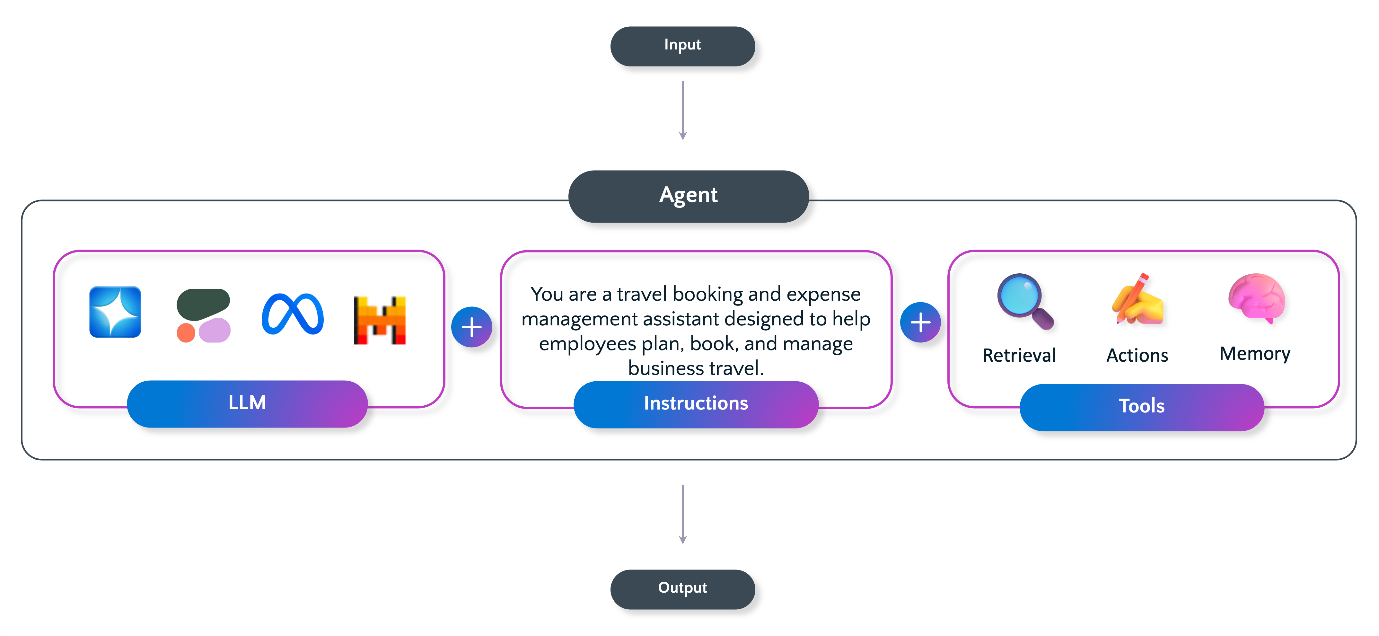
The diagram below shows a simple flowchart of how AI agents are used as a subset of intelligent agents. They include LLM capabilities and additional tools that generate intelligent output based on the user’s prompt.
The Growth of Autonomous AI Systems
Another major development is the rise of autonomous AI systems. These systems are designed to perform actions independently with minimal supervision. In software development, developers already use AI tools to review code, identify issues, and suggest improvements. Many teams are also exploring autonomous AI systems for deployment management, testing, and operational monitoring.
The long-term goal of autonomous AI systems is adaptability. Current AI systems still require regular monitoring and configuration, but future versions may learn from changing conditions and improve decision-making over time. This could help businesses handle fast-changing environments more effectively.
However, organizations must also address the risks associated with autonomous AI systems. If the training data is incomplete or biased, the system may produce incorrect results. Security is another major concern because many AI systems interact with sensitive business information. For this reason, companies need proper governance, monitoring, and approval mechanisms before deploying autonomous AI systems at scale.
Transparency is equally important. Businesses should clearly understand how AI systems make decisions and perform actions. This becomes especially critical in industries such as healthcare, banking, and legal services, where mistakes can have serious consequences.
Future of Intelligent Automation
The rise of Agentic AI is changing how businesses approach automation and digital operations. Instead of using AI only to answer questions, organizations are now building systems that can plan tasks, make decisions, and perform actions independently. At the same time, AI automation, intelligent agents, and autonomous AI systems are helping businesses improve efficiency and reduce repetitive work across multiple industries.
Even with these advancements, human involvement remains important. AI can improve speed and productivity, but people are still needed for creativity, ethics, oversight, and strategic decisions. The organizations that succeed with Agentic AI will be the ones that balance automation with human judgment. As the technology continues to evolve, AI systems will become an increasingly important part of everyday business operations.
Upskill Your Teams with Enterprise-Ready Tech Training Programs
- Team-wide Customizable Programs
- Measurable Business Outcomes
About CloudThat


WRITTEN BY Atul Choudhary
Atul Choudhary is a Subject Matter Expert at CloudThat and a Microsoft Certified Trainer with over 15 years of IT industry experience. Specializing in Azure and Hybrid Cloud solutions, he holds multiple certifications including AZ-104, AZ-305, AZ-700, and AZ-800. Atul is known for delivering hands-on, scenario-driven training that bridges the gap between theory and real-world application. At CloudThat, he empowers professionals and organizations to upskill, modernize infrastructure, and accelerate cloud adoption. He is also a certified International Engineering Educator through IUCEE, committed to advancing global technical education.


 PREV
PREV











Comments