

 Login


 October 29, 2026
|
Voiced by Amazon Polly |
Introduction
A solid AI agent course in 2026 should teach seven things: how LLMs reason and plan, tool and function calling, memory and retrieval (RAG), multi-agent orchestration, open protocols like Model Context Protocol (MCP), evaluation and observability, and guardrails for security and cost.
It should also make you deploy at least one agent on a real cloud platform such as Amazon Bedrock, Microsoft Azure, or Google Cloud’s Vertex AI.
If a course stops at prompt engineering and a chatbot demo, it is teaching 2023 skills. The best programs spend more than half their hours in hands-on labs where agents break, and you fix them.
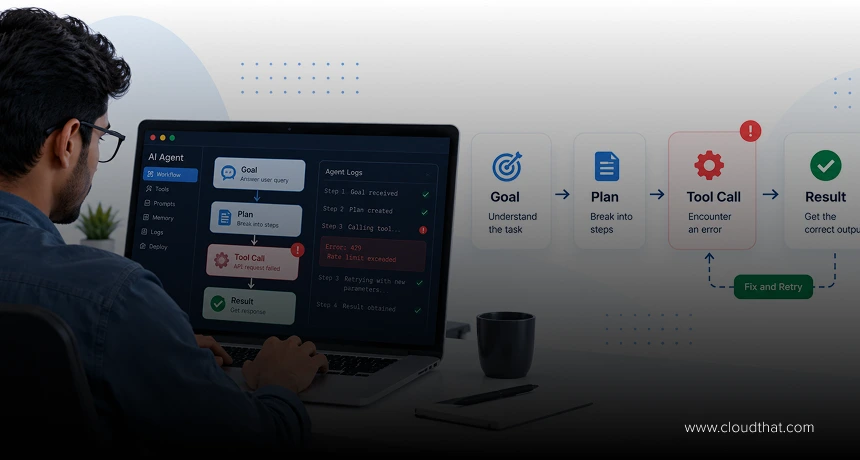
Your agent worked perfectly in the demo.
Then it met real data.
It called the wrong API three times. Looped for eleven minutes. Burned through a chunk of the token budget before anyone noticed.
Sound familiar?
That gap between “it works on my laptop” and “it works in production” is exactly what a good AI agent course should close. And the stakes are real. Gartner predicts over 40% of agentic AI projects will be canceled by the end of 2027, citing rising costs, unclear business value, and weak risk controls.
So before you spend your money and three months of evenings, let’s figure out what an AI agent course should actually teach you. And what it shouldn’t waste your time on.
No Job After Graduation? Cloud Engineering is Your Answer
- Beginner Friendly
- 92% Placement Rate
- Live Instructor-Led
TL;DR
- A useful AI agent course teaches tool calling, memory, orchestration, MCP, evals, and guardrails, not just prompts.
- Over half the course hours should be hands-on labs on a real cloud platform.
- Evaluation and cost control are the skills most courses skip and the ones production teams need most.
- Any building AI agent course worth the fee should end with a deployed, monitored agent you can show in an interview.
Why Do Most AI Agent Course Graduates Still Struggle in Production?
Because most courses teach the happy path.
You build a travel-booking agent. It searches for flights. It books one. Everyone claps.
But nobody shows you what happens when:
→ The flight API times out halfway through a booking.
→ The model hallucinates a tool that doesn’t exist.
→ Two agents keep handing the same task back to each other.
→ A user slips a malicious instruction into a PDF that the agent reads.
That’s the plot twist most learners discover on the job, not in class.
An agent is not a chatbot with extra steps. It’s software that makes decisions, takes actions, and spends money on your behalf. So your training has to teach you to think like a backend engineer and an AI engineer at the same time.
The question is whether you’ll be the developer who ships agents or the one who demos them.
So what does the right skill set look like?
What Core Skills Should an AI Agent Course Teach in 2026?
A modern AI agent course should cover five skill blocks: reasoning and tool use, memory, orchestration, evaluation, and security. Skip one, and your agent has a blind spot.
Let’s go scene by scene.
How Do Agents Reason, Plan, and Call Tools?
This is the engine room. You should learn how patterns like ReAct (reason, then act) work, how a model breaks a goal into steps, and how it decides which tool to call.
Tool calling is where agents stop talking and start doing. Good training makes you write function schemas, handle bad tool outputs, and set retry limits. A strong building AI agent course will make you write a tool that fails on purpose, just so you learn to catch it.
How Do Agents Remember Things?
Short-term memory keeps a conversation coherent. Long-term memory lets an agent recall a customer’s history three weeks later.
You’ll need retrieval-augmented generation (RAG), vector databases, chunking strategies, and the judgment to decide what an agent should forget. Yes, forgetting is a skill. Agents that remember everything get slow, expensive, and confused.
How Do Multiple Agents Work Together?
One agent researches. One writes. One checks the work. That’s multi-agent orchestration, and it’s where 2026 projects are heading.
Your training should cover supervisor patterns, handoffs, and frameworks like LangGraph, CrewAI, or AutoGen. It should also teach the Model Context Protocol (MCP), the open standard that lets agents connect to tools and data sources without custom glue code for every integration.
Learn MCP now. It’s quickly becoming the USB port of the agent world.
How Do You Test, Monitor, and Secure an Agent?
This is the section most courses rush through. And it’s the one that decides whether your agent survives its first week.
You should learn to:
- Build evaluation datasets and score agent outputs, not just eyeball them.
- Trace every step an agent takes using observability tools.
- Defend against prompt injection and data leakage.
- Set token budgets, rate limits, and human approval for risky actions.
If an AI agent course doesn’t mention evals, that’s your red flag. Close the tab.
Knowing the skills is half the story, though. Where you practise them matters just as much.
Which Cloud Platforms Should a Building AI Agent Course Cover?
A building AI agent course should get you hands-on with at least one major cloud platform, because that’s where production agents live.
→ AWS: Amazon Bedrock Agents, action groups, knowledge bases, and guardrails.
→ Microsoft Azure: Azure OpenAI, agent services, and Copilot extensibility.
→ Google Cloud: Vertex AI and its agent-building tools.
You don’t need all three on day one. Pick the cloud your company (or your target employer) already runs on. Then learn IAM, logging, and cost monitoring on that platform, because an agent with admin access and no logs is a horror movie waiting to happen.
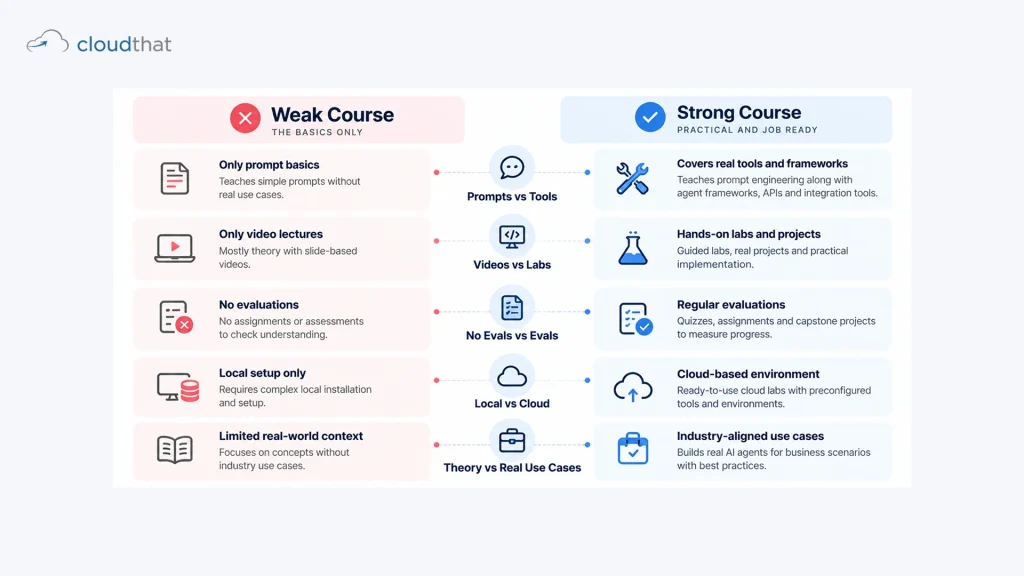
How Do You Tell a Strong AI Agent Course From a Weak One?
The quickest test: ask what you’ll have built by the last week. If the answer is “a chatbot,” keep looking.
| What to Check | Weak Course | Strong Course |
| Core focus | Prompt engineering | Tool calling, memory, orchestration, MCP |
| Hands-on time | Under 20%, mostly videos | 50 to 60% guided labs |
| Cloud deployment | Local notebooks only | Bedrock, Azure, or Vertex AI |
| Evaluation and observability | Not covered | Eval datasets, tracing, monitoring |
| Security and guardrails | One slide | Prompt injection defense, approvals |
| Trainer profile | Content creators | Practitioners who ship agents |
| Final outcome | Certificate of completion | Deployed, monitored agent project |
Print this. Seriously. Hold every option you’re comparing up against it.
What Hidden Costs Does Nobody Mention Before You Enroll?
The course fee is only the trailer. The full movie costs more.
→ API and token bills: Running agents in labs uses real model calls. Ask if credits are included.
→ Cloud sandbox costs: A forgotten vector database can quietly bill you for weeks.
→ Time: Expect 6 to 10 hours a week if you’re working full-time.
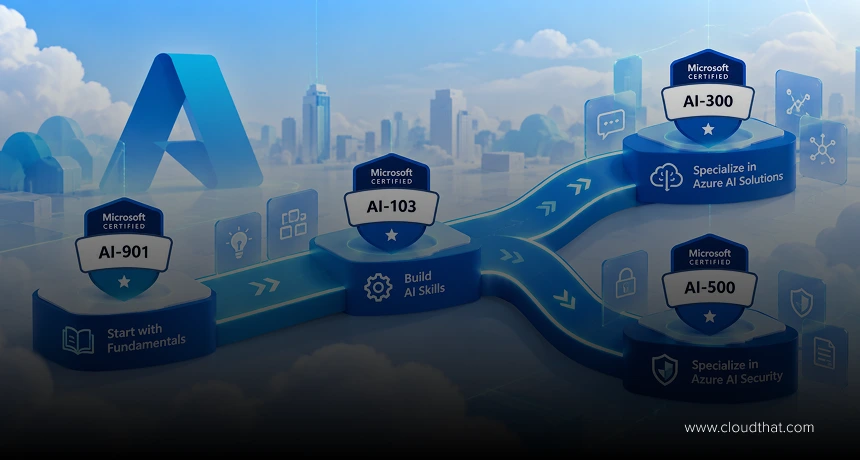
→ Retakes: If the course ties into a certification, check exam voucher and retake policies.
A building AI agent course that includes sandboxed lab environments saves you from that 2 AM “why is my cloud bill this high” moment. Trust me, it’s not a fun moment.
What Order Should You Learn These Skills In?
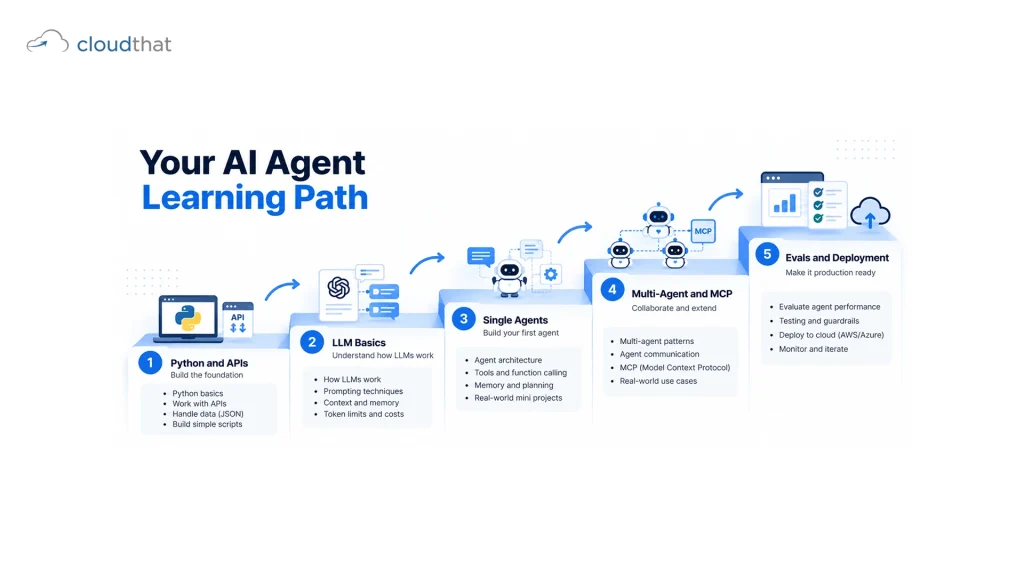
Start with Python and APIs, then move to LLM basics, then agents. Jumping straight to multi-agent systems is like learning to drive on a highway.
- Python, REST APIs, and JSON (if you’re not already comfortable).
- LLM fundamentals: prompts, tokens, context windows, embeddings.
- Single-agent builds with tool calling and RAG.
- Multi-agent orchestration and MCP.
- Evals, observability, guardrails, and cloud deployment.
Developers with 2 or more years of backend experience can usually skip step one. Career switchers shouldn’t. A good program will tell you honestly which step you’re on before it takes your money.
So where do you actually go to learn all of this, the right way?
Why CloudThat Is the Best Choice for an AI Agent Course
CloudThat holds the AWS Agentic AI Competency, along with GenAI, Machine Learning, and MLOps competencies. That matters because the trainers teaching your AI agent course are the same practitioners building agentic systems for clients. You learn from people who have debugged agents in production, not people who read about it.
As an AWS Premier Tier Training Partner and Microsoft, Google Cloud, and NVIDIA training partner, CloudThat runs instructor-led AI/ML and GenAI training programs with 50 to 60% hands-on labs. Learners who want a structured career track can join the Integrated Program in AI & Data Science, while the GenAI Innovation Center brings real Bedrock and agentic AI implementations into the classroom. You can check upcoming batches on the training calendar.
For teams, a building AI agent course has to produce deployable engineers, not certificate holders. CloudThat’s Capability Development Framework assesses skills, builds custom pathways, and gets engineers project-ready in 1 to 60 days. Experiential Learning simulations and internal hackathons then test whether your team can actually ship an agent. With 1.1 million+ professionals and 850+ corporates trained, this is a playbook, not an experiment.
Conclusion
Agents are moving from demos to production. The skills that matter now are tool calling, memory, orchestration, MCP, evals, and security, all practised on a real cloud.
Choose an AI agent course that makes you build, break, and fix things. Because the developers who’ve already watched an agent fail are the ones companies trust to ship the next one.
Key Takeaways
- An AI agent course in 2026 must go well beyond prompt engineering and chatbot demos.
- Tool calling is the skill that turns a model from a talker into a doer.
- Memory and RAG design decide whether agents stay fast, accurate, and affordable.
- Multi-agent orchestration is where most enterprise agent projects in 2026 are heading.
- MCP is fast becoming the standard way agents connect to tools and data.
- Evaluation and observability are the most-skipped and most-needed agent skills.
- Security training should cover prompt injection, data leakage, and human approvals.
- Hands-on labs should make up 50 to 60% of any course worth paying for.
- Token bills, cloud sandboxes, and study hours are hidden costs to plan for.
- The best final project is a deployed, monitored agent you can demo to employers.
Already in IT? Switch to Cloud & Earn 55% More
- Weekend Batches
- Dedicated Career Support
- Official AWS Labs
About CloudThat
FAQs
1. What is an AI agent course?
ANS: – It teaches you to build software that uses large language models to plan tasks, call tools, and take actions on its own. Good courses cover tool calling, memory, multi-agent orchestration, evaluation, and cloud deployment.
2. How long does it take to learn to build AI agents?
ANS: – Developers with Python and API experience can build a working agent in 4 to 8 weeks of part-time study. Production-level skills like evals, observability, and security usually take 3 to 6 months of hands-on practice.
3. Do I need machine learning experience before an AI agent course?
ANS: – No. You need Python, APIs, and basic LLM concepts. Most agent work is software engineering around models, not training models from scratch.
4. Is LangChain enough to build production agents?
ANS: – LangChain and LangGraph are useful frameworks, but production also needs evals, monitoring, guardrails, and cloud deployment. A complete building AI agent course teaches the framework and everything around it.
5. What is MCP, and why does it matter for developers?
ANS: – Model Context Protocol is an open standard for connecting AI agents to tools and data sources. It reduces custom integration code and is now supported across major AI platforms.
6. Can companies train whole teams on agentic AI?
ANS: – Yes. Corporate programs can assess current skills, build role-based pathways, and validate readiness through real-world simulations and hackathons before engineers join live projects.

WRITTEN BY Himisha Raval
Himisha Raval is a Digital Marketing Manager at CloudThat with a strong command of search engine optimization, web analytics, link building, and content strategy. She brings a data-driven approach to digital marketing, helping IT companies strengthen their online presence, improve search rankings, and generate consistent leads across channels. Beyond execution, she plays an active role in ideation, campaign strategy, and website performance optimization. Outside of work, she balances her analytical side with a love for travel, nature painting, and dancing.


 PREV








Comments