

 Login
Login


 September 24, 2026
|
Voiced by Amazon Polly |
Introduction
AI agents have become more proficient at understanding instructions, making decisions, and executing tasks. However, without memory, every subsequent experience is like a brand-new one.
Consider an example where you use an AI assistant to create a project plan that spans over multiple days. The absence of memory will make the agent lose track of previous decisions and deadlines each time you resume your task.
To ensure that AI agents are continuously personalized, there should be a mechanism for them to remember relevant information. Amazon Bedrock AgentCore Memory offers managed memory services that allow agents to retain conversation history and other useful data without requiring developers to construct the whole memory solution on their own.
Ready to lead the future? Start your AI/ML journey today!
- In- depth knowledge and skill training
- Hands on labs
- Industry use cases
What Is Amazon Bedrock AgentCore Memory?
Amazon Bedrock AgentCore Memory is a fully managed service intended to assist AI agents in remembering information learned through interactions.
It offers two kinds of memory:
- Short-term memory retains information during an ongoing conversation or interaction.
- Long-term memory stores useful information which might become useful in some future interaction.
It is not necessary to save all messages forever. It allows the agent to retain its immediate conversation record as well as information that needs to be saved for future use.
Short-Term Memory: Maintaining the Conversation
Short term memory functions as the working memory of the agent. This helps to capture the interaction taking place during the session to enable the agent to comprehend the subsequent queries without asking for any further inputs from the user on past information.
For instance:
User: I want a laptop for video editing.
Agent: What is your budget?
User: Around ₹80,000.
User: Please give me the top three options.
In the last query, there was no mention about laptops, video editing or the budget. Here, short term memory will help the agent to comprehend what “top three options” mean.
AgentCore Memory captures the interactions as events along with their corresponding identifiers like actor ID and session ID.
Long-Term Memory: Remembering What Matters
Long-term memory enables the retention of useful information from session to session.
For example, a shopping assistant could learn from past exchanges that a particular customer prefers lightweight computers, does not like some brands, normally selects devices with 16 GB of RAM or more, and has specific budget constraints.
When the customer comes back weeks later, the agent can recall the above preferences and employ them in making product recommendations.
The AgentCore Memory system manages long-term memory asynchronously. Strategies defined in memory make sense of past interactions and store information which can be useful for future exchanges.
This way agents can retain preferences, interesting facts, summaries, and experiences, without constantly re-processing entire history of conversations.
How AgentCore Memory Works
A simplified workflow for AgentCore Memory is as follows:
- The user makes a request – The agent processes the interaction.
- The interaction is captured – Interactions can be captured into short-term memory so that they can be remembered in the current conversation.
- Analysis of the interaction using memory strategies – Strategies configured decide what information could be useful later on.
- The information captured becomes long-term memory – Details important are put into memory records.
- Retrieving memories as required – Memories become available during future interactions.
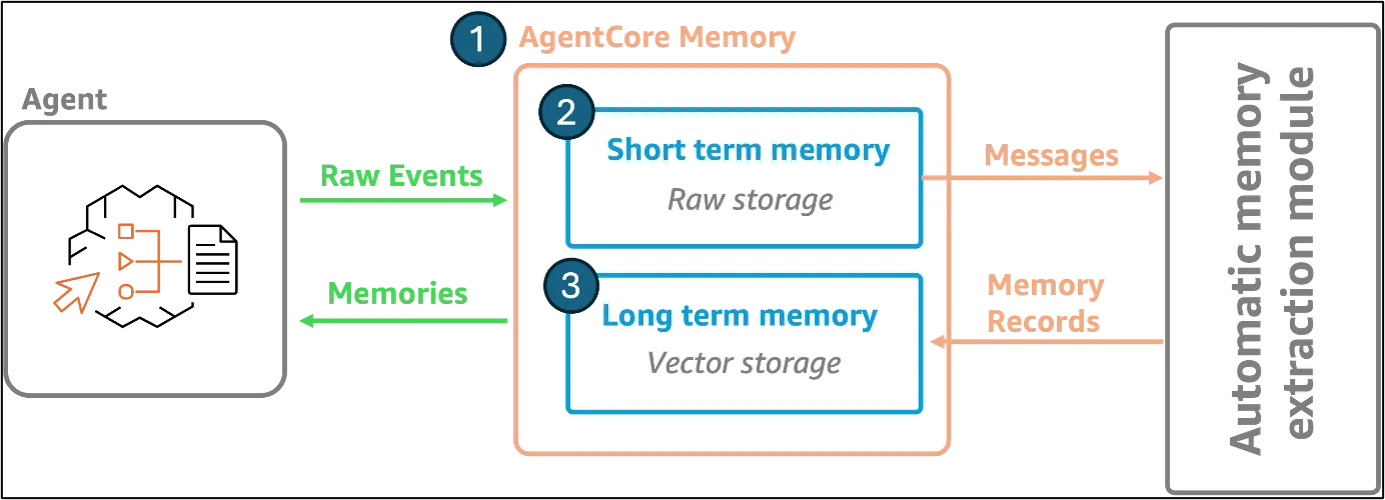
Amazon Bedrock AgentCore Memory architecture showing how short-term and long-term memory work together to maintain conversational continuity and retain useful information. Source: Amazon Bedrock AgentCore Memory: Building context-aware agents
AgentCore Memory vs. RAG
Though Memory and Retrieval Augmented Generation (RAG) might seem similar as both offer extra information for an AI model, they solve different problems.
While RAG finds knowledge from outside sources, e.g. documentation, product catalogues, corporate policy, or a knowledge base, memory recollects information acquired during prior user or agent conversations.
For instance:
RAG: “What is the return policy of our company?”
Memory: “What product was preferred by that customer last time we communicated with him/her?”
In real-life implementations of AI systems, both techniques can be combined. RAG will provide external knowledge and memory continuity.
Where Can AgentCore Memory Be Used?
AgentCore Memory can enhance various kinds of agentic applications.
Customer support agents may remember problems and solutions that were discussed before, hence the need for customer repetition is eliminated. Personal assistants may remember their preferences and decisions made before. Sales agents may remember customer preferences while workflow agents can keep track of the history of lengthy processes. Recommendation agents may use previously known preferences of users and make recommendations accordingly.
In addition, the memory can be used in multi-agent systems where there is a need for several agents to access some information.
Persistent memory requires governance. Companies need to establish what information should be remembered, how long it should be stored, who should have access to the information, and how sensitive information will be protected.
AgentCore Memory provides configuration capabilities for event persistence and encryption features.
Conclusion
Memory makes an AI agent go beyond being merely a conversationalist once and become something capable of providing continuity in its conversations.
Amazon Bedrock AgentCore Memory is the functionality that allows for managed short-term and long-term memory to make sure that an agent remembers necessary things, personalizes their replies, and maintains conversation without needing to develop complicated memory features independently.
Upskill Your Teams with Enterprise-Ready Tech Training Programs
- Team-wide Customizable Programs
- Measurable Business Outcomes
About CloudThat

- Agent Framework
- AgentCore Memory
- Agentic AI
- AI agent memory
- AI Agents
- AI Memory
- Amazon Bedrock
- Amazon Bedrock AgentCore Memory
- AWS AI
- AWS bedrock
- AWS Generative AI
- Bedrock AgentCore
- Claude
- context-aware AI agents
- Contextual AI
- Enterprise AI
- Foundation Models
- Generative AI
- Long-Term Memory
- Memory Management
- Persistent Memory
- Personalization
- personalized AI agents
- Session Memory
- Short-Term Memory

WRITTEN BY Modi Shubham Rajeshbhai
Shubham Modi is working as a Research Associate - Data and AI/ML in CloudThat. He is a focused and very enthusiastic person, keen to learn new things in Data Science on the Cloud. He has worked on AWS, Azure, Machine Learning, and many more technologies.


 PREV
PREV








Comments