

 Login
Login

 September 21, 2026
|
Voiced by Amazon Polly |
The Metaverse marks a new era of interconnected virtual worlds where physical and digital realities merge. It combines Extended Reality (XR), Artificial Intelligence (AI), blockchain, and 5G/6G connectivity to deliver shared, persistent, and interactive experiences. However, this convergence also exposes users to advanced cyber threats that extend beyond traditional data breaches.
Unlike the conventional web, where cybersecurity focuses on protecting data confidentiality and availability, Metaverse Security must defend against attacks targeting human perception, biometric data, and digital identities. As the Metaverse evolves into a multi-trillion-dollar economy, its survival hinges on robust, adaptive cybersecurity frameworks.
Start Learning In-Demand Tech Skills with Expert-Led Training
- Industry-Authorized Curriculum
- Expert-led Training
Understanding the Architecture of Metaverse Threats
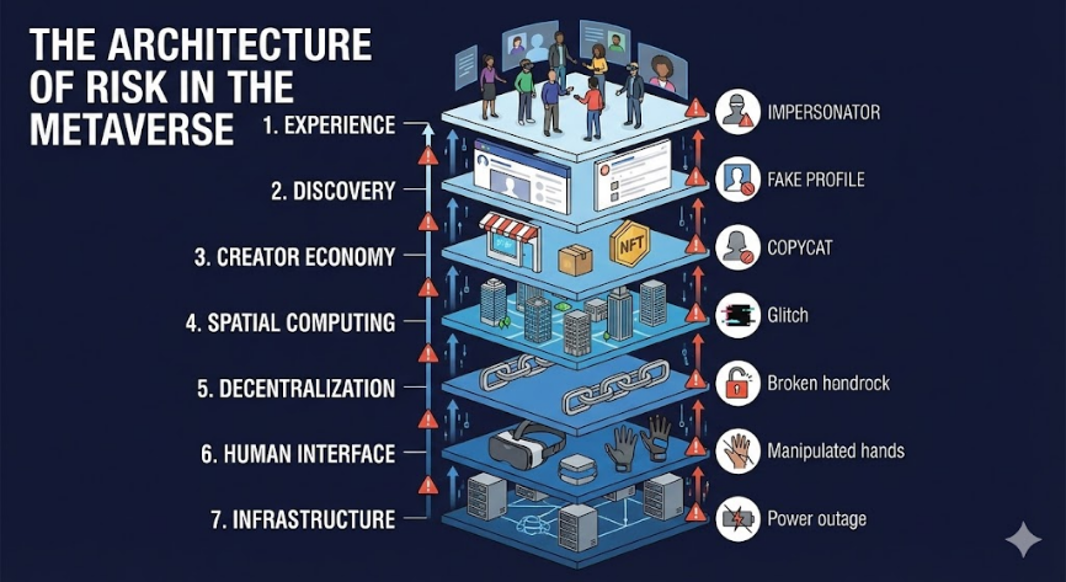
Fig 1: Security risks span every layer of the Metaverse ecosystem.
The Metaverse consists of multiple interconnected layers, each introducing unique vulnerabilities. From physical hardware to decentralized economies, a single weak link can compromise the entire ecosystem.
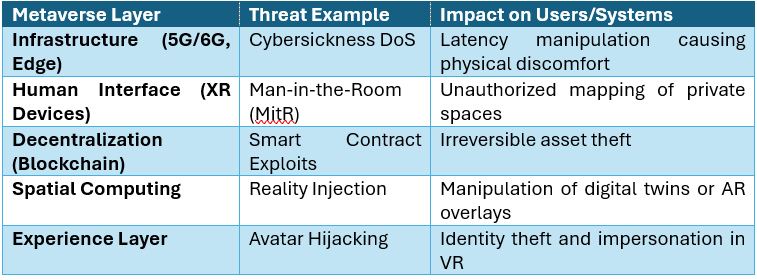
Source: Adapted from University of Waterloo and Blockchain Council research.
Each layer amplifies the next, making multi-dimensional cybersecurity essential to the Metaverse’s integrity.
AI: The Double-Edged Sword in Metaverse Security
AI drives both innovation and exploitation in immersive ecosystems. Autonomous AI agents can analyze smart contracts to uncover zero-day vulnerabilities, while defensive AI systems monitor millions of virtual interactions in real time.
From Microsoft’s perspective, AI is increasingly positioned as a means of enhancing digital safety, governance, and resilience rather than as a tool for exploitation. Microsoft provides AI‑driven solutions such as Azure AI Content Safety, which uses advanced language and vision models to detect and moderate harmful text and visual content, helping organizations uphold platform integrity and responsible AI use. In parallel, Microsoft Security Copilot applies generative AI to cybersecurity operations, enabling faster threat detection, investigation, and response by synthesizing large volumes of security data into actionable insights. Together, these capabilities reflect Microsoft’s emphasis on embedding trust, transparency, and proactive risk mitigation into AI systems operating at enterprise scale.
The challenge lies in ensuring that AI systems deployed for safety cannot themselves be weaponized, a balance that requires transparency, oversight, and continuous auditing.
Building a Resilient Metaverse: Security by Design
- Zero Trust Architecture (ZTA)
The Metaverse nullifies the concept of a fixed security perimeter. A Zero Trust model—based on “Never Trust, Always Verify” treats every user and device as a potential risk.
Key strategies include:
- Continuous authentication using behavioral biometrics such as gait, gesture, or voice.
- Micro-segmentation of virtual environments to limit the movement of compromised entities.
- Device health verification before access to immersive networks.
Organizations can explore advanced zero-trust frameworks, which equip professionals with the expertise to design zero-trust defenses.
- Self-Sovereign Identity (SSI)
SSI offers users decentralized control over their digital identities via Decentralized Identifiers (DIDs) and Zero-Knowledge Proofs (ZKPs). Instead of relying on centralized authentication providers, users verify attributes (like age or NFT ownership) without revealing personal data.
This approach not only enhances privacy but also fosters interoperability across platforms.
Mitigating Emerging Threats: Deepfakes, Biometrics, and Privacy
By 2026, Deepfake-as-a-Service (DaaS) will have made identity impersonation accessible to cybercriminals. Attackers now mimic real voices and avatars in real time, deceiving users into fraudulent transactions or data exposure.
Meanwhile, biometric attacks such as GAZEploit, where AI models infer typed passwords from eye movements, demonstrate the growing need for hardware-level security in XR headsets. Manufacturers must enforce encrypted biometric streams, secure boot processes, and firmware integrity checks to mitigate such risks.
AI Moderation and Privacy Preservation
Scalability challenges demand AI-driven moderation across immersive social environments. Modern solutions employ:
- Voice sentiment analysis to detect toxicity or grooming in real time.
- Computer vision algorithms to identify NSFW or violent virtual assets.
- On-device AI processing to balance safety with privacy compliance.
Such systems ensure a safer digital space while adhering to emerging regulations, such as GDPR for biometric data and CCPA extensions for XR environments.
The Path Forward
The Metaverse symbolizes limitless possibilities, but also unprecedented risk. As cyberattacks evolve from data breaches to perceptual manipulation and identity hijacking, traditional security paradigms fall short.
Building a secure Metaverse demands Zero Trust frameworks, Self-Sovereign Identity models, and AI-based moderation integrated from inception. Enterprises, developers, and policymakers must collaborate to enforce “security by design” and ensure that immersive innovation does not compromise human safety or autonomy.
In this new digital frontier, cybersecurity is no longer optional; it is the foundation of trust.
Upskill Your Teams with Enterprise-Ready Tech Training Programs
- Team-wide Customizable Programs
- Measurable Business Outcomes
About CloudThat


WRITTEN BY Nikita Khandal
Nikita Khandal is a Research Associate specializing in cloud security, identity, and AI technologies. With experience in cloud computing, cybersecurity, and software development, she has supported and trained learners across Azure and Microsoft Security fundamentals. Holding certifications like AZ‑900, AI‑900, SC‑900, MS‑900, SC‑200, and SC‑300, she brings strong technical depth and practical insights to every learning experience. Known for simplifying complex concepts through hands‑on, real‑world examples, Nikita blends clarity and relevance in her teaching. Her passion for AI‑driven security and continuous learning shapes her unique approach to skill development.


 PREV
PREV







Comments