

 Login
Login


 September 4, 2026
|
Voiced by Amazon Polly |
Introduction
Benchmarking is an essential practice for evaluating the performance of database systems. It helps identify potential bottlenecks, measure capacity, and ensure optimal configurations for real-world workloads. For cloud-native databases like Amazon Aurora Serverless V2, benchmarking provides crucial insights into their scalability and efficiency.
This blog explores how to benchmark MySQL Aurora Serverless V2 using Sysbench, a powerful load-testing tool. Sysbench allows users to test database performance under various workloads, making it an ideal choice for evaluating cloud database capabilities.
Pioneers in Cloud Consulting & Migration Services
- Reduced infrastructural costs
- Accelerated application deployment
Sysbench
Sysbench is an open-source benchmarking tool designed to test and evaluate the performance of database systems, file systems, and hardware components. While its primary focus is MySQL databases, it also supports other workloads via bundled tests and custom scripts.
Key Features of Sysbench
- I/O and File System Performance: Tests read/write throughput and latency.
- CPU Performance: Measures computational efficiency under stress.
- Memory Performance: Assesses read and write speeds for memory operations.
- Mutex Operation Analysis: Identifies performance issues caused by mutex operations.
- Concurrency Testing: Simulates workloads with shared or exclusive locks across multiple threads.
Why Benchmark MySQL Aurora Serverless V2?
Amazon Aurora Serverless V2 is a managed relational database service that automatically scales based on application demand. It provides:
- Cost Efficiency: Pay-as-you-go pricing ensures cost savings for variable workloads.
- Seamless Scaling: Automatically adjusts capacity to handle traffic spikes.
- High Availability: Built-in fault tolerance ensures minimal downtime.
Benchmarking Aurora Serverless V2 is essential for validating its performance, especially under high-concurrency workloads, to ensure it meets application demands.
Preparing for Benchmarking
Before benchmarking, you need to configure your Aurora Serverless V2 database and prepare Sysbench. Here’s a step-by-step guide.
- Setting Up the Aurora Serverless V2 Database
- Launch an Aurora Serverless V2 cluster in the AWS Management Console.
- Configure the database with appropriate instance capacity and connection settings.
- Ensure network access to the database endpoint.
- Installing Sysbench
Prerequisites:
- Amazon Linux or Ubuntu EC2 instance with MySQL client installed.
- Access to the Aurora database endpoint.
Installation Steps:
For Amazon Linux or Ubuntu:

- Preparing the Database with Sysbench
Preparing Tables and Data
Before running load tests, Sysbench requires the database to be populated with tables and data. Use the following command to create 5 tables with 500,000 rows each:
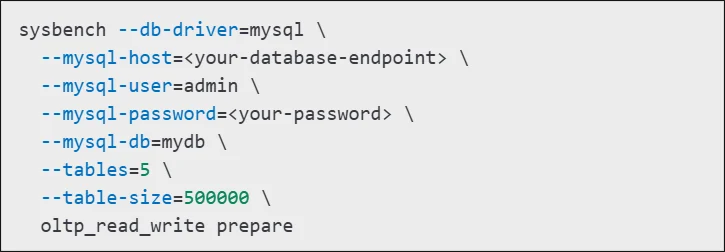
Key Parameters Explained:
- –db-driver=mysql: Specifies the MySQL driver.
- –tables=5: Creates 5 tables in the database.
- –table-size=500000: Populates each table with 500,000 rows.
- oltp_read_write: Specifies an OLTP workload with read-write operations.
This command ensures the database is ready for load testing with sufficient data.
- Running the Load Test with Sysbench
Once the database is prepared, you can run load tests to simulate real-world workloads.
Simulating 2000 Concurrent Users
To benchmark the database with 2000 virtual users for 5 minutes, run the following command:
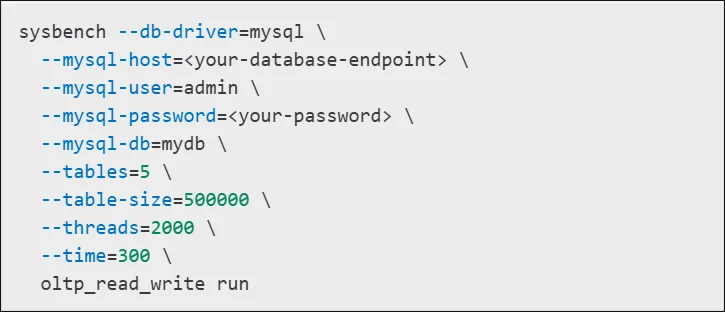
Key Parameters:
- –threads=2000: Simulates 2000 concurrent virtual users.
- –time=300: Runs the test for 300 seconds (5 minutes).
- oltp_read_write: Mixes read and write operations for transactional workloads.
Sysbench Output and Metrics
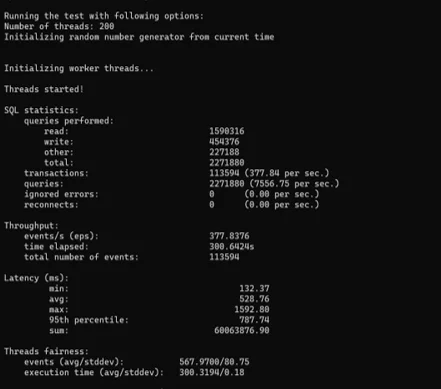
Sysbench provides detailed metrics to evaluate database performance, including:
- SQL Statistics: Counts of read, write, and other queries.
- Throughput: Events per second (EPS) and total events.
- Latency: Minimum, average, and maximum response times.
- Thread Fairness: Distribution of workload across threads.
Understanding the Results
Once the load test is complete, Sysbench generates a comprehensive report.
Example Output:
Interpreting Key Performance Indicators (KPIs)
Analyzing the KPIs allows you to identify areas for optimization. For example:
- High average or 95th percentile latency indicates potential bottlenecks.
- Uneven thread fairness could signal configuration issues.
- Low throughput under high concurrency may require tuning database parameters or increasing instance capacity.
Tips for Effective Load Testing
- Gradual Scaling: Start with a smaller number of threads and gradually increase to observe performance trends.
- Monitor Metrics: Use cloud monitoring tools to observe database health during tests.
- Adjust Parameters: Tune MySQL and Aurora configuration settings for optimal performance.
- Repeat Tests: Perform tests multiple times to ensure consistency in results.
- Test Different Workloads: Experiment with read-heavy, write-heavy, and mixed workloads to match real-world scenarios.
Common Use Cases for Sysbench Testing
- E-commerce Platforms: Handling high transaction volumes during peak sales.
- Real-Time Analytics: Processing large datasets with minimal latency.
- Microservices Architectures: Ensuring scalability and resilience for distributed systems.
Conclusion
Benchmarking is a critical step in optimizing the performance of MySQL Aurora Serverless V2 databases. Using Sysbench, you can simulate realistic workloads, identify performance bottlenecks, and fine-tune database configurations for peak efficiency. Regular load testing ensures your database remains reliable and responsive, even under demanding conditions.
By understanding and interpreting Sysbench results, you can make data-driven decisions to enhance your database performance and deliver an optimal user experience.
Drop a query if you have any questions regarding Sysbench, and we will get back to you quickly.
Empowering organizations to become ‘data driven’ enterprises with our Cloud experts.
- Reduced infrastructure costs
- Timely data-driven decisions
About CloudThat
FAQs
1. What is Sysbench, and why is it ideal for MySQL benchmarking?
ANS: – Sysbench is an open-source tool designed for testing MySQL databases and system performance, making it a versatile option for benchmarking.
2. How does Aurora Serverless V2 differ from traditional MySQL setups for benchmarking?
ANS: – Aurora Serverless V2 dynamically scales resources, making it ideal for variable workloads.
3. What are the primary metrics to analyze in Sysbench test results?
ANS: – Key metrics include throughput, latency, and query performance.


WRITTEN BY Aditi V
Aditi V works as a Research Associate at CloudThat. She specializes in deploying, managing, and scaling cloud infrastructure on AWS. Passionate about simplifying complex concepts, she also explores data science, using tools like Power BI and SQL to deliver insights. She enjoys learning new technologies and optimizing cloud solutions.


 PREV
PREV









Comments