

 Login
Login


 September 9, 2026
|
Voiced by Amazon Polly |
In today’s rapidly evolving business environment, organizations are investing heavily in upskilling and reskilling their workforce. However, a critical question continues to challenge Learning & Development (L&D) leaders: Should employees be given access to a broad course catalog, or should they follow role-based learning paths?
While both approaches have their place in a modern learning ecosystem, the answer largely depends on the organization’s goals. If the objective is to drive measurable business outcomes, accelerate competency development, and improve employee performance, role-based learning paths often deliver superior results.
Start Learning In-Demand Tech Skills with Expert-Led Training
- Industry-Authorized Curriculum
- Expert-led Training
Understanding the Difference
A course catalog is essentially a library of learning resources. Employees can browse available courses and choose topics based on their interests, responsibilities, or development goals. This approach promotes flexibility and self-directed learning.
A role-based learning path, on the other hand, is a structured sequence of courses, assessments, projects, and certifications designed around the competencies required for a specific job role. Learning is organized into a clear progression that guides employees from beginner to advanced proficiency.
For example:
- A course catalog may offer hundreds of cloud computing courses.
- A role-based learning path for a Cloud Engineer may prescribe a specific sequence covering cloud fundamentals, networking, security, automation, and hands-on projects.
Why Course Catalogs Became Popular
Course catalogs gained popularity because they provide:
- Freedom of choice
- Easy content scalability
- Lower administration overhead
- Support for self-motivated learners
Organizations can purchase large content libraries and make them available across the workforce. Employees gain access to a range of topics, from technical skills to leadership and compliance training.
However, this freedom creates a challenge often referred to as the “Netflix problem of learning.” Employees are presented with too many options and may struggle to identify which courses are most relevant to their job responsibilities. As a result, engagement and completion rates can suffer.
The Rise of Role-Based Learning Paths
As businesses increasingly focus on skills-based workforce development, role-based learning paths have emerged as a more strategic learning model. Instead of asking employees to determine what they should learn, organizations define the specific skills required for success in a particular role and create structured development journeys to build them.
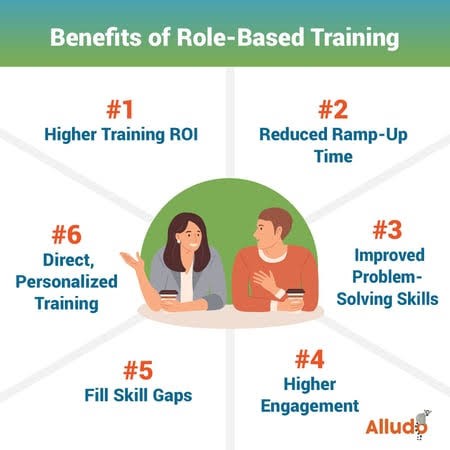
Fig 1: Benefits of Role-Based Learning.
Role-based learning paths provide clear learning objectives, defined competency milestones, strong alignment to business goals, consistent skill development, and easier measurement of outcomes.
Process Diagram: Role-Based Learning Path
The role-based learning path process begins by identifying the target job role and defining its responsibilities, expectations, and business outcomes. Next, the required technical, functional, and behavioral skills are mapped to ensure the learning journey is aligned with role success.
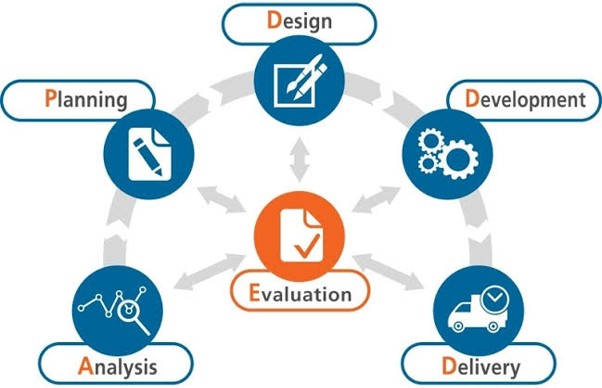
Fig 2: Role-based learning path workflow from skill analysis to training evaluation.
Comparing Outcomes
- Faster Time to Competency
One of the biggest advantages of role-based learning paths is faster skill acquisition. Employees follow a predefined roadmap that eliminates guesswork and ensures a logical progression of knowledge.
- Higher Learning Engagement
Employees are more engaged when learning directly relates to their jobs. When a customer support executive learns skills that help resolve customer issues more efficiently or a sales representative learns techniques that improve conversion rates, the value becomes immediately visible.
Role-based learning journeys create greater relevance and motivation because every module contributes to improving job performance.
- Better Business Alignment
Executives increasingly expect training investments to produce measurable business outcomes. Role-based learning paths align learning content with organizational priorities and key performance indicators.
For example:
- Sales learning paths can focus on revenue growth.
- Security learning paths can emphasize compliance and risk reduction.
This direct alignment makes it easier to demonstrate return on investment from learning programs.
- Improved Knowledge Retention
Research and industry experience suggest that structured learning journeys improve long-term retention compared with isolated learning experiences. Learning paths typically build concepts progressively, reinforce skills through assessments, and incorporate practical application activities.
Employees not only complete training but are also more likely to apply what they learn in their daily work.
- Easier Progress Tracking
With a course catalog, success is often measured by enrolments or completions. While useful, these metrics rarely indicate capability development.
Role-based learning paths introduce measurable milestones that help managers track:
- Skill progression
- Certification readiness
- Competency achievement
- Role preparedness
This creates greater visibility into workforce readiness and future talent planning.
Are Course Catalogs Still Relevant?
Absolutely.
Course catalogs remain valuable for:
- Continuous learning initiatives
- Career exploration
- Cross-functional skill development
- Innovation and curiosity-driven learning
- Personal growth opportunities
In fact, the most successful organizations do not view course catalogs and role-based learning paths as competing models. Instead, they combine both approaches to create a balanced learning ecosystem.
A structured learning path can serve as the foundation for role readiness, while a course catalog can support optional learning and career expansion.
The Best Approach: A Hybrid Model
The future of corporate learning lies in combining the strengths of both approaches.
A hybrid strategy might include:
A hybrid strategy can include mandatory role-based learning paths for core competencies, elective course catalogs for personal development, AI-driven recommendations based on skills gaps, certification-based progression models, and learning analytics connected to business outcomes.
This model provides structure without sacrificing learner autonomy.
Driving Better Learning Outcomes
When the goal is simply to provide access to learning, course catalogs are highly effective. However, when the objective is to build measurable capabilities, accelerate performance, and align skills development with business priorities, role-based learning paths consistently deliver better outcomes.
Organizations that want to close skill gaps faster, improve workforce productivity, and demonstrate training ROI should make role-based learning paths the cornerstone of their learning strategy while using course catalogs as a complementary resource for continuous growth and exploration.
In the modern workplace, learning should not be about consuming more content; it should be about developing the right skills at the right time for the right role. That is where role-based learning paths truly outperform traditional course catalogs.
Upskill Your Teams with Enterprise-Ready Tech Training Programs
- Team-wide Customizable Programs
- Measurable Business Outcomes
About CloudThat


WRITTEN BY Anoop H A
Anoop H A is a Microsoft Certified Trainer (MCT) at CloudThat with over 9+ years of experience in the training industry. He has delivered 600+ sessions and trained more than 4,000 professionals across various domains. Anoop specializes in Microsoft Fabric, Power BI, Azure AI, Dynamics 365, Tableau, and Advanced Excel with Copilot, offering impactful training to clients including Microsoft and other leading corporates. Known for his passionate and learner-centric approach, he stays aligned with the latest tech trends and has conducted numerous seminars and webinars, both online and offline. In recognition of his excellence, he has received the prestigious MCT Quality Award and was named among the Top 100 MCTs globally for 2024–2025.


 PREV
PREV












Comments