

 Login
Login


 September 21, 2026
|
Voiced by Amazon Polly |
Certifications for cloud platforms have existed for over a decade, but formal, vendor-issued credentials for building with large language models are still new. That changed in March 2026, when Anthropic introduced the Claude Partner Network and, alongside it, its first official technical exam: the Claude Certified Architect – Foundations. This article looks at what the Claude Certified Architect – Foundations exam covers, how Anthropic structured it, and who is likely to get real value from sitting it, without walking through it step by step, since the exam content is confidential.
Start Learning In-Demand Tech Skills with Expert-Led Training
- Industry-Authorized Curriculum
- Expert-led Training
A Credential Built Around Judgment, Not Trivia
Most AI courses teach concepts. This exam tests something narrower, and arguably harder to fake, whether a candidate can look at a production scenario and pick the right trade-off. Anthropic’s own exam guide frames it plainly, describing the goal as testing candidates’ practical judgment about architecture, configuration, and trade-offs in production deployments, not recall of API syntax.
The exam consists of 60 items over 120 minutes, drawn at random from a bank of six scenarios. Each scenario describes a real deployment pattern, such as a customer support agent, a multi-agent research pipeline, or a CI/CD code review bot, and the questions ask what an architect should change when something inside that system is underperforming. That format rules out flashcard-style memorization on its own; a candidate has to reason about cause and effect inside a system they haven’t necessarily configured that exact way before.
The Five Domains, Briefly
The blueprint spreads scoring across five domains, weighted by how often each shows up in real deployments:
- Agentic Architecture & Orchestration (27%) covers the agentic loop itself, coordinator-subagent patterns, hooks, and task decomposition. It carries the heaviest weight, which tracks with how central multi-step, tool-using agents have become to production Claude work.
- Claude Code Configuration & Workflows (20%) covers CLAUDE.md hierarchies, custom skills and slash commands, plan mode versus direct execution, and CI/CD integration.
- Prompt Engineering & Structured Output (20%) covers few-shot design, JSON-schema-enforced tool use, validation-retry loops, and when batch processing is the right call.
- Tool Design & MCP Integration (18%) covers writing tool descriptions that a model can reliably choose among, structured error handling, and configuring Model Context Protocol (MCP) servers at the project and user levels.
- Context Management & Reliability (15%) covers preventing context loss across long sessions, escalation design, and error propagation in multi-agent systems.
None of these domains rewards simply knowing a feature exists. Each is tested in a scenario where the obvious fix is usually wrong, and the correct answer depends on understanding why.
Sixty scenario-based items, 120 minutes, a 720-of-1000 passing score, proctored throughout.
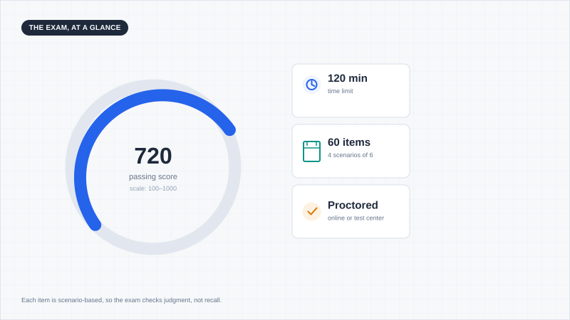
Fig 1: AI certification exam structure, scoring, and competency domains at a glance.
Where This Sits in a Larger Push
The certification didn’t launch in isolation. It’s the technical credential inside the Claude Partner Network, the program Anthropic backed with a $100 million investment for partner training and enablement when it launched in March 2026. By June, the company had added a tiered Services Track for consulting and services firms, and certified headcount had become one of the metrics firms are measured against to reach higher partner standing.
That has a practical effect: for architects at consulting and systems-integration firms, this isn’t only a personal credential anymore, it’s increasingly something an employer tracks. Training providers have responded accordingly. CloudThat, for one, already runs instructor-led programs on operationalizing generative AI in production, including its Generative AI in Production course, which covers deployment, monitoring, and governance practices that overlap with the topics this exam tests under Context Management & Reliability.
Who Should Actually Take This Exam
Anthropic’s guide is specific about the intended candidate: someone with six or more months of hands-on experience building with the Claude Agent SDK, Claude Code, the API, and MCP, not someone learning what agentic AI is for the first time. If your daily work involves designing subagent handoffs, debugging why one tool keeps getting picked over a similar one, or deciding whether a task actually needs plan mode, the material will feel familiar rather than academic.
It’s a poor fit, by contrast, for anyone hoping to learn agentic AI concepts from scratch, or for roles centered on model training, infrastructure hosting, or API billing, all of which are explicitly out of scope. This particular AI certification is scoped tightly around implementation, not the underlying research.
Validating Real AI Expertise
The Claude Certified Architect – Foundations exam reads less like a study-and-recall test and more like a check on whether someone has actually shipped agentic systems and learned from what broke along the way. Its scenario format, its weighting toward orchestration and reliability, and its explicit exclusion of research-level topics all point toward the same intent: verifying implementation judgment rather than surface familiarity with Claude’s tooling. For architects already doing this work, it gives a way to demonstrate a skill set that’s been genuinely hard to prove on a resume. For firms inside the Claude Partner Network, certified headcount is becoming a measurable part of how partner standing gets built. Either way, the value sits less in the badge itself and more in what preparing for it forces a practitioner to get right the first time.
Upskill Your Teams with Enterprise-Ready Tech Training Programs
- Team-wide Customizable Programs
- Measurable Business Outcomes
About CloudThat


WRITTEN BY Akshay K S
Akshay is a Tech Lead at CloudThat, specializing in Azure Integrations and DevOps. With 10+ years of experience in consulting and training, He have trained over 10000+ professionals/students to upskill in Azure, AWS, GCP, GitHub, DevOps and Copilot technologies. Known for simplifying complex concepts, hands-on teaching, industry insights, he brings deep technical knowledge and practical application into every learning experience. His areas of expertise include Cloud, DevOps, DevSecOps, GitHub etc. Akshay's passion for teaching and learning reflects in his unique approach to learning and development.


 PREV
PREV











Comments