

 Login
Login


 September 2, 2026
|
Voiced by Amazon Polly |
Security investigations depend on accurate and complete logs. In many organizations, logs are scattered across Amazon S3 buckets, CloudWatch Logs, and individual AWS accounts, making investigations slow and inconsistent.
As AWS environments grow across multiple accounts and Regions, security logs become difficult to manage. AWS Security Lake solves this by collecting logs from multiple AWS services, normalizing them into a common format, and storing them centrally for investigation. This article explains the fundamentals of Security Lake, its architecture, practical use cases, and best practices for beginner AWS Security Engineers
Imagine a company with 30 AWS accounts. When an Amazon S3 bucket is accidentally made public, the security team must review CloudTrail logs, VPC Flow Logs, and Security Hub findings stored in different locations. This delays incident response.
AWS Security Lake addresses this challenge by collecting security logs from multiple AWS services into a centralized repository, giving security teams a single place to investigate incidents and perform compliance reporting. This approach strengthens Cloud Security while reducing operational complexity.
Start Learning In-Demand Tech Skills with Expert-Led Training
- Industry-Authorized Curriculum
- Expert-led Training
What is AWS Security Lake?
AWS Security Lake is a managed AWS service that automatically collects, normalizes, and stores security logs from AWS services and supported custom sources in Amazon S3.
Its primary goals are to:
- Centralize security logs
- Normalize log formats using OCSF
- Simplify investigations
- Support long-term log retention
- Enable analytics using Amazon Athena and Amazon OpenSearch Service
Security Lake supports multiple AWS Regions and is designed for enterprise environments using AWS Organizations.
Common enterprise use cases include:
- Security investigations
- Compliance reporting
- Threat hunting
- Centralized audit logging
- Long-term forensic analysis
How AWS Security Lake Works
Security Lake continuously collects logs from AWS services, including:
- AWS CloudTrail
- Amazon VPC Flow Logs
- Route 53 Resolver Query Logs
- AWS Security Hub findings
- Amazon EKS Audit Logs
- Custom security sources
These logs are converted into the Open Cybersecurity Schema Framework (OCSF), which standardizes different log formats into a common schema.
The normalized data is stored in Amazon S3. AWS Glue Catalog maintains metadata, allowing Amazon Athena to query logs directly without moving data. Security teams can also integrate Amazon OpenSearch Service for advanced search and dashboards.
AWS Security Lake Architecture
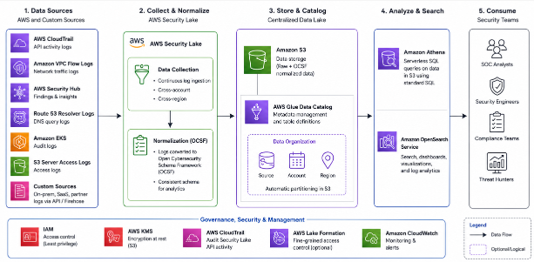
Source: Author-created using Mermaid.
Purpose: Demonstrates how Security Lake centralizes, normalizes, stores, and exposes security logs for investigation.
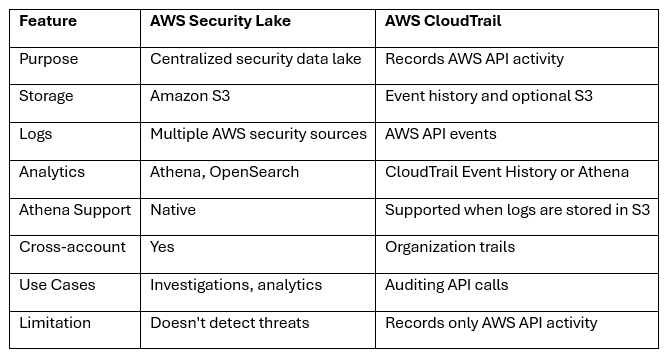
Security Lake vs CloudTrail
Practical Security Investigation
A developer accidentally changes an Amazon S3 bucket policy, making the bucket publicly accessible.
Investigation flow :
CloudTrail records the PutBucketPolicy API call.
↓
Security Lake stores the CloudTrail event.
↓
Amazon Athena queries identify who modified the bucket.
↓
The security engineer reviews the event details.
↓
The bucket policy is corrected, and access is restricted.
Because all security logs are stored centrally, investigators spend less time locating data and more time analyzing the incident.
Athena SQL Example
SELECT eventTime, eventName, userIdentity.arn FROM security_lake_cloudtrail WHERE eventName=’CreateBucket’;
This query returns CloudTrail events where an Amazon S3 bucket was created.
AWS Security Lake stores and organizes security logs, but it does not detect threats. Pair it with AWS Security Hub, Amazon GuardDuty, and Amazon Inspector for a complete AWS Security monitoring solution.
Best Practices
- Enable AWS Organizations integration for centralized management.
- Encrypt Security Lake using AWS KMS.
- Configure Amazon S3 Lifecycle policies to reduce storage costs.
- Enable CloudTrail organization trails across all accounts.
- Follow least-privilege IAM permissions.
- Use Amazon Athena for log analysis instead of exporting large datasets.
Strengthening Cloud Security
For beginner security engineers, AWS Security Lake provides an effective way to centralize security telemetry without building a custom logging platform. By storing logs in Amazon S3, standardizing them with OCSF, and enabling analytics through Amazon Athena, Security Lake simplifies investigations and supports enterprise-scale security operations.
Although Security Lake is not a threat detection service, it complements AWS Security Hub and Amazon GuardDuty by providing the historical evidence needed for incident response, compliance, and forensic analysis. Understanding these services together provides a strong foundation for modern cloud security operations.
Upskill Your Teams with Enterprise-Ready Tech Training Programs
- Team-wide Customizable Programs
- Measurable Business Outcomes
About CloudThat


WRITTEN BY Sheeja Narayanan
Sheeja Narayanan is Champion Amazon Authorized Instructor, Microsoft Certified trainer and Senior Subject Matter Expert at CloudThat, specializing in AWS infra and Migration. With 19 years of experience in Training and consulting, she has trained over 2500 professionals/students to upskill in Networking, Windows and Linux administration, AWS, Azure and Vmware. Known for simplifying complex concepts and delivering highly hands-on sessions, she brings deep technical knowledge and practical expertise into every learning experience. Sheeja's passion for training delivery reflects in her unique approach to learning and development.


 PREV
PREV











Comments