

 Login
Login


 August 25, 2026
|
Voiced by Amazon Polly |
Overview
Predictive maintenance leverages AI and sensor data to anticipate equipment failures. On AWS, this involves building scalable, secure pipelines to collect data, train models, and generate maintenance alerts. Effective predictive maintenance reduces downtime, extends asset life, and enables data-driven maintenance decisions.
Pioneers in Cloud Consulting & Migration Services
- Reduced infrastructural costs
- Accelerated application deployment
Introduction
Imagine a manufacturing plant that relies on critical machines to meet production targets. Unexpected breakdowns cause costly downtime, rushed repairs, and missed deadlines. A predictive maintenance system can analyze sensor data such as vibration, temperature, and pressure to detect early signs of failure. In an AWS-powered setup, services like Amazon Kinesis, Amazon S3, Amazon SageMaker, and Amazon EventBridge help teams turn raw sensor data into actionable maintenance decisions.
Why Predictive Maintenance Matters?
Equipment does not fail at random; it often shows warning signs before a breakdown. In industrial settings, assets run under varying loads, environments, and usage patterns. In the cloud, system-level dependencies must also stay healthy to keep the pipeline running.
Key reasons predictive maintenance matters:
- Late or missing sensor data in Amazon Kinesis or S3.
- Broken ETL jobs in AWS Glue.
- High latency on SageMaker inference endpoints.
- Maintenance rules that change without model updates.
- Sensor drift that reduces prediction quality.
Monitoring and automation connect these moving parts, giving teams a clear view of asset health and maintenance needs.
Common AWS Production Challenges
Predictive maintenance systems often face a mix of data and infrastructure issues.
Common problems include:
- Data drift, when sensor data differs from training data.
- Concept drift, when the relationship between sensor readings and failures changes.
- Missing values, duplicate records, and schema mismatches.
- Failed workflow executions.
- Delayed files or broken ingestion jobs.
- IAM permission issues.
- Noisy or incomplete logs.
These issues can reduce accuracy, delay alerts, and create inconsistencies in the maintenance pipeline. If not monitored, they often surface only after a failure occurs.
Key Metrics to Track
A strong predictive maintenance setup should include both ML metrics and operational metrics.
Track these metrics:
- Model accuracy, using precision, recall, F1-score, or AUC.
- Data quality, including missing values, invalid ranges, and sensor dropouts.
- Prediction distribution, to detect unusual failure probabilities or flat predictions.
- Pipeline health, including ingestion success, ETL duration, processing failures, and endpoint latency.
- Business KPIs, such as unplanned downtime, mean time to repair, and maintenance cost.
In AWS, these signals can be surfaced in CloudWatch dashboards, pushed as custom metrics, and connected to SNS alerts so the right team sees issues quickly.
AWS Architecture for Predictive Maintenance
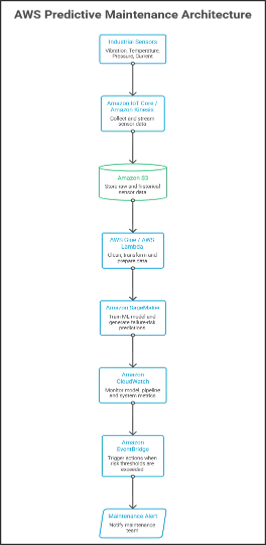
A practical AWS architecture for predictive maintenance includes multiple layers:
- Sensor data arrives in Amazon Kinesis or IoT Core.
- AWS Glue, Lambda, or Step Functions process the data.
- Amazon SageMaker trains and deploys the model.
- Logs and metrics go to CloudWatch; SageMaker Model Monitor checks for drift.
- CloudTrail records configuration changes.
- EventBridge triggers workflows and SNS alerts when risk thresholds are crossed.
This creates a scalable, auditable, event-driven maintenance loop.
Industrial Equipment Example
Consider a predictive maintenance system for industrial motors. The pipeline collects vibration, temperature, and current data from IoT sensors, processes it through AWS Glue or Lambda, and sends risk scores via a SageMaker endpoint.
Monitoring should verify:
- Each asset’s data arrives on time.
- The schema remains consistent.
- Sensor values stay within expected ranges.
- Failure risk scores are realistic for each asset type.
- Prediction error stays within acceptable limits.
- Alerts are triggered when data stops arriving or when risk crosses a threshold.
CloudWatch alarms and EventBridge rules can notify teams before a failure impacts production.
Continuous Feedback Loop
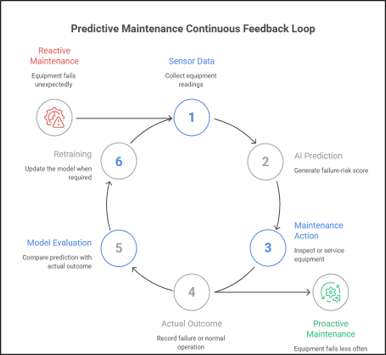
Predictive maintenance becomes most useful when it drives action. A production system should follow a continuous loop: collect sensor data, make predictions, record actual failures, calculate errors, review thresholds, and retrain the model if needed.
On AWS, this can be automated using:
- AWS Step Functions for orchestration.
- AWS Lambda for event-based logic.
- Amazon S3 for storing outcomes and failure logs.
- Amazon SageMaker Pipelines for retraining workflows.
- Amazon SageMaker Model Registry for version control.
Human review still matters, especially when maintenance strategies change or when model output affects production schedules and safety.
Best Practices on AWS
Good predictive maintenance depends on visibility, version control, and clear ownership.
Best practices include:
- Build dashboards for technical and business metrics.
- Tune alerts carefully to reduce noise.
- Track every model version, dataset version, and feature transformation.
- Enable logging for infrastructure and permission changes.
- Centralize logs from your ML and data pipeline services.
- Define monitoring thresholds with maintenance and operations stakeholders.
These practices make predictive maintenance more useful and easier to act on.
Future of Predictive Maintenance
Predictive maintenance is moving toward more intelligent, automated operations. AWS-based systems will increasingly rely on streaming data and real-time alerts rather than batch checks. Automated retraining will become more common as drift detection improves. LLMs and agent-based systems may support root-cause analysis, work order generation, and plain-language risk explanations. As AI becomes more embedded in industrial workflows, observability will be as critical as model training.
Conclusion
Predictive maintenance should never be viewed as optional. It is a core part of building reliable, data-driven operations in AWS. When teams combine model tracking, data validation, pipeline monitoring, and cloud observability, they can reduce downtime, optimize maintenance schedules, and make better operational decisions. For industrial equipment and other asset-heavy use cases, this turns raw sensor data into a long-term business advantage.
Drop a query if you have any questions regarding predictive maintenance, and we will get back to you quickly.
Empowering organizations to become ‘data driven’ enterprises with our Cloud experts.
- Reduced infrastructure costs
- Timely data-driven decisions
About CloudThat
FAQs
1. Why do organizations need predictive maintenance on AWS?
ANS: – Because equipment behavior and operating conditions change over time, predictive maintenance helps detect early signs of failure, reduce unplanned downtime, and plan maintenance based on actual asset health.
2. What should teams monitor in an AWS-based predictive maintenance system?
ANS: – They should monitor model accuracy, data quality, sensor health, endpoint latency, pipeline failures, CloudWatch alarms, and maintenance KPIs. Together, these signals provide a complete view of asset health and maintenance readiness.


WRITTEN BY Kirubanithi Annamalai
Generating response Copilot said: Kirubanithi Annamalai is a Senior Research Associate specializing in Artificial Intelligence, Machine Learning, Deep Learning, and Intelligent Automation. He has experience in developing AI-driven solutions, building scalable machine learning systems, and implementing automation frameworks to solve business challenges across engineering and cybersecurity domains. Passionate about emerging technologies, he focuses on delivering innovative solutions that drive business value.


 PREV
PREV












Comments