

 Login
Login

 August 21, 2026
|
Voiced by Amazon Polly |
Introduction
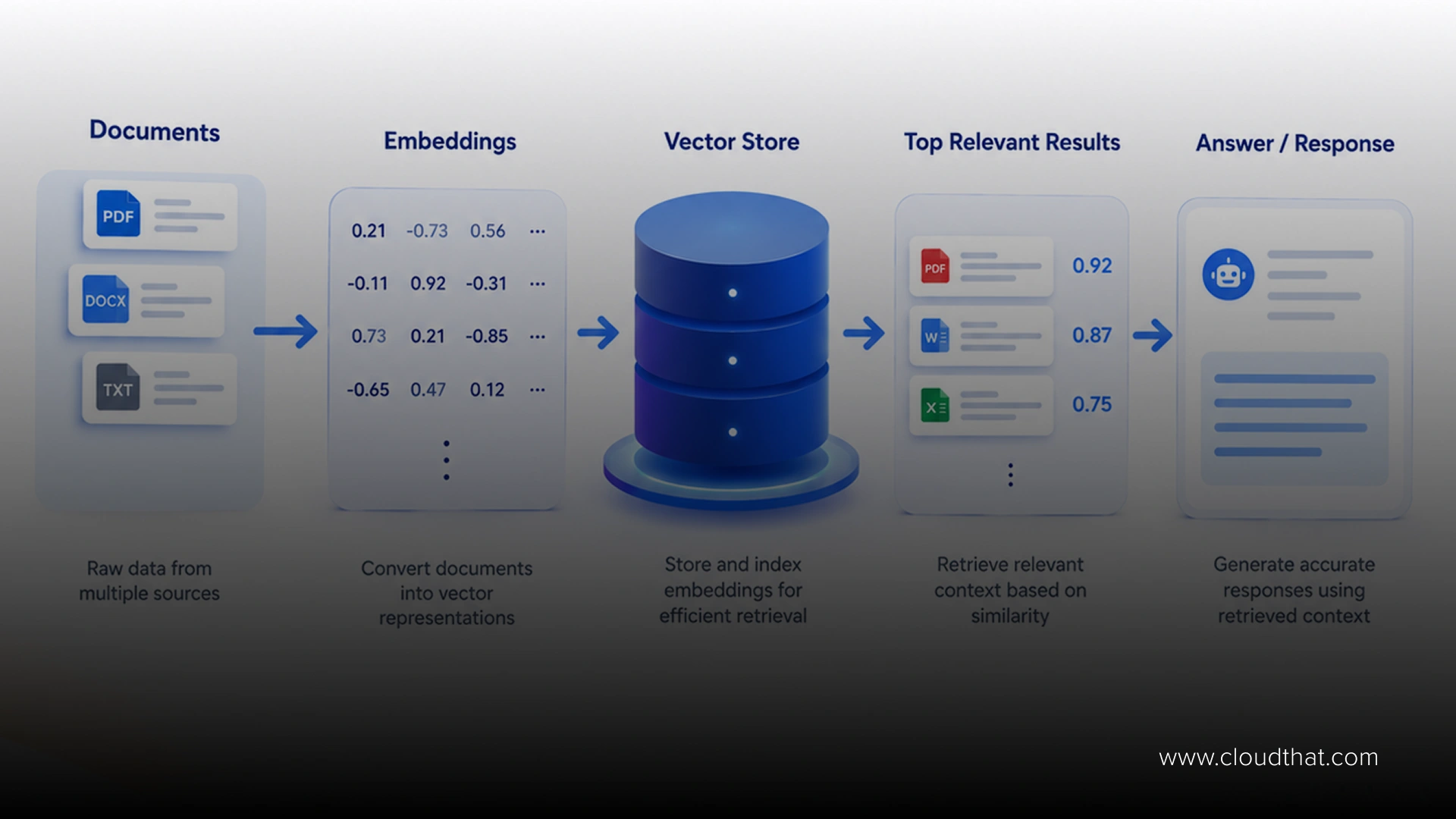
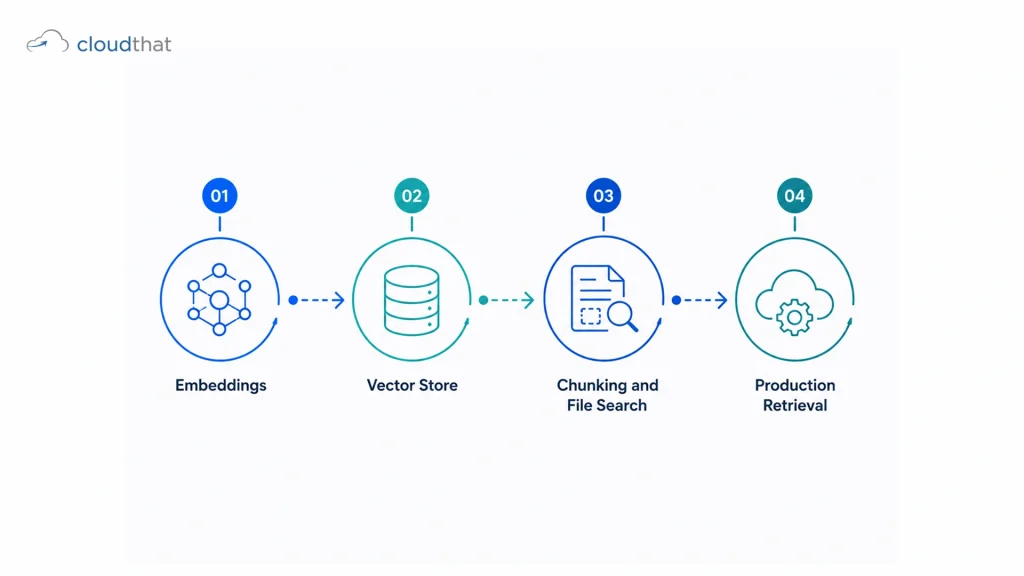
A good RAG course teaches you to ground an LLM’s answers in your own data instead of letting it guess. A proper retrieval augmented generation rag course does not stop at “here is how cosine similarity works.” It takes you through embeddings, vector stores, chunking strategy, and file search, then through building a retrieval pipeline end to end and fixing the failures that only show up in production, like stale embeddings, bad chunk boundaries, and retrieval that returns the wrong passage confidently. Skip the production debugging part, and you are only getting half the skill.
Already in IT? Switch to Cloud & Earn 55% More
- Weekend Batches
- Dedicated Career Support
- Official AWS Labs
The Chatbot Kept Answering With Old Prices
A support team ships a RAG powered chatbot. It answers pricing questions instantly and correctly, at first.
Three months later, prices change. The chatbot keeps quoting the old numbers, confidently, to real customers.
Nobody touched the model. The problem was the retrieval layer nobody re-indexed. That single gap is exactly what a solid rag course is supposed to prevent, and it rarely gets covered in a weekend tutorial that stops after “here is how a vector database works.”
This blog walks through the actual roadmap a strong retrieval augmented generation rag course should follow, from embeddings to vector stores to file search to the production issues that only show up once real users start asking real questions. If you already have GenAI fundamentals from CloudThat’s Generative AI and Prompt Engineering course, this is the natural next layer.
Who Actually Needs a RAG Course
If your GenAI application needs to answer questions using your own documents, policies, or product data, you need a rag course, not just a prompting course.
Developers who already know how to call an LLM API often assume they can wire up retrieval in a weekend. They usually can, for a demo. What structured training actually teaches is why that same setup breaks the moment the document set grows past a few hundred files or the questions get less predictable than a demo script.
This is also relevant if you are past basic prompting and already exploring Agentic AI work, since most agent workflows lean on retrieval to stay grounded in facts instead of hallucinating a confident, wrong answer.
Embeddings: Where the Roadmap Starts
Short answer: embeddings turn text into numbers that capture meaning, and every retrieval augmented generation rag course has to start here because everything downstream depends on getting this right.
An embedding model converts a chunk of text into a vector, a list of numbers positioned so that similar meanings sit close together in that vector space. Get the embedding model wrong for your use case, mixing a general purpose model with highly technical documents, for instance, and retrieval quality suffers before you even reach the vector store.
Strong training covers embedding model selection, dimensionality tradeoffs, and how to actually test whether your embeddings are capturing the right kind of similarity for your documents, not just accepting the default setting and moving on. This is the same practical grounding CloudThat builds into its broader AI and ML courses catalogue.
Vector Stores and Why the Choice Matters
This is the part most tutorials treat as an afterthought.
Once you have embeddings, you need somewhere to store and search them efficiently. A rag course should cover the tradeoffs between managed vector databases and self-hosted options, indexing strategies, and how retrieval speed changes as your document count scales from a few hundred to a few hundred thousand.
Teams building production GenAI applications on Azure often pair this with CloudThat’s AI-103 Develop AI Apps and Agents on Azure course, which covers vector integration inside actual Azure services rather than a local notebook that never sees real traffic.
File Search and Chunking Strategy
Here is where this kind of training either earns its price or wastes your time.
Chunking sounds simple until you try it on a real 40 page policy document. Chunk too small, and you lose context. Chunk too large, and retrieval pulls back irrelevant noise alongside the answer. Strong programs spend real time on chunking strategy, overlap settings, and file search techniques that actually locate the right passage instead of just the most statistically similar one.
This is also where metadata filtering earns its place, letting retrieval narrow results by document type, date, or department before similarity search even runs, which matters enormously once you are searching thousands of files instead of ten. Developers who go on to work with OpenAI’s tooling directly can extend these skills into CloudThat’s Codex Deployment Practitioner Program once retrieval fundamentals are solid.
Production Retrieval: What Breaks Outside the Demo
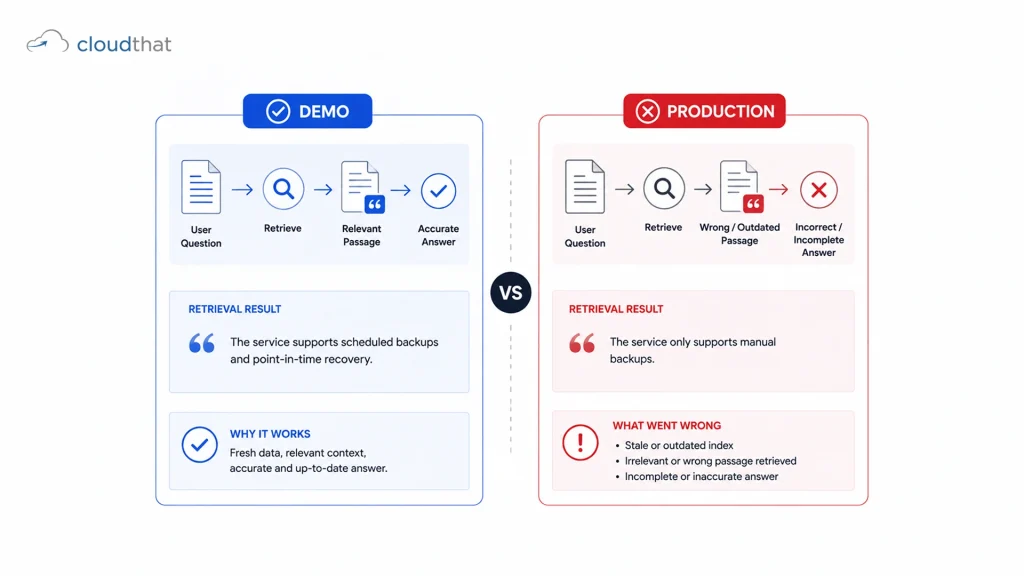
A demo retrieves the right passage once, on a clean question, from a small document set. Production has none of those guarantees.
Documents get updated and nobody re-indexes them. Users ask questions in ways that do not match the phrasing in your documents. Retrieval returns a technically similar but contextually wrong passage, and the model answers confidently anyway. Production-focused training teaches you to catch these failures with evaluation metrics, not customer complaints.
This is the exact gap CloudThat’s broader AWS Generative AI Development track addresses too, treating retrieval as an ongoing system to monitor, not a one time setup step.
RAG Course vs General GenAI Training
People often assume any generative AI course covers retrieval in enough depth. A genuine retrieval augmented generation rag course usually proves them wrong.
| Aspect | General GenAI Course | RAG Course |
| Focus | Prompting and model basics | Embeddings, vector stores, retrieval pipelines |
| Depth on chunking | Rarely covered | Core module |
| Production issues | Not addressed | Stale indexes, retrieval drift, evaluation |
| Outcome | Comfortable prompting a model | Able to ground answers in real data reliably |
A general course teaches you to talk to a model. This kind of program teaches you to make that model trustworthy against your own data.
Building RAG Skills With CloudThat
CloudThat’s AI Technical Practitioner track treats retrieval as a core module, not an optional add-on bolted onto a prompting course. Learners build actual retrieval pipelines against real document sets, choosing embedding models, testing chunking strategies, and fixing the retrieval failures that only surface once the dataset stops being tidy.
The AI-103 Develop AI Apps and Agents on Azure course covers vector search integration inside Azure, while Generative AI and Prompt Engineering builds the prompting foundation retrieval sits on top of. Developers working across multiple providers also draw on AWS Generative AI Development for Bedrock-based retrieval patterns, and those exploring Claude-based agents can extend the same skills through CloudThat’s Claude Certified Architect track. For teams instead of individual learners, CloudThat’s corporate training arm runs cohorts through this exact curriculum, and organisations that need a retrieval system built directly into their product can bring in the GenAI Innovation Center for the consulting side of the build.
Conclusion
A rag course is not just another GenAI elective. It is the layer that decides whether your application gives trustworthy answers or confidently wrong ones. Get embeddings, vector stores, chunking, and production monitoring right, and the retrieval layer stops being the thing that quietly breaks three months after launch.
Key Takeaways
- A rag course teaches you to ground LLM answers in your own data through embeddings, vector stores, and retrieval.
- Embeddings quality directly affects retrieval accuracy, get the embedding model choice wrong and everything downstream suffers.
- Vector store selection and indexing strategy matter more as document count scales.
- Chunking strategy is where most retrieval quality is won or lost.
- File search with metadata filtering narrows results before similarity search even runs.
- Production retrieval breaks in ways demos never show, stale indexes and phrasing mismatches included.
- A retrieval augmented generation rag course differs meaningfully from a general prompting course.
- Evaluation metrics catch retrieval failures before customers do.
- Hands-on practice against real, messy documents teaches retrieval far better than a clean demo dataset.
- Structured training speeds up safe adoption of retrieval systems across engineering teams.
Ready to stop guessing at retrieval and actually build a reliable RAG pipeline? Explore CloudThat’s AI-103 Develop AI Apps and Agents on Azure and start building on real data.
No Job After Graduation? Cloud Engineering is Your Answer
- Beginner Friendly
- 92% Placement Rate
- Live Instructor-Led
About CloudThat
FAQs
1. Do I need machine learning experience before starting?
ANS: – No, but comfort with APIs and basic Python helps. Most programs assume software development skills, not deep ML theory.
2. What is the difference between a rag course and a prompt engineering course?
ANS: – Prompt engineering focuses on how you ask a model questions. A retrieval augmented generation rag course focuses on grounding those answers in your own data through embeddings and search.
3. How long does this kind of training usually take?
ANS: – Most structured programs run a few weeks, with retrieval pipeline builds and evaluation labs taking up the bulk of the hands-on time.
4. Which vector database should I learn first?
ANS: – It depends on your cloud stack. Good training exposes you to at least one managed option so you understand indexing and scaling tradeoffs, not just theory.
5. Can this training help with an existing chatbot that gives wrong answers?
ANS: – Yes, if the issue is retrieval quality rather than the model itself. Most “wrong answer” bugs in RAG systems trace back to chunking or stale indexes.
6. What is the hardest part of this kind of program?
ANS: – Most learners find chunking strategy and production monitoring the hardest, since both require judgment calls that vary by document type.

WRITTEN BY Himisha Raval
Himisha Raval is a Digital Marketing Manager at CloudThat with a strong command of search engine optimization, web analytics, link building, and content strategy. She brings a data-driven approach to digital marketing, helping IT companies strengthen their online presence, improve search rankings, and generate consistent leads across channels. Beyond execution, she plays an active role in ideation, campaign strategy, and website performance optimization. Outside of work, she balances her analytical side with a love for travel, nature painting, and dancing.


 PREV
PREV











Comments