

 Login
Login

 August 13, 2026
|
Voiced by Amazon Polly |
Introduction
You know that moment when everyone in the room says “I work with Claude” and you suddenly realise half of them mean “I’ve typed prompts into it” and the other half mean “I’ve architected production systems on it”?
That gap is about to get a name tag.
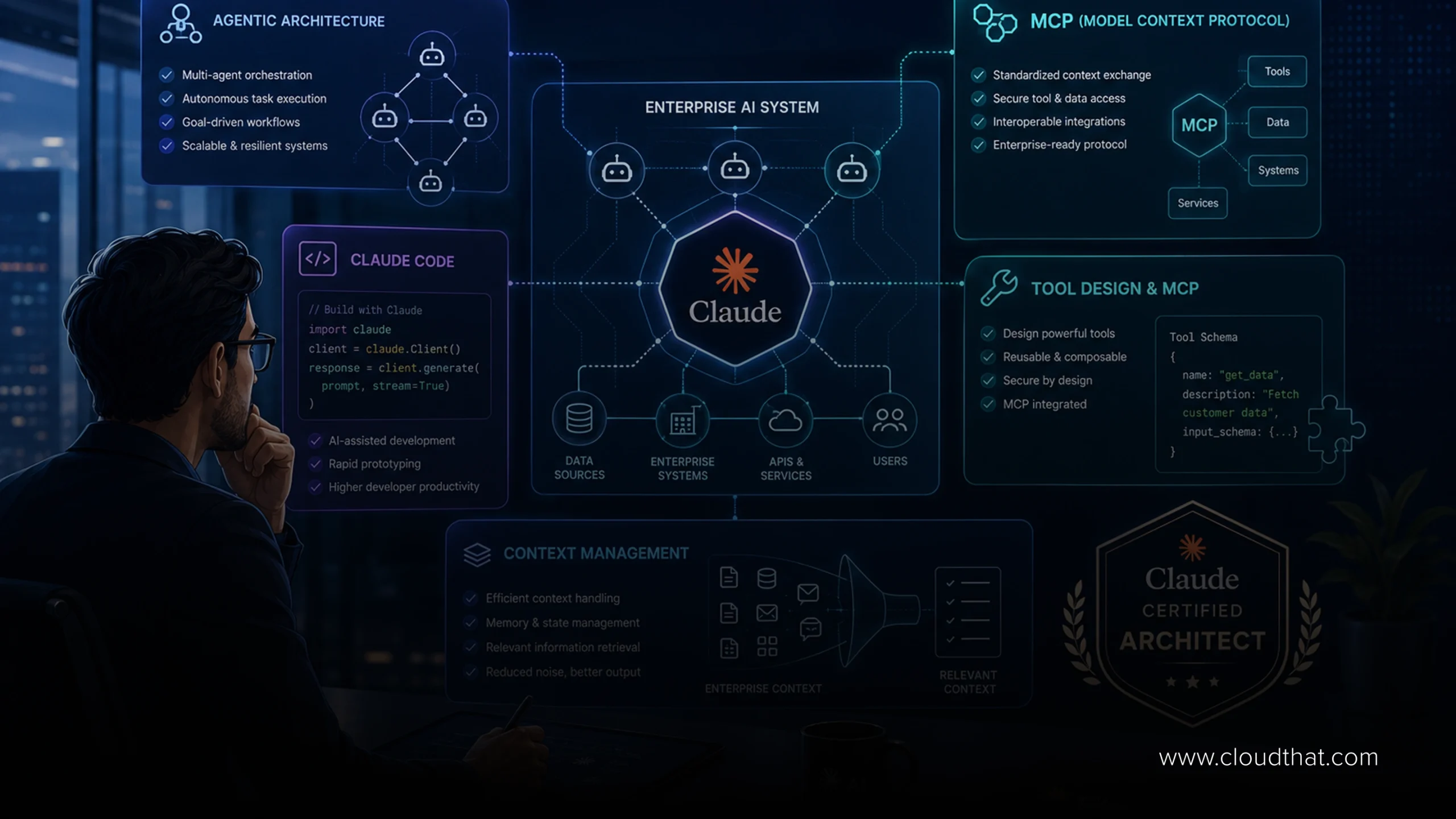
To become a Claude Certified Architect, you need to clear the Claude Certified Architect, Foundations (CCA-F) exam, Anthropic’s official credential launched on March 12, 2026. It is a proctored, 60-question, 120-minute test covering agentic architecture, tool design and MCP, Claude Code configuration, prompt engineering, and context management, and you need a scaled score of 720 out of 1,000 to pass.
That’s the direct answer. Now let’s talk about why this one credential is suddenly the thing everyone in AI circles is quietly Googling at 11 PM.
Master Claude AI for Next-Gen Applications
- Prompt Engineering
- Claude API
- Secure AI Development
The Day “I Know Claude” Stopped Being Enough
Picture this. A solution architect walks into a client review. She’s been building agentic workflows with Claude for eight months. She knows the API cold. She’s shipped three production systems.
And still, the client asks, “Do you have anything that proves this?”
Awkward silence.
That’s the exact gap Anthropic built this certification to close. Thousands of engineers can say they know Claude. Very few can prove it under proctored, closed-book, no-AI-assistance conditions. When Anthropic launched the Claude Partner Network with a $100 million commitment, it wasn’t just building a badge. It was building a credential that consulting giants like Accenture, Deloitte, Cognizant, and Infosys are now training tens of thousands of employees toward.
If you’re the kind of person who’s been quietly building with Claude and wondering whether it’s “official” yet, this is your answer. It is now. And if you’re still catching up on what Claude actually is before diving into architecture, that’s a fair place to pause and start.
And here’s the twist nobody warns you about: this exam doesn’t test whether you can call an API. It tests whether you can design the system around it. Big difference. The kind of difference that decides who gets the architect title and who stays the person who “also knows Claude.”
What Does the Claude Certified Architect Foundations Exam Actually Cover?
This is where people get it wrong the most. They assume it’s a glorified quiz on prompt writing. It isn’t.
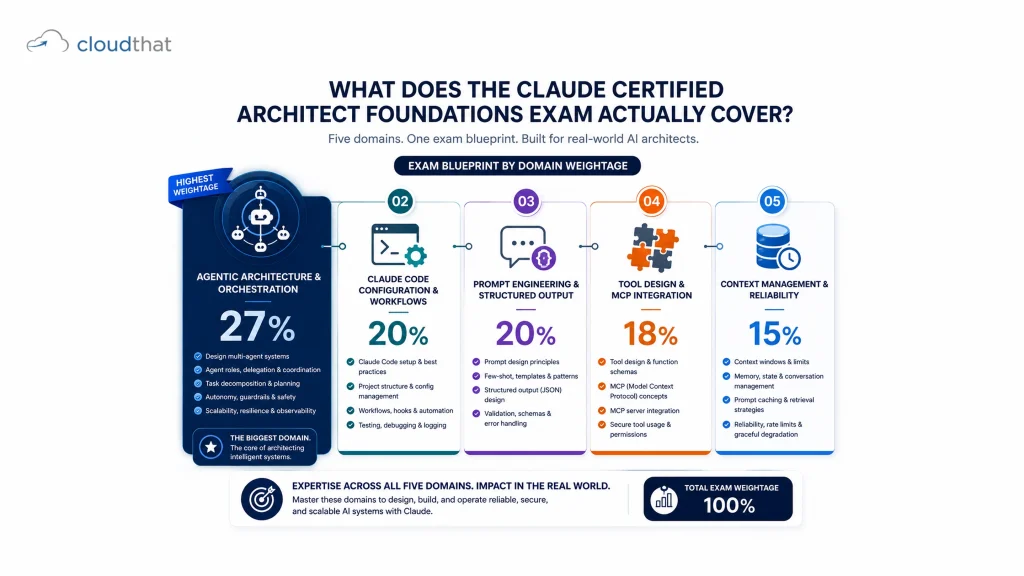
To become a Claude-certified architect, you’re tested across five domains, and the weightage tells you exactly where to put your hours:
| Domain | Weight | What It Really Tests |
| Agentic Architecture & Orchestration | 27% | Multi-agent design, the agent loop, fallback and recovery patterns |
| Claude Code Configuration & Workflows | 20% | CLAUDE.md hierarchy, hooks, permissions, CI/CD integration |
| Prompt Engineering & Structured Output | 20% | Schema enforcement, validation loops, prefilling, reliability |
| Tool Design & MCP Integration | 18% | Tool schemas, MCP servers and clients, secure authentication |
| Context Management & Reliability | 15% | Token budgeting, prompt caching, compaction, long-context handling |
Notice something? The single biggest chunk, at 27%, isn’t about writing prettier prompts. It’s about orchestration. If you’ve only ever used Claude for single-turn chat completions, this domain will hit you like a plot twist you didn’t see coming.
The format itself is unforgiving on purpose: 60 multiple-choice questions, 120 minutes, closed-book, no Claude, no documentation open in another tab. A scaled score of 720 out of 1,000 gets you across the line. That strictness is exactly why the badge means something the moment you earn it.
The Skills You Actually Need Before You Attempt It
Here’s the honest part nobody in a glossy brochure tells you.
You are not “ready” just because you’ve read the docs twice.
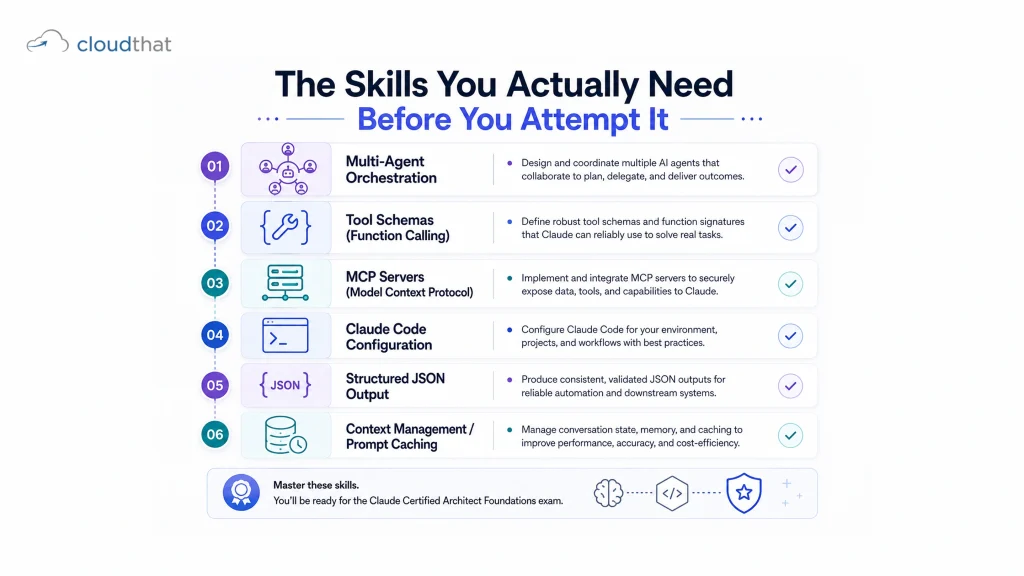
Before you seriously attempt to become a Claude certified architect, you should already be comfortable with:
- Designing multi-agent orchestration patterns, including handoffs between specialised sub-agents
- Writing tool schemas that Claude can call reliably, and spotting the flawed ones
- Standing up and securing an MCP server, not just consuming one someone else built
- Configuring Claude Code for a real team, including CLAUDE.md, hooks, and permission scopes
- Enforcing structured JSON output with validation and retry loops instead of hoping the model behaves
- Managing context windows and prompt caching so a long-running agent doesn’t fall apart on turn 40
Anthropic itself recommends around six months of hands-on production experience with Claude before you sit the exam. That’s not a scare tactic. It’s the difference between passing and walking out having “sort of guessed” your way through half the paper.
If you want a domain-by-domain breakdown before you commit your calendar, freeCodeCamp’s exam-prep overview is a useful free companion to structured Claude architect training, especially for the agentic orchestration and MCP sections most people underestimate.
Your Roadmap: How to Become a Claude Certified Architect, Step by Step
Enough theory. Here’s the actual path to become a Claude certified architect, laid out the way you’d explain it to a friend over coffee, not a corporate slide. If you’re coming from a broader AI and machine learning background rather than a pure Claude one, start at step one anyway. It fills the gaps faster than you’d expect.
- Start with the fundamentals, even if you think you’re past them. Anthropic’s free Skilljar courses, especially “Building with the Claude API,” map directly onto the exam blueprint.
- Get hands-on with MCP before you get comfortable with it in theory. Build a server. Break it. Fix it. That’s where the real learning happens.
- Configure Claude Code for something that isn’t a toy project. Set up CLAUDE.md, hooks, and permissions for a repository with actual stakes.
- Build one project that touches at least three of the five exam domains. Orchestration, tool design, and context management together, ideally.
- Join structured Claude architect training if you want the guesswork removed. A guided program compresses scattered self-study into a focused, scenario-based path that mirrors the real exam.
- Register through the Anthropic Academy portal and book your slot. With 5,000 free exam seats offered to early Partner Network members, timing genuinely matters here.
Follow that sequence and by the time you sit the exam, you won’t be hoping you remember the right answer. You’ll already have built the thing the question is describing.
What Happens After You’re Certified: The Career Path
This is the part that actually keeps people up at night, so let’s not dance around it.
According to Boston Consulting Group, only about one in three employees globally has received any real training on working effectively with AI, which means certified professionals are still a small, visible group in a market that’s scaling fast. Once you become a Claude certified architect, the roles that open up aren’t entry-level. Think solution architect at a consulting firm building Claude-powered systems for enterprise clients, technical lead owning agentic architecture decisions, or AI engineer designing the MCP layer that connects Claude to a company’s internal tools.
Anthropic has already confirmed that Advanced Architect and Developer-track certifications are coming later in 2026, mirroring exactly how AWS and Azure built their own credential ladders. Getting the Foundations certification now doesn’t just prove today’s skill. It puts you first in line for whatever comes next, including the step up to Architect Professional once you’ve put in time at the Foundations level. For a deeper look at how the wider Claude Partner Network ties into this, Claude Directory’s certification guide breaks down the ecosystem well.
That’s really the whole case for why people rush to become a Claude-certified architect the moment a new domain gets added to the exam blueprint. Early credentials in a fast-growing ecosystem tend to pay off disproportionately, and this one is still in its early innings.
Why CloudThat Is the Right Partner for Claude Architect Training
If you’ve read this far, you already know the exam isn’t the hard part. Building the muscle memory to pass it is.
CloudThat runs a dedicated Claude Certified Architect – Foundations program, mapped module by module to all five official exam domains, with roughly 70% of the course spent on scenario-based labs instead of slide decks. If you’re newer to the ecosystem, the Claude Certified Associate – Foundations course is the natural entry point, and developers who want to go code-first first can start with Claude Certified Developer – Foundations before stepping up to architecture.
What makes this Claude architect training different is that it doesn’t stop at exam prep. In-house certified trainers, post-training support, and weekly assessments are built into the program, and there’s no minimum batch size, so it works whether you’re one engineer or an entire team. Enterprises training larger cohorts can route this through CloudThat’s corporate training programs, and teams exploring broader generative AI adoption alongside certification can plug into CloudThat’s GenAI Innovation Center for real deployment experience, not just classroom theory.
As an AWS Premier Tier Training Partner that has already trained over 1.1 million professionals globally, CloudThat brings the same structured, hands-on approach it used for AWS and Azure certifications to Claude architect training. If your goal is a Job Guarantee path into applied GenAI roles, the AWS GenAI Interview Guarantee Program is worth exploring alongside your certification plan, and if you’re still deciding where you sit on the Claude track, the full Claude training catalog lays out every option side by side.
Conclusion
Here’s the honest close.
You don’t need to become a Claude certified architect to keep working with Claude the way you already do. Nobody’s stopping you.
But if you want the badge that ends the “prove it” conversation before it even starts, the path is clearer than it’s ever going to be again. Five domains. One exam. A roadmap you can actually follow, not just admire from a distance.
The window for being one of the early Claude Certified Architects is open right now. It won’t stay this open forever.
Key Takeaways
- Anthropic launched its first official technical certification, Claude Certified Architect, Foundations, in March 2026, alongside a $100 million Claude Partner Network.
- The exam has five weighted domains, and Agentic Architecture & Orchestration alone accounts for 27% of your score.
- You don’t need to memorize the API. You need to have actually built with it.
- Structured Claude architect training compresses months of trial and error into a guided, hands-on path.
- The certification is valid for 12 months, so timing your prep matters as much as passing the exam.
Advance Your AI Career with Claude AI
- Enterprise AI Skills
- Claude API
- AI Assistants
About CloudThat
FAQs
1. What is the Claude Certified Architect Foundations certification?
ANS: – It’s Anthropic’s official credential, launched in March 2026, that validates whether you can design and ship production-grade, agentic applications built on Claude.
2. How long does it take to become a Claude certified architect?
ANS: – There’s no fixed timeline, but most candidates with six or more months of hands-on Claude experience prepare for 4 to 8 weeks before sitting the exam.
3. What is the exam format?
ANS: – 60 multiple-choice questions in 120 minutes, closed-book, with a scaled score of 720 out of 1,000 required to pass.
4. How much does the exam cost?
ANS: – $125 USD, though the first 5,000 Claude Partner Network members get the fee waived entirely.
5. Do I need coding experience to attempt it?
ANS: – Yes. It’s architecture-focused rather than syntax-heavy, but it assumes solid hands-on experience with the Claude API, Agent SDK, and MCP.
6. Is Claude architect training worth it if I already use Claude daily?
ANS: – If you’ve only used Claude for chat completions, yes, strongly. Structured Claude architect training closes the gap between “using Claude” and “architecting with Claude,” which is exactly what the exam tests.
7. What comes after the Foundations certification?
ANS: – Claude Certified Architect, Professional, is the next step up, along with upcoming Developer and Seller-track certifications Anthropic has confirmed for later in 2026.
8. How long is the certification valid?
ANS: – 12 months from the date it’s awarded, so plan your recertification timeline early.

WRITTEN BY Himisha Raval
Himisha Raval is a Digital Marketing Manager at CloudThat with a strong command of search engine optimization, web analytics, link building, and content strategy. She brings a data-driven approach to digital marketing, helping IT companies strengthen their online presence, improve search rankings, and generate consistent leads across channels. Beyond execution, she plays an active role in ideation, campaign strategy, and website performance optimization. Outside of work, she balances her analytical side with a love for travel, nature painting, and dancing.


 PREV
PREV












Comments