

 Login
Login


 July 28, 2026
|
Voiced by Amazon Polly |
Overview
This blog explains how Artificial Intelligence is changing demand forecasting and inventory optimization in modern retail. As customer preferences, seasonal demand, and market trends continue to shift, traditional forecasting methods often struggle to keep up. AI-based systems analyze historical sales and inventory data to generate more accurate demand forecasts and replenishment recommendations.
Pioneers in Cloud Consulting & Migration Services
- Reduced infrastructural costs
- Accelerated application deployment
Introduction
Retailers need the right products at the right place and time. Running out of stock leads to lost sales, while excess inventory increases costs and wastes storage space. Today’s retail market is rapidly changing due to seasonality, promotions, market trends, and shifting customer preferences, making manual planning increasingly difficult.
AI analyzes current trends and local demand, enabling better inventory decisions rather than relying solely on historical sales. This is especially useful for retailers managing multiple stores, product categories, and fast-moving inventory.
Current Challenges in Retail Inventory Management
Managing inventory efficiently is one of the toughest challenges in retail operations. Keeping too much stock raises storage costs and ties up capital, while having too little stock results in missed sales and unhappy customers.
Several reasons contribute to this complexity:
- Customer demand changes across cities, stores, and product categories.
- Seasonal preferences and fashion trends change rapidly.
- Promotions and holidays cause sudden increases in demand.
- Manual planning becomes difficult as the number of stores and SKUs increases.
For retailers with hundreds of locations and thousands of products, manually handling replenishment is no longer practical.
Why Traditional Forecasting Falls Short?
Traditional forecasting methods have supported retail planning for years, but they are less effective in today’s fast-paced market. Since they mainly depend on past sales and basic trend analysis, they often cannot respond quickly to changing customer demand.
These methods have a few key limitations:
- They rely heavily on past sales and ignore current market conditions.
- They do not capture differences in demand at the individual store level.
- They struggle to respond to sudden changes in demand and emerging trends.
- They require frequent manual review and adjustments.
As retail evolves, businesses need forecasting systems that can respond to changing demand rather than relying solely on historical patterns.
How AI Enhances Demand Forecasting?
Modern forecasting systems use machine learning and business data to create more accurate demand predictions. After gathering, cleaning, and validating data from various sources, the model identifies recent sales trends to generate reliable forecasts.
Unlike traditional methods that provide regional estimates, AI can forecast demand at the city, store, or SKU level, helping retailers stock products based on local buying habits. It also allows flexible planning periods, providing forecasts for 15, 30, 45, or 60 days depending on business needs and supplier lead times.
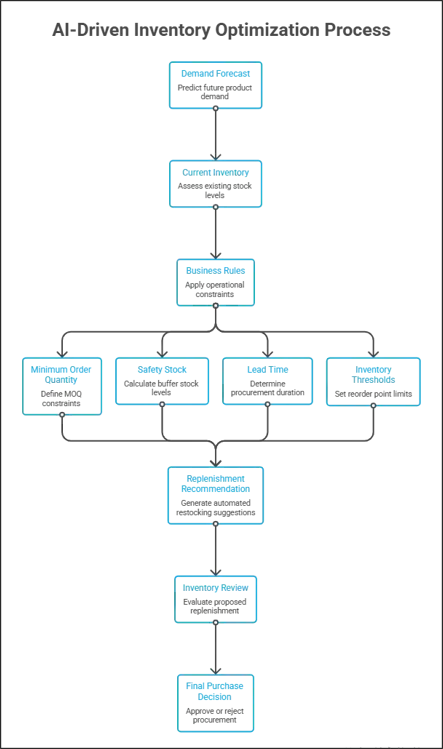
The overall forecasting process can be summarized as shown below.

AI-Driven Inventory Optimization
AI-powered inventory optimization uses demand forecasts and current stock levels to determine replenishment needs. Instead of applying the same strategy across stores, it recommends stock levels based on local demand and business requirements.
These systems also consider:
- Minimum order quantity.
- Safety stock.
- Inventory thresholds.
- Store-level storage capacity.
- Replenishment lead times.
By combining forecasts with these business rules, AI helps retailers make accurate and practical replenishment decisions.
Why Data Quality Matters?
The accuracy of any AI forecasting system depends on the quality of its data. Incomplete or inconsistent data can reduce forecast reliability.
Retail organizations rely on data from sales, inventory, and product management systems. Missing records, duplicate SKUs, incorrect inventory balances, and inconsistent product information can all impact forecast accuracy.
Strong data validation and cleansing are essential to provide reliable inputs and generate trustworthy recommendations.
Business Benefits of AI-Based Forecasting
Retailers using AI forecasting can reduce excess stock, ensure high-demand products remain available, and use capital more efficiently.
Other benefits include:
- Improved product availability across stores.
- Lower inventory holding costs.
- Faster, more consistent replenishment decisions.
- Better efficiency through automation.
- Greater scalability for large retail networks.
A Practical Retail Scenario
A clothing retailer with stores in different cities may see varying demand for the same product due to local preferences, weather, and season. Instead of sending the same stock to every store, AI helps adjust replenishment by analyzing sales, inventory, and location-specific demand. This means busy stores get more stock, while slower stores avoid overflow.
Challenges and Considerations
Although AI improves forecasting, successful implementation relies on accurate data, integrated systems, and regular model monitoring.
Some important considerations include:
- Maintaining high-quality business data.
- Integrating enterprise systems.
- Monitoring forecast performance.
- Keeping recommendations explainable.
- Updating models as market conditions change.
Clear and explainable recommendations help retail planners trust AI, making successful adoption easier.
Future of AI in Retail
The future of retail forecasting goes beyond just predicting demand. New AI solutions are increasingly considering external factors such as weather, local events, promotions, and customer trends to improve forecast accuracy further.
As AI technology continues to grow, retailers can expect systems that learn and adapt continuously and respond in near real time. These advancements will help businesses operate more efficiently and deliver better customer experiences.
Conclusion
AI is helping retailers move beyond traditional forecasting methods and make smarter inventory decisions. By combining sales data, inventory records, and business rules, AI enhances replenishment, lowers costs, and strengthens supply chain performance.
Drop a query if you have any questions regarding AI, and we will get back to you quickly.
Empowering organizations to become ‘data driven’ enterprises with our Cloud experts.
- Reduced infrastructure costs
- Timely data-driven decisions
About CloudThat
FAQs
1. What is AI-powered demand forecasting?
ANS: – AI-powered demand forecasting uses machine learning and analytics to predict future product demand by examining historical sales, inventory levels, product information, and business trends.
2. How does AI improve inventory optimization?
ANS: – AI compares predicted demand with current stock levels and applies business rules such as safety stock, lead times, and replenishment policies to help retailers maintain optimal inventory levels and reduce stockouts.


WRITTEN BY Kirubanithi Annamalai
Generating response Copilot said: Kirubanithi Annamalai is a Senior Research Associate specializing in Artificial Intelligence, Machine Learning, Deep Learning, and Intelligent Automation. He has experience in developing AI-driven solutions, building scalable machine learning systems, and implementing automation frameworks to solve business challenges across engineering and cybersecurity domains. Passionate about emerging technologies, he focuses on delivering innovative solutions that drive business value.


 PREV
PREV








Comments